'Public Works': Laying Foundation Stone for North Kabd Water Treatment Plant with Capacity of 500,000 Cubic Meters Daily
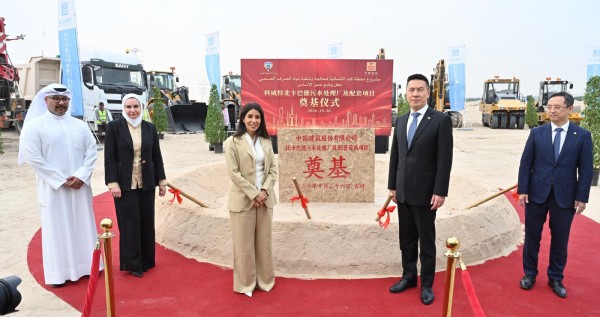
Minister Al-Mashaan and Chinese Ambassador participate in laying the foundation stone for the North Kabd Water Treatment Plant project with a capacity of 500,000 cubic meters daily
Translated by Qiyas from السياسة — Original source
- The project spans 2.8 million square meters and aims to provide 50% of its energy needs from renewable sources.
- Al-Mushaan: The project enhances the wastewater management system and environmental sustainability, supporting sustainable development in Kuwait.
Minister of Public Works Dr. Noura Al-Mushaan laid the cornerstone for the North Kabd Wastewater Treatment Plant, in the presence of Yao Chen, Ambassador of the People’s Republic of China to Kuwait.
Al-Mushaan stated that the project embodies the depth of relations, friendship, and cooperation between Kuwait and China, and is implemented in accordance with the directives of His Highness the Amir of Kuwait, His Highness the Crown Prince, and His Highness the Prime Minister, who prioritize infrastructure projects and sustainable development, striving to realize the aspirations of the nation’s people for a better future.
She added that the project is among the major strategic initiatives undertaken by the Ministry of Public Works to develop Kuwait’s wastewater management system, in line with the national development plan and enhancing environmental sustainability. She noted that the project covers an area of approximately 2.8 million square meters.
She clarified that the project is not limited to constructing a wastewater treatment plant, but includes an integrated system of facilities and infrastructure, led by the North Kabd Treatment Plant, with an operational capacity of 500,000 cubic meters per day, with the potential for future expansion to reach one million cubic meters per day.
She mentioned that the project includes the construction of pumping stations in several areas, including Ash-Shaddadiya, Al-Jahra, and Mushref, along with pipeline networks, as well as deep injection networks with diameters reaching up to three meters—the first of their kind in Kuwait—alongside storage tanks with a total capacity of 600,000 cubic meters.
The project also includes the construction of a central incinerator for disposing of pollutants resulting from treatment processes, and a renewable energy system relying on solar and biogas energy, aiming to cover 50% of the project’s energy needs.
Al-Mushaan pointed out that the project’s significance lies in developing wastewater infrastructure, enhancing the utilization of treated wastewater for irrigation and afforestation, thereby contributing to water conservation, preserving natural resources, protecting the environment, and combating desertification.
She emphasized that the project represents a crucial step toward developing modern and sustainable infrastructure, reflecting the Ministry’s efforts in implementing vital projects that meet the country’s current and future needs and support its path toward sustainable development.
For his part, Chinese Ambassador Yao Chen expressed his pleasure at participating in the cornerstone-laying ceremony, stating that the project represents significant progress in its implementation.
He added that the North Kabd Plant is currently the largest wastewater treatment project in Kuwait, and upon completion, it will enhance the country’s capacity to collect, transport, and treat wastewater, as well as utilize treated water, while contributing to improving the regional environment and public service levels.
Chen explained that the project is one of the major cooperation initiatives between the governments of Kuwait and China, noting that China will contribute its expertise in construction and technology to support sustainable economic and social development in Kuwait and achieve Kuwait National Vision 2035.
He said that mutual political trust between the two countries has strengthened in recent years, under the strategic guidance of Chinese President Xi Jinping and His Highness the Amir Sheikh Meshal Al-Ahmad Al-Jaber Al-Sabah, and that the foundations of cooperation based on mutual benefit have been solidified, broadening the horizons of friendship between them. He noted that high-level relations have seen intensive communication, alongside deepening the linkage between the development strategies of both countries and achieving tangible and continuous results.
He added, “We continue to work side by side with the Kuwaiti side to implement the important understandings reached by the leaders of the two countries, and to build a more solid, higher-quality, and more effective strategic Chinese-Kuwaiti partnership. We also wish to contribute Chinese capabilities to achieving peace, stability, prosperity, and development in Kuwait.”
He continued, “We look forward to maintaining close cooperation with the Kuwaiti side and accelerating practical cooperation in various fields, including major projects, and translating strategic plans into tangible achievements on the ground, thereby delivering greater benefits to the peoples of both countries.” He wished the project success and expressed hope that it would enter service as soon as possible.
For his part, the chairman of China State Construction Engineering Corporation (CSCEC), Wang Chahai, said that since its launch last year, the project has made steady progress thanks to the commitment of the Kuwaiti government and the Ministry of Public Works, along with the support of the Chinese government and the close cooperation between the two countries.
He noted that the project reached an important milestone with the signing of the agreement at Bayan Palace on July 26, paving the way for a new chapter in bilateral cooperation. He expressed his gratitude to the Kuwaiti government, the Ministry of Public Works, the Chinese government, and all parties that contributed to advancing the project.
He clarified that the company is fully aware of the responsibility it bears, reaffirming its confidence in its ability to complete the project to the highest standards, based on its experience in executing major infrastructure projects and its capabilities in technological innovation, project management, quality control, safety, and resource allocation.
He emphasized that the company would devote its full expertise to the project, fulfill its contractual obligations, and adhere to the highest standards of safety, efficiency, and quality. He expressed confidence that the project would proceed smoothly, thanks to the support of the governments of both countries, the Ministry of Public Works, and cooperation among all concerned parties, thereby contributing to Kuwait’s sustainable development and the well-being of its people.
