Health Minister inaugurates the 9th Scientific Conference of Al-Amiri Hospital: Integration of specialties and care team collaboration
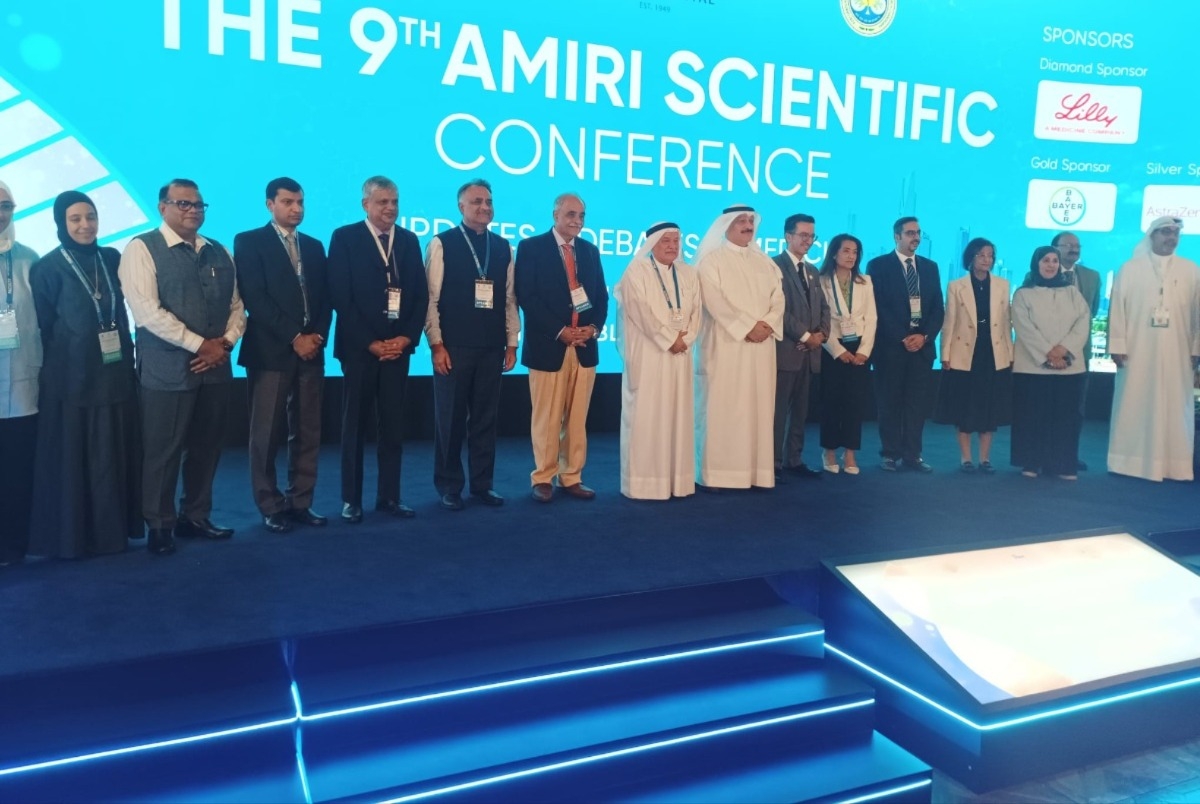
Inauguration of the 9th scientific conference for Al-Amiri Hospital with participation of experts from India to discuss internal diseases
Translated by Qiyas from الجريدة — Original source
Minister of Health Dr. Ahmed Al-Awadi emphasized the importance of medical conferences in exchanging expertise and discussing scientific evidence and research findings, thereby enhancing the quality of medical decisions and placing patient welfare at the core of healthcare. He commended Al-Amiri Hospital for its progress in digital transformation, noting its achievement of the sixth stage in the HIMSS EMRAM (Electronic Medical Record Adoption Model) maturity measurement program for electronic health records.
This statement was made by Al-Awadi during the opening of the hospital’s ninth scientific conference today, which discusses the latest developments in internal medicine and its subspecialties, and features participation from experts from the Republic of India, aiming to strengthen scientific cooperation and knowledge exchange among medical institutions.
Al-Awadi stressed the importance of integrating medical specialties and collaborating among healthcare teams to comprehensively meet patients’ needs. He highlighted the role of Kuwaiti Board programs and specialized fellowship courses offered by the Kuwait Institute of Medical Specialties in preparing national cadres, enhancing their clinical skills, and improving their decision-making abilities and capacity to work within multidisciplinary teams.
He expressed pride in the efforts of those managing medical training programs and their instructors, commending their contributions to advancing medical practice and elevating healthcare standards in the country.
For his part, Dr. Oosan Al-Muhaini, Head of the Medical Staff at Al-Amiri Hospital and Conference Chairman, stated that the conference, titled “Updates and Debates in Medicine,” focuses on the latest scientific advancements in internal medicine and its subspecialties through lectures, dialogues, and discussions showcasing medical developments and recent research.
Al-Muhaini noted that the 2026 edition is distinguished by its collaboration with the Center for Studies and Research in Chandigarh, Republic of India, and the hosting of five specialized professors who will participate in the second day’s events to present the latest medical studies and research.
He added that the first day is dedicated to participation by Al-Amiri Hospital consultants, while the second day features Indian experts. He clarified that the conference was first launched in 2009, and its organizers strive to deliver fresh scientific content that distinguishes each edition from its predecessors.
Al-Muhaini pointed out that diabetes, hypertension, heart diseases, and obesity represent the most prominent health challenges in Kuwait and the Gulf region generally, emphasizing the importance of prevention, early intervention, and reducing risk factors associated with chronic diseases.
He underscored the importance of leveraging artificial intelligence technologies to support medical practice and keep pace with technological advancements, noting that AI serves as a supportive tool for physicians but does not replace clinical examination, medical expertise, or specialized consultation. It can be utilized to support multidisciplinary integration and benefit from diagnostic and imaging test results.
For his part, Dr. Abdulnabi Al-Attar, Head of the Diabetes Unit at Al-Amiri Hospital, stated that the hospital has evolved from merely a service-providing institution into a center for medical education and training, alongside its role in delivering healthcare. He noted its impact extends to various countries worldwide through doctors, nurses, and staff who trained, graduated, or worked in Kuwait.
Al-Attar explained that the hospital’s history dates back to the late 1930s, when construction began before being halted during World War II and resumed afterward. It was officially opened in 1949 under the patronage of the late Sheikh Ahmed Al-Jaber Al-Sabah.
He added that the history of medicine in Kuwait dates back to before the establishment of the Amiri Hospital, recalling the late Kuwaiti physician Sheikh Muaid Al-Azmi, who traveled to Al-Azhar Al-Sharif to pursue knowledge, studied medicine, and then returned to Kuwait to practice. His medical activities extended to Gulf countries at that time.
He emphasized that medicine is no longer limited to clinical practice and prescribing medications; rather, continuous medical education has become an essential requirement in a physician’s professional journey, whether at the beginning of their career or during stages of scientific and practical development.
He noted that the Internal Medicine Conference is part of the continuous medical education framework, pointing to the growing number of participants and scientific contributions year after year, alongside the ongoing development in the conference’s level and the quality of its content.
He expressed his pride in hosting experts from the Republic of India, specifically from one of the leading medical education and training institutes in Chandigarh, affirming the importance of this participation in enhancing scientific communication and exchanging expertise, and hoping that the conference achieves its objectives while combining scientific benefit with enjoyment for the participants.
