Si Aoun sa delegasyon ng negosyo ng Sirya: Ang katatagan ng Lebanon ay katatagan ng Sirya, at ang kabaligtaran ay totoo.
&cropxunits=450&cropyunits=298&w=770)
Beirut – Mansour Shaaban
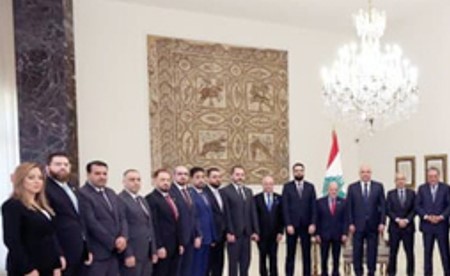
President General Joseph Aoun welcomed the expanded Syrian delegation that visited Lebanon, headed by Minister of Economy Mohammad Nidal Al-Shaar, on the occasion of the Lebanese-Syrian Investment Forum held in Beirut under the patronage of President Aoun, represented by Minister of Economy and Trade Dr. Amer Al-Bassat. He conveyed his greetings to his counterpart, President Ahmad Al-Sharaa, and praised the positions that “call for consolidating relations between the two countries based on complementarity, balance, mutual respect, and non-interference in internal affairs.” He stated that “these principles were the starting point of the discussions during the first meeting I held with President Al-Sharaa.”
President Aoun considered this visit “an indicator of the soundness of relations between the two countries,” highlighting the great importance he attaches to the idea he proposed at the Arab League and in Iraq regarding economic complementarity in the region, similar to the European Union. He added, “There are significant capacities in the region that we must activate through balanced relations and mutual respect. Lebanon and Syria enjoy a distinguished position on the Mediterranean Sea, which qualifies them to be a suitable alternative in the event of tensions or problems in the region.” He continued, “This is what I conveyed to US President Donald Trump.”
Referring to the “numerous challenges faced by both Syria and Lebanon,” President Aoun emphasized that “Lebanon’s stability is part of Syria’s stability, and vice versa. We must work on security and military stability, but also on economic stability, which strengthens the overall situation.” He noted, “In every crisis, there is an opportunity that must be exploited for complementarity and development.”
For his part, Minister Al-Shaar conveyed President Al-Sharaa’s greetings to “President Aoun, the government, and the brotherly Lebanese people,” stressing that “this meeting is of great importance and was long awaited by the current Syrian officials.” He said, “The former regime held hundreds of meetings with former Lebanese presidents, but we aspire to meet with sincerity, love, and loyalty. With your meeting today, this dream has been realized.”
He clarified, “We come to Lebanon today with hearts full of longing and nostalgia. We were deprived of this relationship for 60 years. Now, we are opening a new page—a page of peace, love, sincerity, loyalty, and balance in relations. We fully recognize that you and His Excellency President Al-Sharaa have laid the first stone in the edifice of a balanced and fair relationship between the two countries.” Minister Al-Shaar reassured that “our presence is not to compete economically or commercially with the Lebanese as Syrian companies, because we cannot compete with a people who are part of us and we are part of them. We must establish a strong economic system and then move to the world as an important pathway, instead of remaining a fragile base as is the current situation.”
In New York, Prime Minister Dr. Nawaf Salam continued his meetings on the sidelines of the United Nations General Assembly. He met with the Secretary-General of the Arab League, Nabil Fahmy, in the presence of Minister of Foreign Affairs and Expatriates Youssef Raji, and emphasized “the importance of a unified Arab position in light of the current regional circumstances, and the coordination of Arab positions and efforts to contribute to de-escalation and protecting the security and stability of the region.” Minister Raji met with his European counterparts, and the discussion with German Foreign Minister Johann Wadefol focused on the period after the end of the UNIFIL mission. He clarified the Lebanese government’s position calling for the continuation of an international presence in the south. Wadefol praised “the courage of the Lebanese government in the decisions it made regarding the monopoly of weapons by the state” and expressed hope that “this path will be completed until its full realization.”
