Nasser Al-Mohammed: 'Francophonie' has become a living and renewed space for communication, creativity and knowledge exchange
Press coverage 3 newspapers covered this event: Al-Jarida · Al-Qabas · Al-Wasat →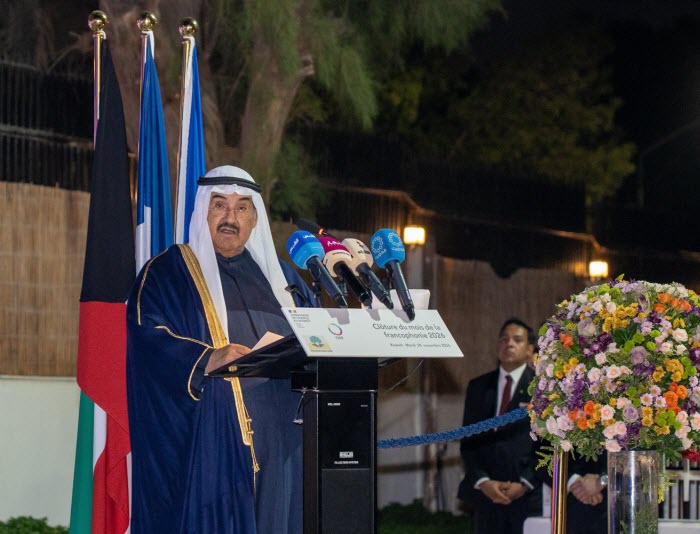
His Highness Sheikh Nasser Al-Mohammed confirms the vitality of Francophonie as a space for communication and creativity in Kuwait
Translated by Alqyas from Al-Wasat — Original source
His Highness Sheikh Nasser Al-Mohammed Al-Sabah affirmed that “Francophonie” is no longer merely a cultural legacy, but has become a vibrant and renewing space for communication, creativity, and knowledge exchange, serving as a vital pillar of cultural diversity that enriches human civilization.
Speaking at an event held under his patronage at the French Ambassador’s residence to mark the conclusion of Francophonie Month on the evening of the day before yesterday, His Highness Sheikh Nasser Al-Mohammed Al-Sabah stated that linguistic and cultural diversity represents a source of richness for humanity, and that dialogue and interaction among civilizations form the foundation for building a more open, understanding, and peaceful world.
He pointed out that Francophonie does not seek to compete with or replace the English language, but rather offers a model of linguistic and cultural integration.
He added that the celebration of World Francophonie Day and its official events in the State of Kuwait began on a regular annual basis at the start of the new millennium, specifically over the past two decades, before expanding to encompass a full month of Francophonie activities. These include French spelling competitions, film screenings, sports tournaments, and discussion panels at the University of Kuwait, all aimed at highlighting linguistic and cultural diversity.
His Highness clarified that although the State of Kuwait is not yet an official member of the International Organization of Francophonie (OIF), it has a long and active history with the French language that extends beyond merely celebrating World Francophonie Day.
He reviewed the historical roots of the organization’s establishment, noting that the intellectual initiative emerged in the late 1960s from non-French heads of state: Tunisian President Habib Bourguiba, Senegalese President Léopold Sédar Senghor, Nigerien President Hamani Diori, and Cambodian Prince Norodom Sihanouk, with the aim of uniting French-speaking countries into a single entity.
He noted that this initiative received support from several French presidents, including Charles de Gaulle, François Mitterrand, and Jacques Chirac, leading to the signing of the Niamey Agreement on March 20, 1970. This agreement established the Agency for Cultural and Technical Cooperation (ACCT), which served as the nucleus of the current International Organization of Francophonie.
His Highness Sheikh Nasser Al-Mohammed Al-Sabah highlighted that the organization continued to evolve over the past decades, culminating in the 20th Summit hosted by the Cambodian capital, Phnom Penh, in 2026, under the theme “Reinvesting in Peace for Shared Prosperity and Sustainable Stability,” reflecting Cambodia’s historical experience in overcoming war to achieve reconstruction and development.
He explained that one of the key indicators of the organization’s success is the steady increase in the number of French speakers, which reached approximately 396 million according to its latest reports, compared to an estimated 321 million in previous assessments. Projections suggest this number could reach 590 million by 2050.
He added that more than 170 million people are currently learning French, reinforcing its status as one of the most widely spoken languages in the world.
He clarified that the African continent has become the main center of gravity for Francophonie’s growth, with approximately 65 percent of the world’s French speakers currently residing there. Projections indicate that nine out of every ten future French speakers will be from the continent.
He pointed out that the Democratic Republic of the Congo has surpassed France to become the largest French-speaking country by number of speakers, with an estimated 68 million speakers according to recent data, reflecting a geographical and cultural shift in the center of gravity of Francophonie from Europe to Africa.
His Highness Sheikh Nasser Al-Mohammed Al-Sabah affirmed that the achievements of the International Organization of Francophonie have not been limited to the cultural sphere, but
Over the past decades, it has expanded to encompass the fields of politics, education, economics, and sustainable development, thereby strengthening its role in supporting cooperation and communication among countries and peoples. For his part, Olivier Goffen, the French Ambassador to Kuwait, said in a speech that Francophonie in Kuwait today has become a living and renewed reality, reflecting the natural and sincere affection that Kuwaitis hold for the French language. Ambassador Goffen added that Francophonie is not merely an institutional or official matter, but rather a story of friendship and love between the French language and all its speakers, as he highlighted key milestones in the development of French language education in Kuwait. He emphasized the essential role played by the French Institute in Kuwait, both in teaching the language and in certifying language competencies and issuing recognized certificates, alongside the role of schools and universities that contribute to spreading the French language in the country. This ceremony capped several weeks of events, meetings, and cultural, educational, and sports initiatives organized as part of the Francophone Cultural Season, initiated by members of the Council for the Promotion of Francophonie in Kuwait.
