United States and Qatar: Guarantee Freedom of Navigation in 'Hormuz'
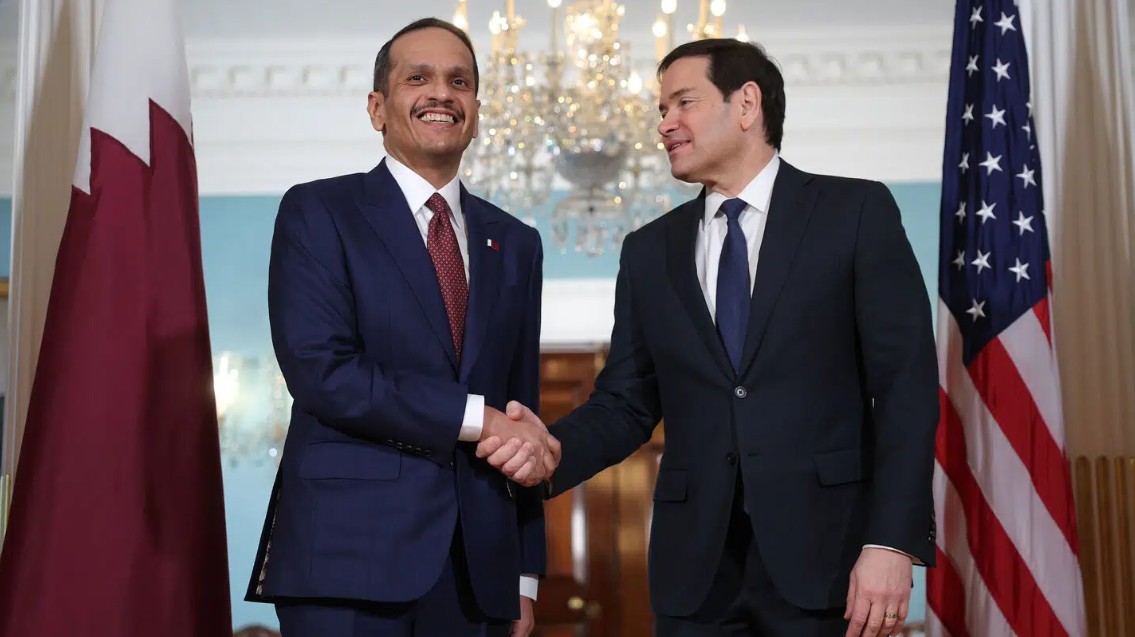
Joint statement confirms Washington and Doha commitment to guarantee security of waterways and defense and economic cooperation
Translated by Alqyas from Al-Wasat — Original source
The United States and Qatar reaffirmed yesterday their shared commitment to ensuring freedom of navigation in the Strait of Hormuz and the importance of maintaining safe, unimpeded passage through this vital waterway, which serves as a cornerstone of regional security, stability, and global energy supply and economic flows. This was stated in a joint statement issued by the two governments following the eighth round of the U.S.-Qatar Strategic Dialogue held in Washington, chaired by U.S. Secretary of State Marco Rubio and Qatari Prime Minister and Minister of Foreign Affairs Sheikh Mohammed bin Abdulrahman Al Thani, with senior officials from both sides participating.
The statement, published by the U.S. Department of State, noted that Secretary Rubio reiterated the United States’ commitment to Qatar’s security, emphasizing the importance of the defense partnership in enhancing joint capabilities and protecting mutual interests. He added that the two sides discussed strengthening Qatar’s integrated air and missile defense capabilities to protect its territory and critical infrastructure, alongside reviewing progress made under the $38 billion Defense Cooperation Statement of Intent.
On regional matters, Rubio, on behalf of U.S. President Donald Trump, expressed appreciation for the role of the Emir of Qatar, Sheikh Tamim bin Hamad Al Thani, and the Qatari government in international mediation efforts and in promoting peace, security, and stability.
For his part, the Qatari Prime Minister and Foreign Minister praised President Trump’s efforts to reach agreements ending regional conflicts, underscoring the pivotal role of American diplomacy in creating conditions for lasting peace.
The statement indicated that the talks addressed a number of regional and international files, including Gaza, Iran, Syria, Lebanon, and Afghanistan, as well as counterterrorism and security challenges.
Economically, both sides affirmed their intention to expand trade and investment opportunities and build upon economic agreements worth more than $240 billion, announced during President Trump’s visit to Qatar in May 2025. The two countries also signed a framework for cooperation in critical minerals to diversify and strengthen supply chain resilience, alongside expanding collaboration in advanced technologies, cybersecurity, digital infrastructure, and energy.
In the field of counterterrorism, both sides stressed the importance of enhancing security cooperation, information sharing, combating terrorist financing, money laundering, and transnational organized crime, and continuing joint efforts to confront the so-called Islamic State (ISIS).
