Al-Khayriya Foundation opens Ibrahim and Maryam Al-Asfour Charitable Village in Indonesia
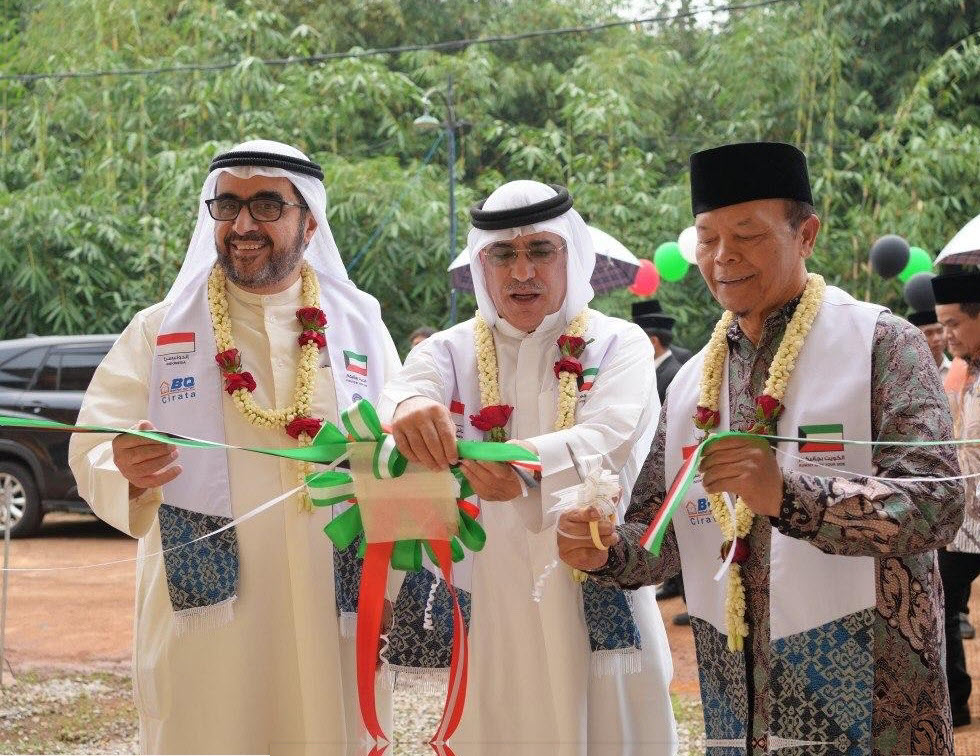
Opening of Ibrahim and Maryam Al-Asfour Charitable Village in Indonesia to support education and care
Translated by Alqyas from Al-Wasat — Original source
Badr Al-Sumait, the General Manager of the Islamic World Charity Organization (IWCO), recently inaugurated the Ibrahim and Maryam Al-Asfour Charity Village in West Java, Republic of Indonesia. The event was attended by various Indonesian officials and representatives from government, educational, and charitable institutions, alongside benefactor Waleed Ibrahim Al-Asfour, representing the Al-Asfour family.
The village was established at the Bayt Al-Quran Institute in the Cisarua area of Bogor, covering an area of approximately 2,100 square meters. It serves 1,338 male and female students enrolled at the institute. The facility includes a two-story mosque, a school with four classrooms, orphan housing, a teacher’s residence, a central kitchen, a dining hall, a health clinic, a waqf shop, and a water well. These integrated facilities aim to meet the beneficiaries' needs and provide a comprehensive educational and living environment.
The village presents an integrated model for educational and charitable projects designed to establish the foundations of a dignified life for students. Through a comprehensive system of educational, da'wah, residential, health, and service facilities, it enhances the institute's capacity to fulfill its educational and humanitarian mission, providing students with a suitable environment for learning, residence, and care.
The ceremony began with the playing of the national anthems of Kuwait and Indonesia, followed by a series of speeches highlighting the project's importance and its role in serving the institute's students and strengthening cooperation and charitable work between the State of Kuwait and the Republic of Indonesia. Indonesian officials praised Kuwait's humanitarian role and its continuous contributions to supporting educational and developmental projects.
Engineer Badr Al-Sumait emphasized that the inauguration of the village represents a significant addition to efforts supporting education and student welfare. He noted that the project embodies the spirit of Kuwaiti generosity in building integrated educational environments that provide students with the essentials for learning, care, and stability, thereby enabling educational institutions to continue their educational and humanitarian missions.
He clarified that the Charity Organization places great emphasis on the education sector, driven by the belief that investing in human capital is one of the most important paths to sustainable development. He added that empowering generations with knowledge and science contributes to building societies and enhancing their ability to face challenges and create a better future.
Al-Sumait outlined some of the organization's efforts in this sector, noting that between 2023 and September 2026, it implemented approximately 475 educational projects in 34 countries, with a total cost of $35,643,118 USD. These projects benefited 125,335 students, in collaboration with 82 local and international entities.
He pointed out the diversity of these projects and their fields, reflecting the organization's commitment to expanding access to education, improving educational environments, supporting educational institutions, and ensuring the continuity and growth of their services, thereby achieving a sustainable impact on the lives of students and beneficiary communities.
Al-Sumait expressed his sincere gratitude and appreciation to the generous Al-Asfour family for their support of the project. He commended the Bayt Al-Quran Cisarua Institute for hosting the initiative and transforming it into an educational and humanitarian landmark serving students. He also praised the role of the Kuwaiti-Indonesian Charity Association in cooperating and coordinating to complete the project.
He highlighted the deep fraternal relations between Kuwait and Indonesia, affirming that this village stands as new evidence of what can be achieved through sincere partnerships between philanthropists and local institutions, resulting in high-quality projects with sustainable humanitarian and developmental impacts.
