Hungary: Discovery of silver coins dating back more than two thousand years
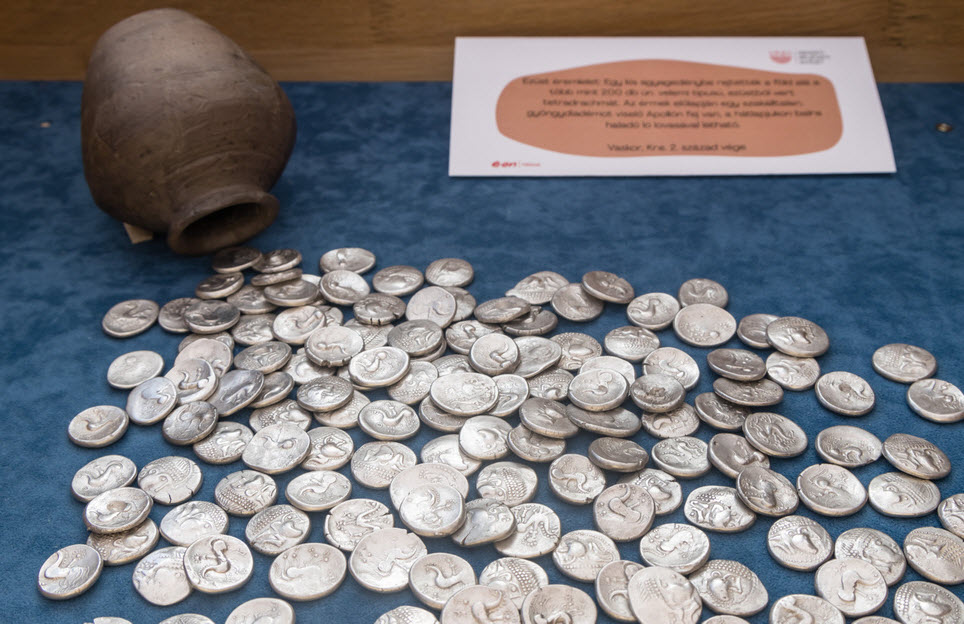
Archaeologists discover 208 Celtic silver coins in Hungary
Translated by Alqyas from Al-Wasat — Original source
Archaeologists in the city of Szombathely in western Hungary have discovered 208 silver coins dating back to the Celtic civilization, more than 2,000 years old, during excavations carried out prior to the construction of a power plant at the site. The Hungarian website Index reported that the coins were found at a depth of 30 to 40 centimeters below the surface, inside a pit, with some kept in a small pottery vessel. The use of metal detectors helped locate the majority of the coins after agricultural activities had scattered some across the area.
The coins, whose total weight exceeds two kilograms, date to the late second century BC or the early first century BC. They are known as “Velem tetradrachms,” named after the Velem region believed to be where they were minted, near the discovery site. One side of the coins features a head rendered in a Celtic style, while the other depicts a horse and rider.
The tetradrachm is a silver coin equivalent to four drachmas and was used in trade and high-value transactions. The frequent discovery of such coins in buried hoards suggests they were also used to store wealth.
The discovery was made as part of excavations conducted by the National Institute of Archaeology, affiliated with the Public Collections Center of the Hungarian National Museum. Over the past years, these excavations at the site have yielded approximately 400 archaeological features and thousands of artifacts spanning various historical periods, including stone tools dating back around 7,000 years, Iron Age items, and remains of an ancient Roman building.
