The Third Cultural Forum of the Al-Isalah Social Association Discusses Personal Status and the Kuwaiti Family Between Jurisprudence, Law, and Reality
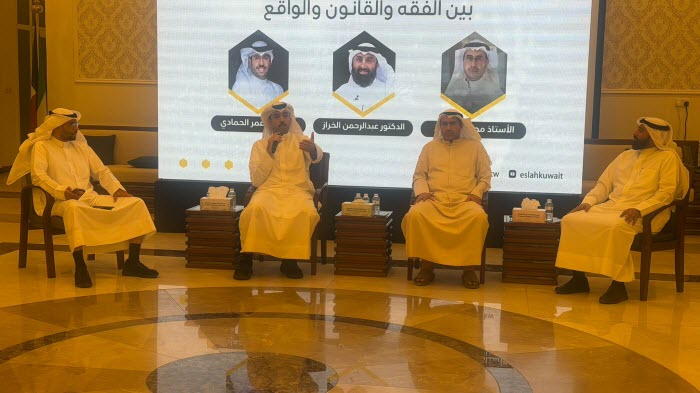
The Al-Isalah Social Association organized a cultural forum on personal status with the participation of Mohammed Al-Murshed and Omar Al-Hammadi
Translated by Alqyas from Al-Wasat — Original source
He called for the development of an integrated system to protect the family and promote reconciliation, awareness, and amicable settlement before resorting to courts.
In the context of its interest in family issues and enhancing social stability, the Social Reform Association organized its third cultural forum under the title “Personal Status and the Kuwaiti Family: Between Jurisprudence, Law, and Reality.” The forum featured a distinguished group of specialists in Islamic jurisprudence, Sharia, social reform, and law, who discussed the reality of the Kuwaiti family, the challenges it faces, and the key developments related to the draft Personal Status Law, alongside presenting practical solutions and initiatives aimed at protecting the family and safeguarding the rights of its members.
The forum featured comprehensive perspectives addressing the Sharia-based reference for family legislation, the importance of family reform and early intervention to resolve marital disputes, as well as the role of awareness and comprehensive reconciliation in reducing judicial conflicts. It also emphasized that family stability is a shared responsibility requiring the integration of legal, Sharia-based, and social efforts.
Al-Kharaz: The Personal Status Law derives its rulings from Islamic jurisprudence... New amendments require careful study
Professor of Islamic Jurisprudence and its Principles, Dr. Abdulrahman Al-Kharaz, stated that Kuwait’s Personal Status Law No. 51 of 1984 is based on the reference of Islamic jurisprudence, including its principles and evidences. He stressed that any legislative amendments must be grounded in Sharia evidence, the objectives of Sharia, and the principles of jurisprudence, while taking into account the needs of contemporary families.
He clarified that the new draft law represents the most comprehensive amendment since its enactment, touching on fundamental issues related to marriage prerequisites, alimony, marital separation, and child custody. These matters require the participation of jurists and specialists in their study before approval, given their direct impact on family stability and the rights of spouses and children.
Al-Kharaz reviewed divorce indicators in Kuwait, noting that there were 13,303 marriages and 7,865 divorces in 2023. Of these divorces, 710 occurred within the first year of marriage, and 610 took place before consummation. He pointed out that these indicators necessitate strengthening awareness and pre-marital family preparation programs.
He emphasized the importance of Article 13 bis, which mandates prospective spouses to undergo a preparatory course, describing it as a step toward enhancing awareness of marital rights and obligations. He called for allowing sufficient time to discuss the new draft and for opening a broad dialogue involving jurists, specialists, and family and community institutions, to achieve legislation that balances Sharia-based references with the requirements of reality.
Al-Murshid: Family reform is a science and methodology...
Protecting children begins by resolving disputes away from revenge. For his part, social counselor Mohammed Al-Murshed affirmed that family stability requires integrated solutions and the provision of practical, realistic initiatives that address family challenges. He pointed out that the problem does not lie in divorce itself, but in the transformation of disputes after separation into a state of revenge and mutual recrimination, with children being the first victims.
He clarified that marital disputes may arise from multiple causes, such as mistreatment and abandonment, but their danger multiplies when affection turns to aversion and mercy to cruelty, and when the bonds that united the couple become enmity and revenge, rather than a separation based on respect, safeguarding rights, and considering the children’s best interests.
Al-Murshed noted that the reality of family rehabilitation centers reveals a significant presence of accumulated disputes among couples who have spent about 15 years in marriage, explaining that problems in such cases are often more complex due to the accumulation of disputes and the intertwining of their causes.
He stressed that family rehabilitation is not a random act or individual effort, but a science that requires qualification and a deep understanding of the social, psychological, and family reality, affirming that the Islamic methodology possesses an integrated rehabilitation system based on mercy, wisdom, justice, and the preservation of rights.
Al-Murshed called for enhancing early intervention before disputes reach the courts, and for activating specialized programs for family counseling and rehabilitation, urging the Social Rehabilitation Association to include these programs in its activities and community initiatives, thereby contributing to the protection of the family, safeguarding children’s rights, and enhancing social stability.
Al-Hammadi: Comprehensive family reconciliation shortens disputes and preserves the rights of parties, with the child’s best interest first.
For his part, lawyer Omar Al-Hammadi affirmed that family protection begins with awareness before marriage and continues with understanding and reconciliation when disputes occur, explaining that many family problems arise due to a lack of knowledge about rights and duties and insufficient preparation to bear the responsibilities of married life.
Al-Hammadi proposed two initiatives to enhance family stability: the first is establishing a family counseling center sponsored by the Social Rehabilitation Association, which would offer specialized workshops and consultations before marriage, during it, and after having children; the second is building partnerships with state institutions to implement joint, continuous awareness programs that keep pace with different stages of family life.
He highlighted the importance of adopting comprehensive family reconciliation as a practical option preceding litigation, whereby disputes related to divorce, alimony, custody, and other rights are consolidated into a single reconciliation agreement, attended by both parties, in which their rights and obligations are comprehensively defined, and then submitted to the court according to applicable legal procedures.
He explained that this approach helps save time, effort, and costs, limits the multiplication of lawsuits, and prevents the escalation of disputes, noting that reconciliation contracts are currently in practice, and that the new draft of the Personal Status Law includes their regulation, although they have not yet been enacted.
Al-Hammadi emphasized that family cases require an integrated legal vision linking the Personal Status Law, the Child Law, the Family Court Law, and other relevant legislation, stressing that the child’s best interest must be present in every agreement or settlement concerning children’s rights and care.
He concluded by affirming that awareness prevents disputes before they occur, and reconciliation preserves rights when they do, and that the child’s best interest should remain at the forefront of priorities when addressing family disputes.
