Putin's Nuclear Briefcase Draws Attention with Appearance at APEC Summit
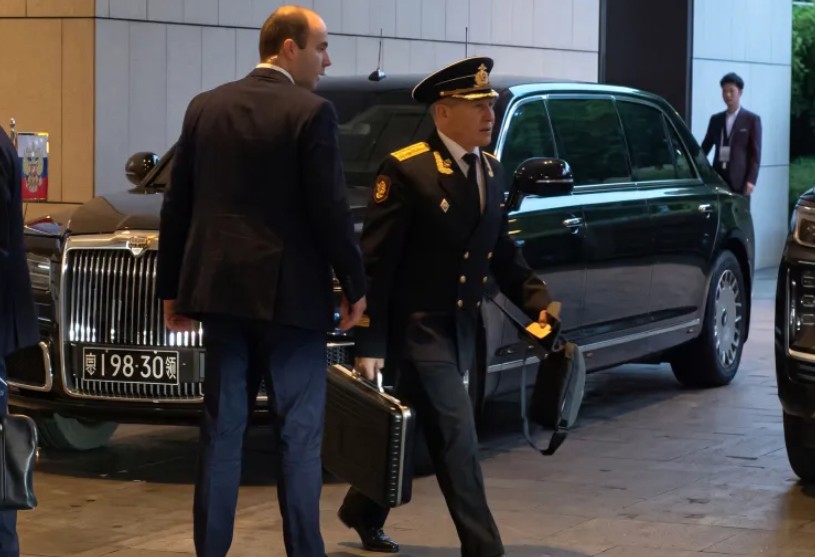
A rare appearance of the Russian nuclear briefcase with Putin at the Shanghai summit raised questions about diplomatic messages
Translated by Alqyas from Al-Wasat — Original source
In an unusual public appearance before cameras, Russia’s nuclear briefcase, known as “Cheget,” stole the spotlight at the Asia-Pacific Economic Cooperation (APEC) forum summit in the Chinese city of Shenzhen on Wednesday. The briefcase, which contains the codes and encrypted keys needed to authorize nuclear strikes, was seen in the possession of a Russian naval officer accompanying President Vladimir Putin, according to footage broadcast by Russian state television.
Cameras captured a notable moment when Russian journalist Yevgeny Popov asked the officer carrying the black briefcase, “Is this the nuclear briefcase?” to which the officer gave a definitive reply: “Yes, it is.”
The briefcase accompanies the Russian president on all domestic and foreign travels, in compliance with security and military protocols. Its public display at a major international event has sparked widespread speculation among observers about the purpose and underlying messages behind deliberately showcasing this “rare” footage.
Some commentators noted that, in the language of diplomacy, the presence of the nuclear briefcase at an economic summit is not merely a routine measure but is interpreted as a silent reminder that economics and military deterrence are two sides of the same coin.
Bloggers drew comparisons between the command systems of major powers, noting that Putin’s “Cheget” briefcase corresponds to the U.S. “nuclear football,” a mobile command system that accompanies U.S. President Donald Trump. Both briefcases enable their respective leaders to communicate instantly with military command to issue orders related to the nuclear arsenal.
The “Cheget” briefcase is an essential and vital component of Russia’s mobile nuclear command system, known as “Kazbek.” It allows the president, as commander-in-chief of the armed forces, to securely communicate with senior military leadership to transmit launch codes in emergency situations.
The system is linked to the Russian General Staff and its comprehensive nuclear command infrastructure, which oversees land-based missiles, submarines, and strategic bombers. Military experts explain that assigning the task of carrying the “Cheget” briefcase to Russian naval officers is based on strict military traditions and specific security protocols.
