Tehran expects new US attack and threatens 'more destructive' response
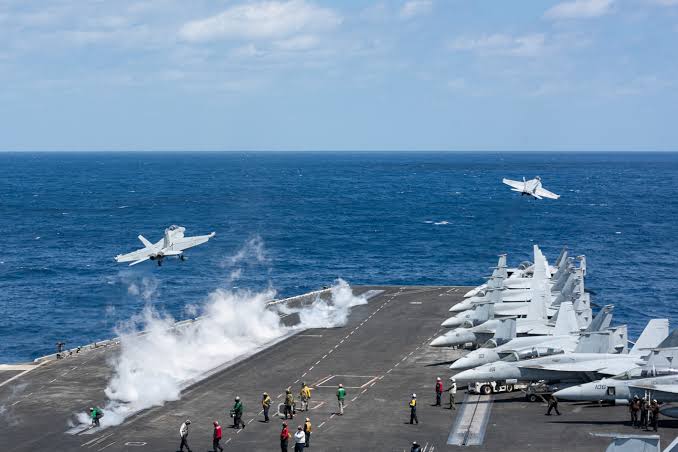
Escalating tensions between Iran and the United States with threats of military response, while Israel embarks on a ground operation in Gaza.
Translated by Alqyas from Al-Wasat — Original source
Signs are mounting in Iran of a new American attack, as U.S. reports speak of continued, limited, and unacknowledged military exchanges between Washington and Tehran, despite President Donald Trump’s conflicting statements about the end of the war with Iran. NBC News reported, citing two U.S. officials and an informed source, that military confrontations have not ceased and that the U.S. military is launching attacks on Iranian targets, while Tehran responds almost daily, without officially acknowledging most of these operations, particularly over the past two months. According to the report, Iranian attacks included commercial oil tankers in the Strait of Hormuz, U.S. Navy vessels, and U.S. military installations, while the U.S. response focused on intercepting missiles and drones, along with targeting missile launch platforms in some cases.
A U.S. military official said on Tuesday that American fighter jets targeted an Iranian Revolutionary Guard Corps missile launch platform on Qeshm Island, in retaliation for a drone attack on Monday evening that targeted a U.S. radar system in Bahrain. The official, whose remarks were relayed by Reuters, confirmed that the strikes were in response to attacks on U.S. forces and military equipment.
In Tehran, statements by military, political, and judicial officials reflected growing talk of the possibility of renewed confrontation, alongside official assurances that the armed forces are working to enhance their military capabilities and prepare for escalation scenarios. Iran’s Army Chief of Staff, Amir Hatami, said on Wednesday that the readiness of the military and armed forces “is evolving moment by moment,” adding that the army and armed forces are monitoring the adversary’s movements “with vigilance and precision,” in reference to U.S. military preparations. Hatami warned that the Iranian armed forces’ response to any new attack would be “more crushing,” and that any party viewing Iran and the Iranian regime “with hostility will become a lesson for all.”
In a related development, Qasem Qorashi, deputy head of the Basij organization, announced that increasing the range of missiles had been incorporated into the Iranian Armed Forces’ plans, in accordance with directives from Supreme Leader Mojtaba Khamenei. On Wednesday, Qorashi stated that the Islamic Revolutionary Guard Corps’ Aerospace Force would implement this strategy, noting that the prospect of U.S. military activities shifting to more distant bases and areas, amid what he described as the U.S. withdrawal from the region, makes developing missile range and the capacity for proportional response essential.
Meanwhile, Hassan Qashqaei, spokesperson for the National Security and Foreign Policy Commission of the Iranian Parliament, spoke about the advancement of Iran’s missile and defensive capabilities, asserting that the readiness of the armed forces had reached a level that, in his words, renders the United States and its allies unable to pinpoint the locations that Iranian missiles might target. Qashqaei added, during a gathering of regime supporters in the city of Borujerd, that radar and surface-to-air missile capabilities had been enhanced, arguing that Washington would not be able to extract concessions from Tehran through negotiations.
On the diplomatic front, Morteza Mahmoudi, an MP for Tehran in the Iranian Parliament, accused Qatar of operating within what he termed a “U.S. policy scheme,” claiming that Doha was using diplomatic tools to reassure global markets and suggest that the Strait of Hormuz crisis was nearing its end. In statements to the Khaneh Mellat news agency on Wednesday, Mahmoudi said Qatari officials continued their daily communications with Tehran, seeking to portray negotiations in a positive light and imply progress, whether through media statements or direct contacts. He added that the continued uncertainty in the Strait of Hormuz was imposing significant economic costs on the global economy and Western countries, accusing Qatar of attempting to leverage diplomatic moves to influence markets and prolong strategic equations. Mahmoudi stated that Iranian decision-makers, according to him, were aware of what he described as a “double game” and would not allow diplomatic communications to be turned into a tool for psychological pressure on markets.
These positions come despite Doha playing a mediating role in de-escalating regional tensions and avoiding direct military confrontation between Tehran and Washington through open dialogue channels. The simultaneous Iranian statements, alongside reports of continued limited strikes, indicate that the possibility of renewed military confrontation remains part of Tehran’s calculations, at a time when the nature of upcoming U.S. steps remains unclear, as well as whether the reciprocal operations will remain confined to limited strikes or escalate into a broader confrontation.
Salah al-Din Axis in Gaza..
The Occupation Begins First Ground Operation in the Strip Since the Ceasefire Agreement - An Israeli Tank on the Border with the Gaza Strip
The Israeli occupation army announced on Wednesday the start of a military operation in areas northeast of the Nuseirat and Al-Bureij refugee camps in central Gaza, encompassing several blocks and residential neighborhoods surrounding what is known as the Yellow Line.
In a press statement, the occupation army said the military operation would include closing the main Salah al-Din axis, which connects the north and south of the Strip, to traffic in the targeted areas for the duration of the operation, warning Palestinian civilians against being present there until further notice.
Following the issuance of forced evacuation orders by the occupation army, Palestinian families began evacuating the aforementioned areas entirely, amid fears that the scope of military operations would expand and target new residential zones within the operation, under a climate of fear and anticipation prevailing in the area.
The closure of the Salah al-Din axis has raised Palestinian concerns over restrictions on movement between the north and south of the Strip, at a time when residents are facing difficult humanitarian conditions due to the ongoing aggression and blockade imposed on Gaza.
Israeli tanks and military bulldozers advanced into central Gaza in tandem with the army’s announcement of the start of a military operation in three areas in the central Strip, according to local Palestinian media, yesterday.
The Palestinian “Quds Network” reported on its website that “occupation tanks and military bulldozers advanced in the Atalat Al-Rais area east of Al-Bureij camp, in central Gaza, amid continuous artillery shelling and gunfire.”
The Israeli army stated in a statement that the operation includes blocks “660,” “661,” and “666,” announcing the closure of the Salah al-Din axis to traffic within the scope of these areas.
The “Network” noted that block “660” is located north and northwest of Al-Bureij camp, while block “661” is adjacent to it within the camp’s perimeter. Block “666” is located north of Nuseirat camp and includes the Ad-Dawa area and regions near Wadi Gaza to the south.
Meanwhile, the body overseeing US President Donald Trump’s plan to end the war in Gaza accused both Israel and Hamas of failing to fulfill their commitments to halt hostilities, which leaves Gaza’s residents facing deteriorating conditions and threatens the ceasefire with collapse.
Trump: South China Sea Dispute to Be Addressed - Philippine President Ferdinand Marcos Jr. Shakes Hands with US President Donald Trump During Their Meeting in Manila
US President Donald Trump affirmed on Wednesday that he is not concerned about the dispute between the Philippines and China in the South China Sea, confirming that the issue will be addressed despite ongoing tensions in the contested waters.
Responding to a question about the maritime dispute during his meeting with Philippine President Ferdinand Marcos Jr. at the Presidential Palace in the capital Manila, as reported by the Philippine News Agency, Trump said, “I am not concerned about it at all, and the matter will be addressed.”
Trump pledged to continue supporting the Filipino people, noting that the governments of both countries are working to expand defense cooperation, which he described as a cornerstone of security in the region, alongside enhancing partnership in the energy and technology sectors.
In the defense sector, Trump revealed an increase in external military funding provided by Washington to Manila and approved arms sales exceeding $5 billion since he took office, affirming continued work with Philippine President Ferdinand Marcos Jr. to expand defense cooperation between the two countries.
In the energy sector, he pointed to opportunities to supply Pacific region allies with American oil and natural gas, considering that the Philippines could
Kuwait officials are seen as a “natural partner” in plans to export energy supplies through a new pipeline in Alaska, United States. He clarified that Washington and Manila are holding discussions on cooperation in civilian nuclear technology, considering that the Philippines’ adoption of American technology in its first modern nuclear project would strengthen the partnership between the two sides. For his part, the Philippine president affirmed that relations between his country and the United States have continued to grow and develop over decades, with exploration of new areas of cooperation, especially in the technology sector. He noted that the two countries are celebrating this year the 80th anniversary of the establishment of diplomatic relations and the 75th anniversary of the alliance under the Mutual Defense Treaty, emphasizing that the United States is the only ally of the Philippines with which it has a mutual defense treaty. These talks come ahead of U.S. President Donald Trump’s later travel today to the Chinese city of Shenzhen to participate in the Asia-Pacific Economic Cooperation (APEC) Economic Leaders’ Meeting, held on November 18 and 19. Trump is scheduled to hold a trilateral meeting tomorrow, Thursday, with Chinese President Xi Jinping and Russian President Vladimir Putin to discuss international issues, including nuclear arms reduction. Defense relations between Manila and Washington date back to the Mutual Defense Treaty signed in 1951, which obligates the two countries to take action to address common threats in the event that either is attacked by armed forces in the Pacific region, in accordance with the constitutional procedures of each country. The Philippines is working to expand its network of security partnerships and strengthen its alliance with the United States amid ongoing tensions with China over disputed areas in the South China Sea, where maritime claims of several countries overlap. Chinese President supports establishment of a global association for cooperation among bay areas worldwide Chinese President Xi Jinping expressed Beijing’s support yesterday, Wednesday, for the establishment of a global association to enhance economic cooperation among bay areas around the world, with the aim of deepening exchanges and interactions among them. Xinhua News Agency reported that this came during a speech delivered by the Chinese president at the opening of the APEC Economic Leaders’ Meeting in Shenzhen. The agency quoted Xi as saying that his country supports the establishment of the association as a step aimed at exploring new ways to develop the APEC forum. The Chinese president called for openness, cooperation, and innovation, emphasizing his country’s readiness to work with all parties to promote shared prosperity and build an “Asia-Pacific community.” He pointed out that the global economy lacks sufficient momentum for growth amid rising unilateralism and protectionism, while global trade continues to grow despite “headwinds,” and the pace of breakthroughs in emerging technologies is accelerating. He added, “This presents us with two choices: openness or closure… cooperation or division…”
“Change or Stagnation,” pointing out that “these are questions raised by the challenges of the era.” He emphasized the necessity of safeguarding the international system that emerged after World War II and building a balanced, orderly multipolar world, as well as enhancing inclusive economic globalization that benefits everyone, while resolving differences through dialogue to consolidate the foundations of security and stability in the region. He also stressed the importance of preserving the multilateral trading system centered on the World Trade Organization, supporting free trade and open investment, alongside deepening cooperation in the digitalization of trade, cross-border e-commerce, smart customs, and industrial and supply chains. He called for creating partnerships based on technological innovation and intensifying cooperation in the digital economy and artificial intelligence, while pushing for a low-carbon green transition, highlighting the importance of removing trade and investment barriers and achieving balanced development that would benefit all economies and the various segments of their populations.
Three Palestinians, including a child, martyred in Israeli occupation raids on Gaza
The health authorities in the Gaza Strip announced on Wednesday that three Palestinians, including a child, were martyred and others were injured with varying degrees of severity following airstrikes carried out by the Israeli occupation air force on various areas of the Gaza Strip, coinciding with the continuation of shooting operations and the demolition of houses and buildings in the eastern areas of the Strip.
The health authorities in the Gaza Strip said in a statement that two Palestinians were martyred as a result of two raids carried out by Israeli occupation aircraft. The first targeted a group of Palestinians near the (Marine Club) on Al-Rashid Coastal Street in southwestern Gaza City, while the second targeted the city of (Deir al-Balah) in the center of the Strip, resulting in the martyrdom of another Palestinian and injuring several others with varying degrees of severity.
It added that an 11-year-old Palestinian child was martyred at (Al-Shifa) Hospital in Gaza City from injuries sustained in a strike carried out by an Israeli occupation drone that targeted areas in the northern part of the Strip yesterday.
In related field developments, violent explosions occurred in the eastern areas of Gaza City and east of (Al-Maghazi) camp in the center of the Strip as a result of demolition and blasting operations carried out by Israeli occupation forces, affecting several remaining houses and buildings in areas under their control within what is known as the (Yellow Line), which separates the areas of Israeli troop deployment from the rest of the Strip.
In the southern part of the Strip, Israeli occupation forces opened fire from their positions east of (Khan Younis) toward areas where displaced people are gathered west of the city.
Katz threatens to occupy more land in Gaza, Lebanon, and Syria
Israeli Defense Minister Israel Katz threatened on Wednesday to occupy more land in the Gaza Strip, Lebanon, and Syria if the situation escalates there in the event of a resumption of war against Iran.
Katz said in a statement that the Israeli army “continues to impose its control over security areas in Lebanon, Syria, and the Gaza Strip.”
Israel occupies about 70 percent of the Gaza Strip’s area, in addition to lands in Lebanon and Syria, some of which for decades.
Katz added: “As we have clearly stated: Israel will not withdraw from the current lines of these security areas, nor will it redeploy its forces.”
He conditioned any such move on “the dismantling of Hamas, disarming the Gaza Strip, disarming Hezbollah throughout Lebanon, and eliminating all jihadist threats coming from Syria,” according to his words.
Threatening, he said: “If the situation escalates on various fronts, we are fully prepared to control additional territories, evacuate the local population, and annex them to Israel’s permanent security zone.”
Statements by Israeli officials, including Katz, anticipate an escalation of tensions, particularly in Gaza and Lebanon, should Tel Aviv engage in a new escalation against Iran. Warnings are mounting in Israel that outgoing Prime Minister Benjamin Netanyahu is pushing hard to resume the war on Iran, hoping to remain in power. Leaders of the “Change and Renewal” bloc, whose leader Gadi Eisenkot has been tasked with forming a new government, say Netanyahu is seeking a state of emergency to impose a unity government with his participation.
“ADNOC”: One of our ships attacked while transiting the Strait of Hormuz
The UAE-based ADNOC Supply and Services Company announced on Wednesday that one of its ships was attacked while transiting the Strait of Hormuz on the evening of the previous day, noting the loss of one crew member and injuries to 11 others. The Emirates News Agency (WAM) quoted the company as saying that one crew member remains missing, while search and rescue operations continue in coordination with relevant authorities. It added that all other crew members were safely evacuated from the ship, noting that 11 crew members were injured and those whose conditions require it are receiving necessary medical care. The company emphasized that its top priority is supporting search and rescue efforts and providing assistance to the crew members and those affected by the incident. ADNOC stressed the importance of protecting sailors and ensuring freedom of navigation and maritime security, calling on the public to obtain information only from official sources and to avoid circulating rumors or unverified information. ADNOC confirmed it will announce any updates as soon as additional information becomes available.
Jordanian Army: Five injured in helicopter crash
The Jordanian Army announced on Wednesday that five members of the armed forces were injured in a crash involving a Black Hawk helicopter during a training exercise. The Jordanian News Agency (Petra) quoted the General Command of the Jordanian Armed Forces – Arab Army in a statement that the incident resulted in injuries to five military personnel, clarifying that the injured were transported to Queen Alia Military Hospital to receive necessary treatment, with injuries ranging from one severe injury to four minor ones. The statement noted that the General Command is monitoring the health condition of the injured, affirming its commitment to providing them with necessary medical care. The General Command called on citizens to refrain from circulating rumors and to obtain information from official sources.
Russia: Significant decline in grain supplies to Africa via the Black Sea
Russian Deputy Foreign Minister Georgy Borisenko announced on Wednesday that there has been a significant decline in grain supplies to African countries via the Black Sea due to security developments related to the war with Ukraine. The Russian news agency RIA Novosti quoted Borisenko as saying that security developments in the Black Sea have significantly affected grain exports to African markets, prompting Moscow to seek alternative routes to ensure the continued flow of supplies to its partners on the continent. He added that Russian ports on the Baltic Sea represent one of the available alternatives to continue export operations, affirming his country’s readiness to fully meet Egypt’s grain needs through shipments from Baltic Sea ports. These statements come amid growing disruptions in commercial navigation in the Black Sea and the Sea of Azov, stemming from the ongoing Russo-Ukrainian war and attacks on port infrastructure and commercial vessels, which have impacted grain shipping and heightened the importance of alternative routes. In this context, data cited by TASS agency indicated...
Russian officials told the Russian Grain Union that grain shipments through Russian ports reached approximately 2.3 million tons in October, compared to around 7 million tons in the same month last year, while shipments via Baltic ports rose to about 1.56 million tons. These developments indicate a growing reliance by Russian exporters on northern ports to offset the decline in export volumes from southern ports, despite challenges related to capacity constraints, transportation costs, and pressure on the railway network. These shifts are of particular importance to African countries importing grains, as some of them depend on Russian and Ukrainian supplies to meet their domestic market needs, and any disruption to shipping routes could lead to higher import costs and increased pressure on food prices. Egypt is among the leading importers of Russian wheat, while Moscow seeks to maintain its presence in African grain markets by diversifying export routes and ensuring the continuity of supplies despite challenges facing maritime trade.
