Celebrating the Silver Jubilee of the International Day to Prevent the Use of the Environment in War and Armed Conflict
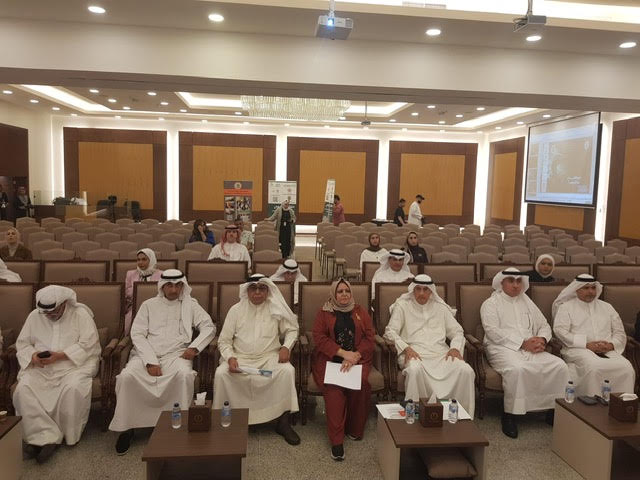
The Kuwait Society for the Protection of the Environment organized a media meeting on the occasion of the Silver Jubilee of the International Day to Prevent the Use of the Environment in War and Armed Conflict, with representatives of the United Nations and the Arab League.
Translated by Alqyas from Al-Wasat — Original source
- UN Secretary-General’s Representative: Continue partnership with the government, civil society, and media within the framework of strategic cooperation between the United Nations and the State of Kuwait
The Kuwait Environment Protection Association, in collaboration with the Kuwait Journalists Association and under the patronage of the General Secretariat for Environment and Sustainable Development of the General Union of Arab Producers, affiliated with the Arab League, organized a media event at the Kuwait Social Club headquarters to mark the Silver Jubilee of the International Day for Preventing the Exploitation of the Environment in War and Armed Conflict, observed on November 6.
Dr. Wijdan Al-Aqab, Secretary-General of the General Secretariat for Environment and Sustainable Development, and representative of the President of the General Union of Arab Producers, Dr. Ibrahim Abu Dhakri, delivered a speech on his behalf. After welcoming attendees and representatives of various entities and organizations, she conveyed his gratitude to the Kuwait Environment Protection Association and the Kuwait Journalists Association for organizing the event, and to the Kuwait Social Club for its hospitality.
Speaking on behalf of Dr. Abu Dhakri, she stated, “The General Union of Arab Producers embraced the establishment of the General Secretariat for Environment and Sustainable Development in response to a clear need within our media ecosystem: the need for specialized environmental media capable of understanding environmental issues, explaining their dimensions, and making them relevant to people’s interests and daily decisions.”
Dr. Al-Aqab added in her own remarks, “Dr. Ibrahim Abu Dhakri’s familiarity with the awareness campaign for November 6, which I initiated, and his recognition of the importance of this day and its humanitarian message, played a significant role in embracing this idea. Together, we recognized the gap between the severity of environmental damage caused by wars and its presence in media content, as well as the need for institutional action that bridges experts and media and production professionals. This led to the establishment of the General Secretariat for Environment and Sustainable Development. We insisted that the Cairo Festival on November 6, 2017, serve as the launch event for the Secretariat, expressing respect for this international day and linking the Secretariat’s mission from its inception to the media’s responsibility toward the environment and humanity.”
She clarified, “As we celebrate the Silver Jubilee of the International Day for Preventing the Exploitation of the Environment in War and Armed Conflict, we recall the 25 years since its adoption by the United Nations in 2001. This occasion calls on us to evaluate our progress in conveying its message, to expand its presence in media institutions, and to raise awareness among new generations. The importance of environmental media stems from the direct relevance of its topics to people’s lives: the water they drink, the air they breathe, the food they rely on, and their communities’ capacity to withstand crises and live safely.”
Continuing, the Secretary-General of the General Secretariat for Environment and Sustainable Development said, “During times of war, this responsibility grows. Behind images of destruction lie questions that require follow-up and explanation: What happened to water sources? What is the impact of damaged infrastructure on soil and air? How are agriculture and livelihoods affected? And what damage will persist after fighting stops? Professionally answering these questions requires journalists who possess tools for knowledge and verification, can interpret data, consult experts, distinguish between confirmed information and preliminary estimates, and deliver clear content that respects the audience’s intellect and right to know.”
Dr. Al-Aqab noted, “Therefore, building the capacities of journalists and content creators lies at the core of the Secretariat’s mission. We believe this training should encompass reporters, correspondents, editors, program presenters, cameramen, producers, and digital platform workers; each of them contributes to shaping the image that reaches the public.”
“We aspire to implement programs that help them select reliable sources, understand environmental terminology, verify images and information, and craft stories that link environmental impact to human life, while tracking solutions and remediation outcomes.” In the context of joint Arab efforts, the organization behind the campaign to raise awareness of November 6 stated: “We are proud of the Secretariat’s efforts in supporting the decisions of the Arab Environmental Media Committee at the League of Arab States, and its influential contribution to preparing a unified plan for addressing environmental issues in the media, through the participation of the General Union of Arab Producers in the work of the expert team tasked with drafting it. This approach underscores the importance of grounding environmental coverage in a shared professional vision and sustained cooperation between media institutions and specialized entities.”
Continuing this work, the Arab Forum for Environmental Media has emerged. The Secretariat proposed its organization, which received approval from the Standing Committee for Arab Media at the League of Arab States, to serve as a platform bringing together journalists, producers, and environmental experts, enabling the exchange of expertise and the development of Arab environmental content. Through this forum, we aim to strengthen partnerships, support capacity building, and transform environmental knowledge into impactful media materials that reach various segments of society. We view today’s meeting as a step that supports this direction, offering direct dialogue on the needs of journalists and their role in addressing environmental issues professionally and responsibly.”
Dr. Wijdan Al-Aqab concluded her speech by saying, “We hope that today’s meeting will help strengthen the bond between journalists and experts, identify training needs, and open the door for producing Arab environmental content that deserves public trust and responds to their questions. Precise wording, verified images, and professional questions are tools by which we can raise awareness, support responsible decision-making, and ensure that environmental issues maintain their rightful presence.”
For his part, Nasser Al-Shatti, Head of the Office of the UN Resident Coordinator in Kuwait, said in his speech: “First, a Kuwaiti initiative that became an international commitment. Twenty-five years ago, on November 5, 2001, the delegation of the State of Kuwait presented draft resolution A/56/L.8 before the UN General Assembly under item 171 of the agenda of the fifty-sixth session. The first paragraph was adopted by a recorded vote of 55 in favor, with no votes against. The resolution as a whole was then adopted, becoming Resolution 56/4, which declared November 6 of each year as the International Day to Prevent the Exploitation of the Environment in War and Armed Conflicts.
The Kuwaiti delegation at the time relied on paragraph 3 of Article 35 of Additional Protocol I to the Geneva Conventions, which prohibits the use of means or methods of warfare that are intended, or may be expected, to cause widespread, long-term, and severe damage to the natural environment. It put forward a clear humanitarian equation: human survival from the horrors of war is incomplete if people do not subsequently find a healthy and sound environment in which to live. This initiative was not merely theoretical; Kuwait experienced it firsthand.”
The United Nations Compensation Commission documents the burning of more than 700 oil wells in 1991, and awarded the State of Kuwait approximately 3 billion US dollars for environmental remediation and restoration projects, including more than 2.2 billion dollars for treating oil lakes and rehabilitating approximately 114 square kilometers of polluted desert. These are damages that span generations, and this is what Kuwait wanted the world to remember every year. Today, the issue transcends the boundaries of our region; the United Nations Environment Programme indicates that at least 40% of internal conflicts over the past sixty years have been linked to the exploitation of natural resources. Consequently, the international legal framework has evolved, with the General Assembly noting in its 2022 resolution 77/104 twenty-seven principles for environmental protection in relation to armed conflicts. Thus, a Kuwaiti initiative has become an extended international reference.
Secondly: Media as a Partner in Truth
Distinguished attendees, choosing the media as the starting point for these events is a wise decision. Article 19 of the Universal Declaration of Human Rights guarantees the freedom to seek, receive, and impart information, while Article 19 of the International Covenant on Civil and Political Political Rights stipulates that the exercise of this right carries special duties and responsibilities. Furthermore, Principle 10 of the 1992 Rio Declaration affirms the public’s right to access environmental information.
In June 2024, the UN Secretary-General launched the “Global Principles for Information Integrity,” comprising five principles: community trust and resilience, independent, free, and pluralistic media, sound incentives, transparency and research, and public empowerment. Additionally, the Security Council, in its 2015 resolution 2222, recognized that journalists can play an early warning role in conflict prevention and the protection of civilians.
From this, we emphasize that the media and journalists bear a noble mission and three key responsibilities: First, verifying environmental information from primary official sources, such as United Nations documents and relevant national authorities, before publication. Second, clearly distinguishing between scientific fact and opinion, and avoiding sensationalism and misinformation, especially during crises. Third, simplifying environmental knowledge for the public and highlighting stories of recovery and solutions, not just damages.
Al-Shatti concluded his speech by reaffirming the United Nations’ commitment in Kuwait to continue partnering with the government, civil society, and all media outlets, within the framework of the strategic cooperation between the United Nations and the State of Kuwait for the remaining period from 2026 to 2030, to achieve the Sustainable Development Goals, for a safe environment that is not a silent victim of war.
He renewed his thanks to the Kuwait Environment Protection Association and the supporting entities, wishing the Silver Jubilee events every success and good fortune.
The media event included a number of activities, beginning with the screening of a documentary film titled “Why November 6,” followed by speeches from participating entities and organizations. The speeches were delivered in the following order: the host of the event, Dr. Ibrahim Abu Dhakri, President of the General Union of Arab Producers under the League of Arab States, whose remarks were delivered by Dr. Wijdan Al-Aqab, Secretary-General of the General Secretariat for Environment and Sustainable Development at the Union and President of the Environment Association.
This was followed by a speech by Nasser Al-Shatti, representing the United Nations Office in Kuwait and the UN Resident Coordinator; a speech by Dr. Mahmoud Fathallah, Minister-Counselor and Director of the Environment and Meteorology Affairs Department at the League of Arab States, on behalf of the League; a speech by Adnan Khalifa Al-Rashid, President of the Board of Directors of the Kuwait Journalists Association; and a speech by Abdullah Al-Radwan, President of the Kuwait Socialists Association.
The media event then moved to the “Session on the International Day for Preventing the Exploitation of the Environment in War and Armed Conflict and the Silver Jubilee,” presented by Dr. Wijdan Al-Aqab, President of the Environment Association and founder of the campaign to raise awareness of November 6. This was followed by a practical exercise titled “Analysis of the United Nations General Assembly Meeting Record (56th Session),” after which an open discussion was held on the International Day for Preventing the Exploitation of the Environment in War and Armed Conflict and the associated awareness campaign.
