Al-Mikhaizim: Kuwait Proceeds with Strategic Projects to Enhance Energy Security and Increase Electricity and Water Production
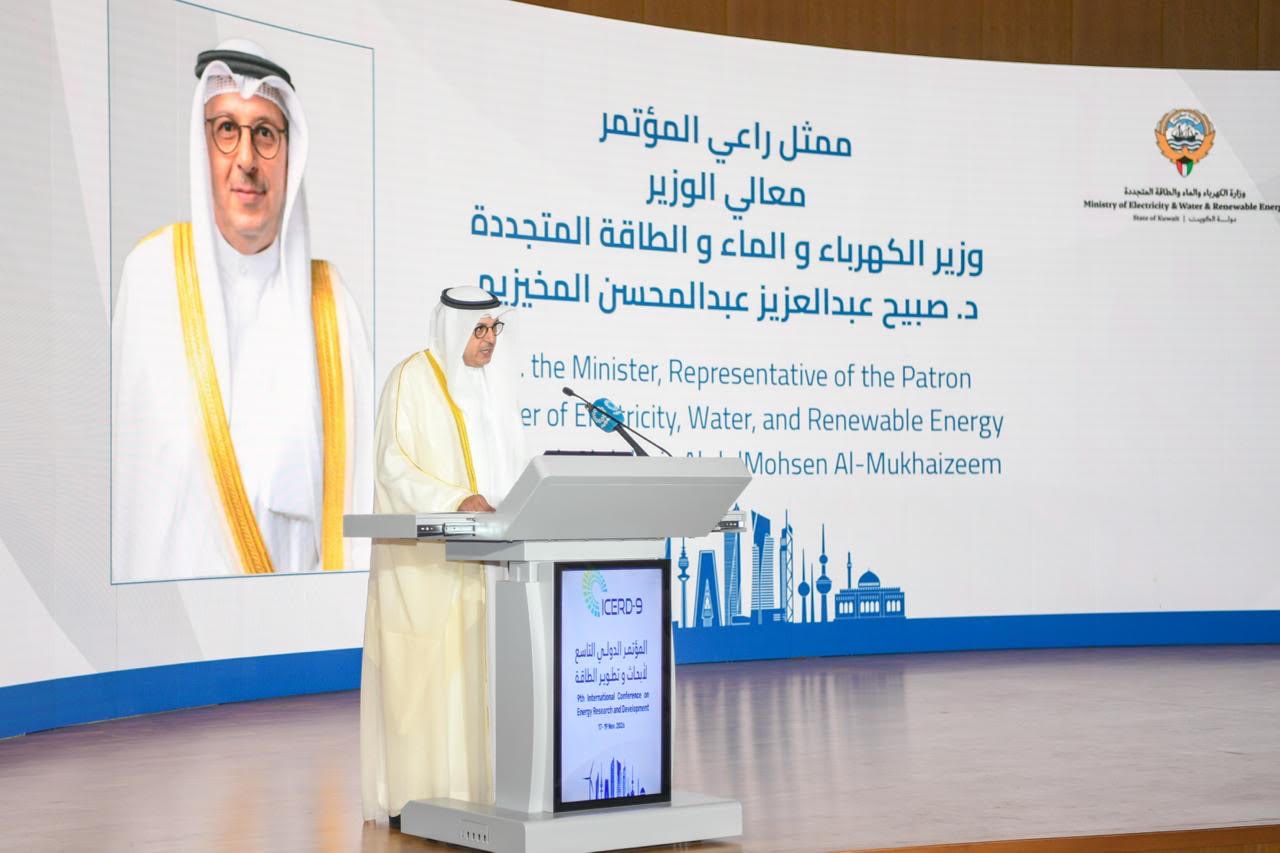
Minister of Electricity confirms implementation of major projects to increase electricity and water production
Translated by Alqyas from Al-Wasat — Original source
- Al-Milhem: The conference’s convening coincides with Kuwait University’s celebration of its 60th anniversary. - Al-Yousef: Local scientific research is essential to address climate challenges and achieve sustainability. The Minister of Electricity, Water, and Renewable Energy, Dr.
Sabih Al-Makhzoomi stated that the State of Kuwait is moving forward with the development of its electricity and water systems, increasing their production capacities, and enhancing their reliability by implementing major strategic projects and leveraging modern technologies, thereby meeting the country’s needs, supporting its development initiatives, and strengthening energy security and sustainability.
This was said in a speech delivered by Al-Makhzoomi on behalf of His Highness the Prime Minister, Sheikh Ahmad Al-Abdullah Al-Salim Al-Sabah, during the opening of the Ninth International Conference on Energy Research and Development, organized by Kuwait University under the patronage of His Highness the Prime Minister, and attended by a distinguished group of scientists, researchers, experts, and specialists in the energy sector from within Kuwait and abroad.
Al-Makhzoomi noted that the Ministry has made significant strides in implementing electricity and water production projects, most notably the signing of the contract for the North Al-Zour Power and Desalination Plant project, covering its second and third phases, with a production capacity of 2,700 megawatts of electricity and 120 million imperial gallons of water per day. He also mentioned the launch of the first phase of the Al-Khiran Power and Desalination Plant project, with a production capacity of 1,800 megawatts of electricity and 33 million imperial gallons of fresh water per day.
Regarding renewable energy projects, Al-Makhzoomi emphasized that the Ministry is paying special attention to the Al-Shaqiya Renewable Energy Project, which is considered a strategic initiative to diversify electricity generation sources and enhance sustainability. He clarified that the total production capacity of the first and second phases amounts to 1,600 megawatts, while the total production capacity of the third and fourth phases reaches 3,000 megawatts.
Al-Makhzoomi affirmed that His Highness’s patronage of this scientific event reflects Kuwait’s interest in scientific research and its support as a fundamental pillar for developing the energy sector and enhancing its capacity to keep pace with development requirements and future challenges.
He explained that the conference takes place at a time when the need to develop energy systems and achieve a balance between supply security, economic efficiency, and environmental sustainability is growing. He noted that this responsibility requires long-term planning, investments in infrastructure, and the application of scientific research to find practical, implementable solutions.
He pointed out that the conference topics cover a wide range of issues related to energy transformation, management, and conservation, as well as energy storage technologies, policies, and planning, alongside renewable energy, emerging technologies, and the efficiency of generation, air conditioning, and cooling systems, as well as plant safety.
He highlighted that these topics are of particular importance to Kuwait and regional countries in light of climatic conditions and rising cooling demand, which leads to increasing loads on the electricity system. He explained that developing air conditioning technologies and improving energy efficiency in buildings represent two areas where scientific research can have a direct and tangible impact.
He added that these projects reflect the Ministry’s direction toward increasing production capacities, leveraging modern technologies, and enhancing partnerships with the private sector, thereby supporting electricity and water security and contributing to building a more sustainable future for Kuwait.
He confirmed that the Ministry is simultaneously working to improve the operational efficiency of plants and networks, develop control systems and technical services, enhance demand management, and promote energy conservation. He stressed that every improvement in energy efficiency contributes to conserving resources, reducing loads, and optimizing the use of existing and future investments.
Al-Muxaim stressed that achieving a gradual and balanced transformation in the energy sector requires close cooperation among government entities, universities, research institutions, and the private sector, ensuring that research priorities are directed toward operational, planning, and development needs.
For her part, Kuwait University President Dr. Dina Al-Milhim affirmed that the patronage of the Prime Minister for the conference reflects the political leadership’s interest in education and scientific research, and its commitment to empowering academic and research institutions to contribute to the progress of Kuwait and the realization of its developmental aspirations. Al-Milhim noted that the conference continues a scientific journey spanning 27 years, held every three years to serve as a platform for exchanging knowledge and expertise and for forecasting the future of energy. She highlighted Kuwait University’s pride in organizing the event in collaboration with the American Society of Heating, Refrigerating and Air-Conditioning Engineers (ASHRAE), with the participation of academic and research institutions, government entities, and the private sector.
For his part, Conference Organizing Committee Chairman Dr. Osama Al-Yousef emphasized that the conference represents an important scientific platform for discussing challenges related to energy security and efficient energy use, particularly in the arid regions of the Arabian Peninsula, which experience high temperatures and significant electricity consumption for air conditioning.
Al-Yousef stated that global geopolitical shifts have demonstrated that energy security is no longer measured solely by resource abundance, but by the ability to diversify energy sources, enhance efficiency, and possess the knowledge required to develop sustainable solutions. He clarified that the region’s climatic conditions, with summer temperatures exceeding 50 degrees Celsius, make reliance on imported solutions alone insufficient, underscoring the necessity of developing local scientific research tailored to the environment’s characteristics and needs.
