940,000 Palestinians live in flood-prone areas in Gaza
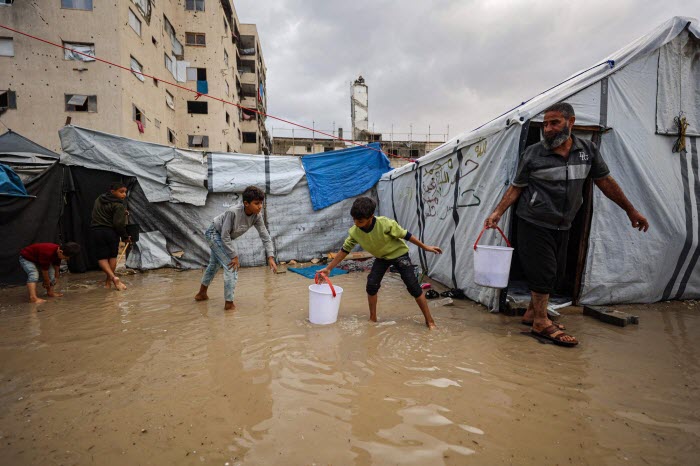
Relief associations warn of health risks for Gaza displaced persons due to flooding and accumulation of supplies
Translated by Qiyas from الوسط — Original source
Charities and aid organizations have warned of a lack of protection amid health concerns for more than 940,000 displaced people living in flood-prone areas of the Gaza Strip. Aid agencies reported that tens of thousands of Palestinians were left in waterlogged and damaged tents after deadly storms over the weekend, while 150,000 new shelters remain held outside Gaza, awaiting Israeli approval for entry. At least four Palestinian children and a woman were killed by heavy rain and winds that battered fragile, leaking tents. Thousands were left without shelter, and sewage infrastructure was destroyed, with wastewater flowing into people’s tents. According to the Palestinian Ministry of Health, one child drowned in floodwaters, and at least three children and their mother died when a sand dune collapsed onto their tent over the weekend.
This comes as Israeli airstrikes and gunfire killed five people in the Gaza Strip two days ago, while overnight strikes killed at least one person, according to the Associated Press.
“Cold is killing our children”
Raed Jamal, a displaced Palestinian, said, “All our clothes got wet. All my children are sick, and I can’t afford to buy them new clothes... Watching them suffer in the cold is heartbreaking.”
He added, according to Britain’s Guardian newspaper, “These conditions are extremely difficult. All night long, I had to use pots to collect rainwater because it was falling on us.” He said the winds shake his tent while rain seeps through holes in its roof.
Aid workers warn that diseases will spread rapidly unless families are quickly provided with new shelter and heating.
The British-based charity Medical Aid for Palestinians (MAP) expressed concern over rising health problems, as families live in waterlogged tents with nowhere else to go.
More diseases
Mai Al-Awawda, communications officer for MAP in Gaza, said, “Our medical teams expect to see more respiratory illnesses and other health complications related to cold, dampness, and crowded conditions. We fear more children will die from hypothermia, as happened last winter.”
According to the United Nations, 940,000 people in Gaza are in flood-risk areas, living in temporary tents without protection from heavy rain. The flood threat has worsened because stormwater pumping facilities are not operating due to a lack of electricity.
ShelterBox, a charity operating in humanitarian crisis zones, said the tents it usually provides during emergencies have been waiting outside Gaza for about two years, forcing it to improvise with shelters made from plastic sheets and wooden pallets. However, it stated that even these materials are being restricted.
A spokesperson for ShelterBox said, “The recent devastating floods affecting displaced people in Gaza clearly demonstrate the urgent need for more durable shelter improvements before winter arrives.”
He continued: “Overreliance on emergency solutions, rather than building shelters from more durable materials, simply means that many people are living in shelters unsuited to withstand the weather conditions experienced in the region, and these shelters will quickly deteriorate.”
Supplies piled up at crossings
The United Nations said that 26,000 families requested assistance after the rains, and that at least 3,900 families are now completely without shelter.
Gaza’s Palestinians are enduring their second winter since a ceasefire agreement was reached more than a year ago, but aid workers said conditions are no better than last year, due to Israeli restrictions on “dual-use materials” and bottlenecks at crossings that limit vital supplies for shelter construction.
A spokesperson for ShelterBox said: “It is extremely difficult to deal with, because there is also no clear process for these items. There is a level of unpredictability; one day toolkits are allowed entry, and the next day they are not, and they do not say why.”
Pressure on Israel
The Arab-British Understanding Council called on the British government to pressure Israel to allow supplies into Gaza and to reverse restrictions on humanitarian workers, including reinstating the licenses of dozens of organizations such as Doctors Without Borders, Oxfam, and the Norwegian Refugee Council, according to The Guardian.
In a related development, Joseph Willits, head of parliamentary affairs at the Arab-British Understanding Council (CAABU), said: “Winter rains and floods—which were anticipated—have struck Palestinians already suffering from catastrophic conditions, with disease and malnutrition widespread. Obtaining even a simple tent has become extremely difficult due to restrictions imposed by Israel, an artificial shortage resulting from deliberate policies.”
