IRGC Reveals 'New Underground Missile City'
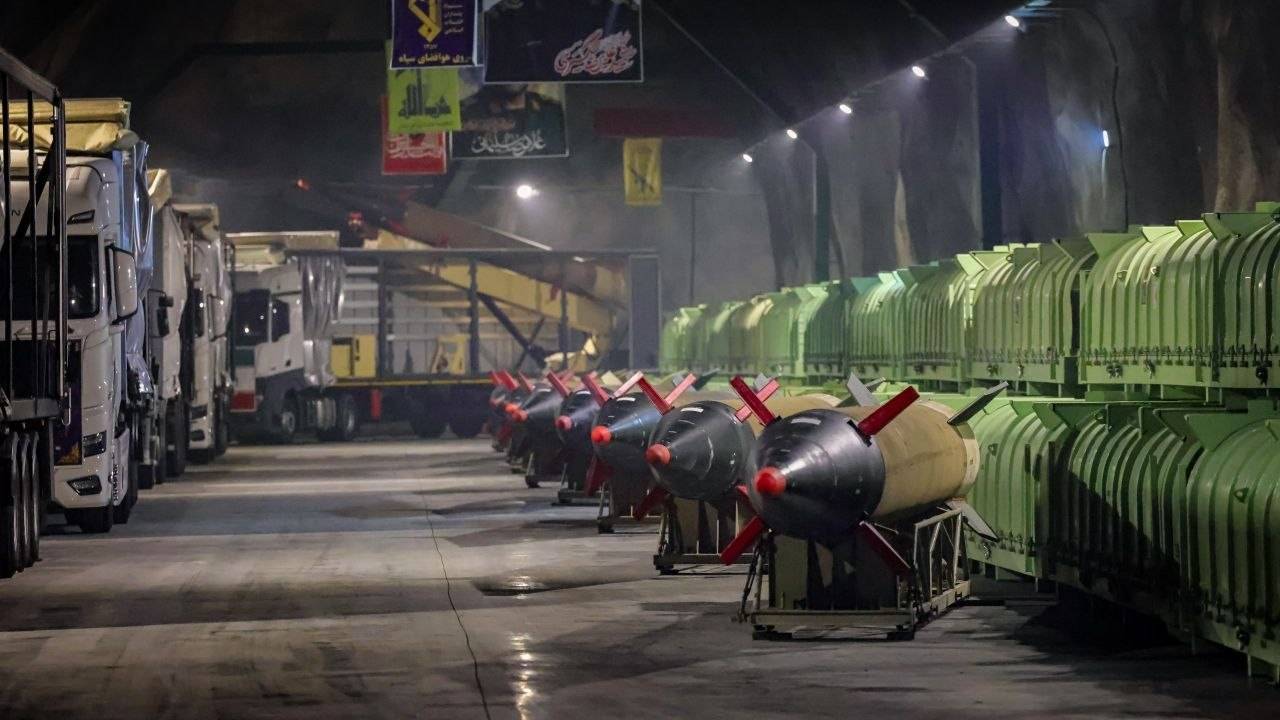
The Iranian IRGC unveiled an underground missile city to enhance deterrence, while US President Donald Trump described Iran's military capability as vanishing.
Translated by Qiyas from الوسط — Original source
The Islamic Revolutionary Guard Corps (IRGC) unveiled a new underground “missile city” and displayed new weapons, hours after U.S. President Donald Trump stated that Iran is “militarily finished.”
Iranian media published photos and video clips on Tuesday showing a tour by Major General Ali Abdollahi, Chief of Staff of the Armed Forces and Commander of Operations, and Majid Mousavi, commander of the IRGC’s missile unit, inside one of the facility’s tunnels. The media did not specify the location of the facility or the number of missiles it houses. During the tour, which state media described as taking place in a “strategic missile city,” Abdollahi said that “the impact of advanced missiles on the battlefield will surprise the enemies.”
The images showed ballistic missiles inside underground tunnels, warheads, missiles mounted on mobile launchers, as well as missile and drone storage facilities. No officials other than Abdollahi and Mousavi appeared in the footage.
The images, broadcast by Iranian state television, showed an underground missile city at an undisclosed location, with missiles ready for launch.
Official Iranian news agencies reported that the two commanders inspected parts of the complex and reviewed the “capabilities and operational readiness” of the missile units. The agencies described the “missile cities” as part of the country’s defensive infrastructure, stating that they play a role in “enhancing deterrence and responding to potential threats.”
Among the weapons displayed was a missile described as “advanced and surprising,” without revealing its name, range, or specifications.
Earlier, on Monday, after meeting Qatari Prime Minister and Foreign Minister Sheikh Mohammed bin Abdulrahman Al Thani at the White House, Trump said Iran’s military manufacturing capacity had declined by about 85 percent. He added that Iran still produces “limited numbers” of missiles and drones. Trump said military action “does not seem absolutely necessary” at this stage, but Washington is “ready to move” if the situation changes. He spoke of “positive momentum” toward ending the war and noted that another aircraft carrier had arrived “loaded to the brim with new equipment.”
In an interview with CBS’s “60 Minutes” that aired on Sunday, Trump said he saw “no reason” to escalate fighting. However, on the same day, he told CNN that Washington had identified targets in Iran’s infrastructure, including 38 bridges, which it would strike if operations resumed.
On the same day, Iranian media reported a U.S. attack on Qeshm Island, with no comment from the U.S. side. A senior Iranian source told Reuters that the strikes hit radar systems, missile launch pad bases, and naval mine-laying systems.
Iranian state television had previously reported that the IRGC’s naval unit targeted four oil tankers in the Strait of Hormuz within 24 hours, and 11 tankers over the past ten days.
On Monday, Iranian Army spokesperson Mohammad Akbari Nia said the military doctrine was shifting toward an “offensive approach” in accordance with orders from Supreme Leader Mojtaba Khamenei. He clarified that the concepts of “effective response” and “no geographical restrictions” were being translated into “operational strategies,” and that military capabilities were being enhanced “without pause.”
Mohsen Rezaei, secretary of the Supreme National Security Council, responded to Washington’s remarks on negotiations, writing on the X platform that they were “floundering like a desperate gambler.” He called on the U.S. to “submit to the seven conditions Iran has repeatedly set.”
