Al-Faleh: Integrated national system for managing environmental risks
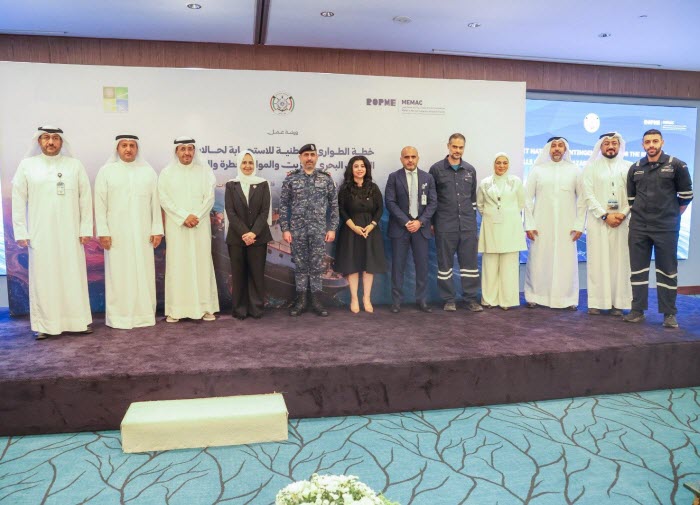
The Public Authority for Environment concluded a workshop on the National Emergency Plan for Responding to Marine Pollution by Oil and Hazardous Materials, attended by Minister of State for Development and Sustainability Dr. Reem Al-Faleh and Director General of the Coast Guard Administration, Commodore.
Translated by Qiyas from الوسط — Original source
- Al-Yousef: Protecting the marine environment is an integral part of the national security system - Al-Awadi: Regional cooperation is a cornerstone for enhancing responses to maritime incidents
With the attendance of State Minister for Development and Sustainability Dr. Reem Al-Faleh, Director General of the General Directorate of Coast Guard Rear Admiral Sheikh Mubarak Ali Al-Yousef Al-Sabah, and Director General of the Public Authority for Environmental Affairs, the Authority concluded a two-day workshop on the National Emergency Plan for Responding to Marine Pollution by Oil and Hazardous and Noxious Substances. This event is part of ongoing efforts to strengthen the country’s marine environmental protection system.
Protecting Biodiversity
State Minister for Development and Sustainability Dr. Reem Al-Faleh stated that “the marine environment constitutes a fundamental pillar of sustainable development, given its importance in protecting biodiversity, sustaining fish stocks, and preserving natural resources and the economic activities associated with them. Safeguarding it is a shared national responsibility that ensures the sustainability of these resources for current and future generations.”
She added, “In light of current regional developments, the esteemed Cabinet has directed the State Minister for Development and Sustainability, in coordination with relevant government entities, to monitor the national readiness level to address potential environmental risks and to provide the Cabinet with periodic reports on readiness levels and measures taken.”
She further noted, “In implementing this directive, work has been carried out with relevant state entities to build an integrated national system for managing environmental risks, based on identifying risks, clarifying roles and responsibilities, exchanging data, and monitoring national readiness and response plans. These efforts included preparing the National Register of Environmental Risks, cataloging and classifying eight major risks, and defining response pathways, thereby supporting proactive planning, protecting natural resources, and ensuring their sustainability.”
Emergency Plan
She considered that “updating the National Emergency Plan for Responding to Marine Pollution Incidents complements the state’s efforts in this field and translates environmental sustainability objectives into practical measures. The Public Authority for Environmental Affairs, in cooperation with relevant entities, has worked to develop and expand the plan to include hazardous and noxious substances, enhancing the state’s capacity to protect its marine environment and mitigate impacts that threaten its sustainability.”
For his part, Director General of the General Directorate of Coast Guard Rear Admiral Sheikh Mubarak Ali Al-Yousef Al-Sabah said that “this step represents an important move toward strengthening the maritime security and safety system and raising the national readiness level to deal with marine pollution incidents.” He expressed his gratitude and appreciation to “the Public Authority for Environmental Affairs and all participating entities for their efforts and cooperation in completing this national work.”
He added, “The history of the State of Kuwait is closely linked to the sea, which has served as a source of livelihood, a route for trade, and a witness to the struggles of fathers and forefathers.”
“The sea remains today a strategic resource linked to food and water security, as well as to the state’s economic interests and vital facilities.” He emphasized that “protecting the marine environment is not merely an environmental responsibility, but an integral part of the national security system, requiring coordinated efforts and complementary roles among various concerned entities.” He considered that “oil and hazardous material marine pollution incidents are challenges that demand prior preparedness.” He added, “From this perspective, the importance of the National Plan emerges as a unified framework that organizes the responsibilities of participating entities, and defines reporting, coordination, and response mechanisms, thereby ensuring swift implementation of necessary measures and efficient management of operations in the event of incidents.”
Supporting Field Operations He also pointed out that “this role extends to supporting field operations, facilitating the access of response teams and equipment to incident sites, overcoming obstacles that may hinder mission execution at sea or on the coast, as well as coordinating available resources among participating entities according to operational requirements and the needs of the on-site response commander.” He considered that “the strength of this plan lies in each entity’s commitment to its role, and our ability to operate within a single national system, bound by clear procedures and a shared objective.”
Swift Response For her part, Dr. Lujain Al-Sayegh, Head of the Sea Water Monitoring Section at the Water Quality Monitoring Department of the Public Authority for Applied Sciences and Technology (PAAST), affirmed that “the objective of the plan is to achieve a swift, well-considered, and effective response to incidents and the resulting impacts of oil and hazardous and harmful material pollution in Kuwait’s marine environment, in cooperation with various state entities involved in response efforts.” She clarified that “the most significant update in the plan is the development of the response system and the clarification of the roles and responsibilities of concerned entities, ensuring coordinated efforts and rapid incident handling.” She noted that the plan relies on three levels of response, depending on the scale of the incident and the required capabilities.
A Local Working Document In his speech, Captain Aref Aqil Al-Awadi, Director of the Regional Organization for the Protection of the Marine Environment (ROPME), said, “We gather today to jointly celebrate the handover of the ‘National Plan for Combating Oil and Hazardous and Harmful Material Spills in the State of Kuwait,’ and to launch the training and coordination workshop to activate this plan.” He stated that “the strength of this plan lies not only in it being a local working document, but in the fact that it was designed and built according to the highest international and global standards and references.” He concluded, “Our completion of drafting and handing over the plan today marks the end of the planning phase and the beginning of the most crucial phase: the activation and field readiness phase. This is where the importance of this workshop we are launching today arises, as we aim through it to: • Review and solidify roles and responsibilities: to ensure integrated coordination and complete harmony among all government and private entities when activating the plan. • Test communication and rapid response mechanisms: and exchange information in real-time and reliably. • Enhance the efficiency of national cadres: to ensure professional and rapid handling of any oil spill or chemical and hazardous materials to protect the country’s natural resources, economic assets, and vital facilities.”
