Saud Al-Nasser Diplomatic Institute hosts seminar on 'Arms and Security Trends in the Middle East'
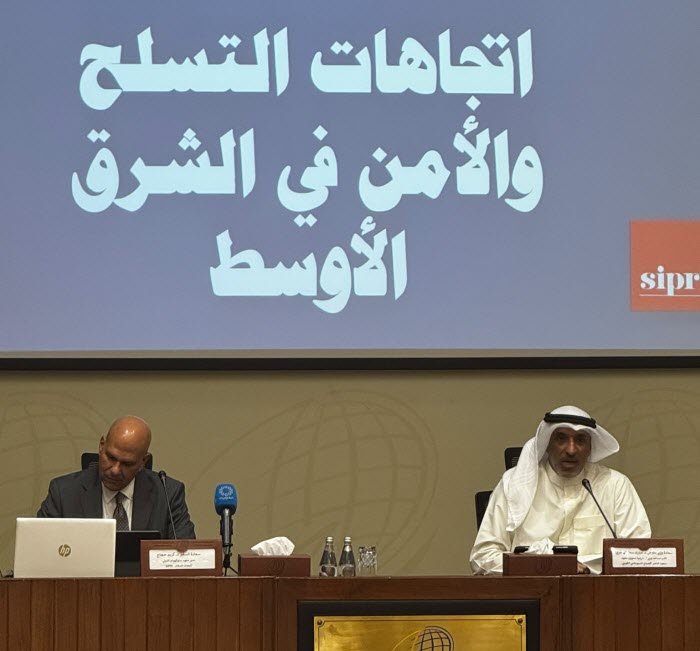
The Director of the Stockholm International Peace Research Institute (SIPRI), Ambassador Dr. Karim Hujaj, affirmed that the security and military landscape at both the international and regional levels is undergoing rapid transformations. These changes are driven by the return of conventional wars between states, escalating security competition among major powers, and the evolution of arms and military technology patterns, alongside the erosion of several pillars of the international system related to arms control, non-proliferation, international law, and multilateralism.
This statement was made during a seminar titled “Arms Trends and Security in the Middle East,” held at the Kuwait Institute for Diplomatic Studies (KIDS). During the event, Hujaj outlined the most significant shifts in the international landscape and their implications for regional security, addressing rapid technological and military developments and their repercussions on conflict trajectories and regional stability.
At the outset of his speech, Hujaj expressed deep gratitude to the Kuwaiti Ministry of Foreign Affairs for the kind invitation and the opportunity to attend the institute. He also extended his appreciation to Dr. Mubarak Al-Hajjar, Director of the Kuwait Institute for Diplomatic Studies, noting his pleasure at participating in the seminar in the presence of Assistant Foreign Minister for Asian Affairs, Ambassador Nasser Al-Sabah, praising his attendance and participation.
He specifically singled out Ambassador Nabila Al-Mulla, one of the pioneers of Arab diplomatic work, expressing his delight at meeting her. He joined Dr. Al-Hajjar in thanking Ambassador Mohamed Hayat, Kuwait’s Ambassador to Switzerland, who was unable to attend the seminar due to his recent assumption of duties at the embassy. Hujaj described him as an outstanding ambassador, a friend, and a cherished colleague, commending his efforts in organizing the event.
Hujaj clarified that Dr. Mubarak Al-Hajjar had provided such a comprehensive introduction to the Stockholm International Peace Research Institute that it obviated the need for a lengthy preamble. He explained that the institute specializes in all matters related to arms issues, monitoring their legal, technological, and strategic dimensions.
**Arms Trends and Middle East Security**
Hujaj stated that the lecture title, “Arms Trends and Security in the Middle East,” reflected three main axes: the first provided an overview of the international landscape; the second covered arms and security transformations in the Middle East; and the third focused on proposing a new approach to achieving regional stability.
He began the first axis with a brief review of international developments regarding arms issues, based on data monitored and tracked by SIPRI. He pointed out fundamental variables in the international landscape and in strategic thinking related to security and arms issues.
**Conventional Wars**
He explained that the world is witnessing a growing return to conventional wars between technologically advanced states, citing the Russian-Ukrainian war, which he described as the largest conventional war on the European continent since the end of World War II. He also mentioned the ongoing war in the Middle East between the United States and Israel on one side, and Iran on the other.
He noted that these developments are accompanied by another significant trend: the rise of US-led international alliances, whether in the form of collective alliances represented by NATO or bilateral alliances with certain Asian countries, including Japan, South Korea, and Taiwan.
**Security Competition**
He added that all of this is accompanied by intensifying security competition among major powers, intersecting with what he described as the most important development: the erosion of the pillars of the international system in general. He clarified that this erosion is evident in several areas, including the collapse of the arms control and non-proliferation regime, the declining role of international law, particularly international humanitarian law, the securitization of supply chains and critical materials, and the reduced effectiveness of multilateral frameworks.
He explained that these developments collectively explain the steady increase in global military spending, noting that the current landscape reflects an upward trend in spending on military capabilities and arms.
Hujaj emphasized that technological development is a key factor in current transformations in arms patterns. He highlighted several major developments, foremost among them advancements in missiles and unmanned aerial vehicles (UAVs), which are now used for multiple tasks, including executing precise strikes targeting the depths of enemy territory.
**Artificial Intelligence**
He touched upon the rapid development in the field of artificial intelligence, ranging from a focus on autonomous weapon systems capable of selecting targets without direct human intervention, to decision support systems used in military planning, target identification, and information analysis.
He also pointed to the evolution of cyber operations, including data system breaches, electronic warfare, and attacks on infrastructure, with a growing trend toward notably integrating artificial intelligence technologies into these operations.
He noted that outer space has also become an increasingly important domain for military operations, whether in surveillance, command and control, or missile defense systems. Additionally, he mentioned the development of conventional weapons capabilities approaching areas related to strategic nuclear weapons management.
**War Economics**
Hujaj discussed the major transformation in the economics of war and military manufacturing, highlighting two key points that underscore the importance of this shift. The first is the declining cost of technology and weapon components; the second is the ease of making technological systems available and employing them for military purposes, given that a large portion of these technologies originates in the civilian rather than the military sector.
He explained that this has caused a significant shift in the nature of arms, as modern military capabilities are no longer exclusively tied to technologies developed within military institutions. Instead, it is now possible to utilize many available civilian technologies for military applications. He noted that this development has also changed the nature of responses to weapons and accelerated the pace of military operations and related interactions, which has reflected on the nature of modern conflicts.
**Technological Developments**
Hujaj clarified that technological developments have narrowed the time gap between war and peace, accelerating and complicating the pace of military interactions. This has, in turn, reduced the time available for decision-makers to respond to events.
He explained that this development increases the likelihood of miscalculation and error in decision-making, heightens the risk of attacks, and raises the probability of escalation. He linked this to the multiplicity of escalation pathways, and consequently, the multiplicity of military risks.
He said these developments could lead to unforeseen consequences for concerned states and parties, including the potential involvement of neutral states in escalation scenarios. He also pointed to the blurring of lines between the civilian and military domains, between conventional and nuclear levels, and to an imbalance between defense and offense in favor of offense.
**Arms and Security Transformations in the Middle East**
Hujaj moved on to discuss arms and security transformations in the Middle East, noting that the region is witnessing phenomena similar to those observed at the international level.
He stated that the first of these phenomena is the return of armed wars between states, citing the war between Iran, Israel, and the United States, following approximately three decades dominated by irregular wars, whether in the form of civil wars or foreign interventions in those conflicts.
He explained that conflicts in the region have recently acquired a more existential nature, which is reflected in the nature of armed wars and the calculations of various parties, as well as affecting the nature of military and security preparations.
He noted that these transformations occur within a broader context related to cooperation between states and societies, aid, and efforts aimed at achieving stability, and attempts to identify opportunities to enhance cooperation and utilize resources and capabilities to achieve security.
**Military Spending**
Hujaj revealed that total military spending in the Middle East reached $218 billion in the previous year, representing a 36 percent increase over the past decade.
He said these figures reflect a number of important transformations and repercussions, foremost among them the increasing rates of an arms race in the region. He clarified that the pattern of arms is no longer limited to relying on defensive means; rather, there is now competition among regional states in the field of arms and the development of military capabilities.
He added that the region is also witnessing the emergence of new patterns of deterrence and proactive military doctrines. He pointed out that one of the most prominent examples in this context is the shift in Israeli military doctrine from the concept of deterrence to seeking the complete destruction of the enemy.
He explained that there are also transformations in the military doctrines of several regional states, citing Iran, which, according to his presentation, has transitioned from a focus on defense to adopting offensive and proactive capabilities. This represents a significant shift in deterrence patterns and risk management at the regional level.
