Kuwait Expands Use of Robotic and Remote Surgery to Enhance Healthcare Quality
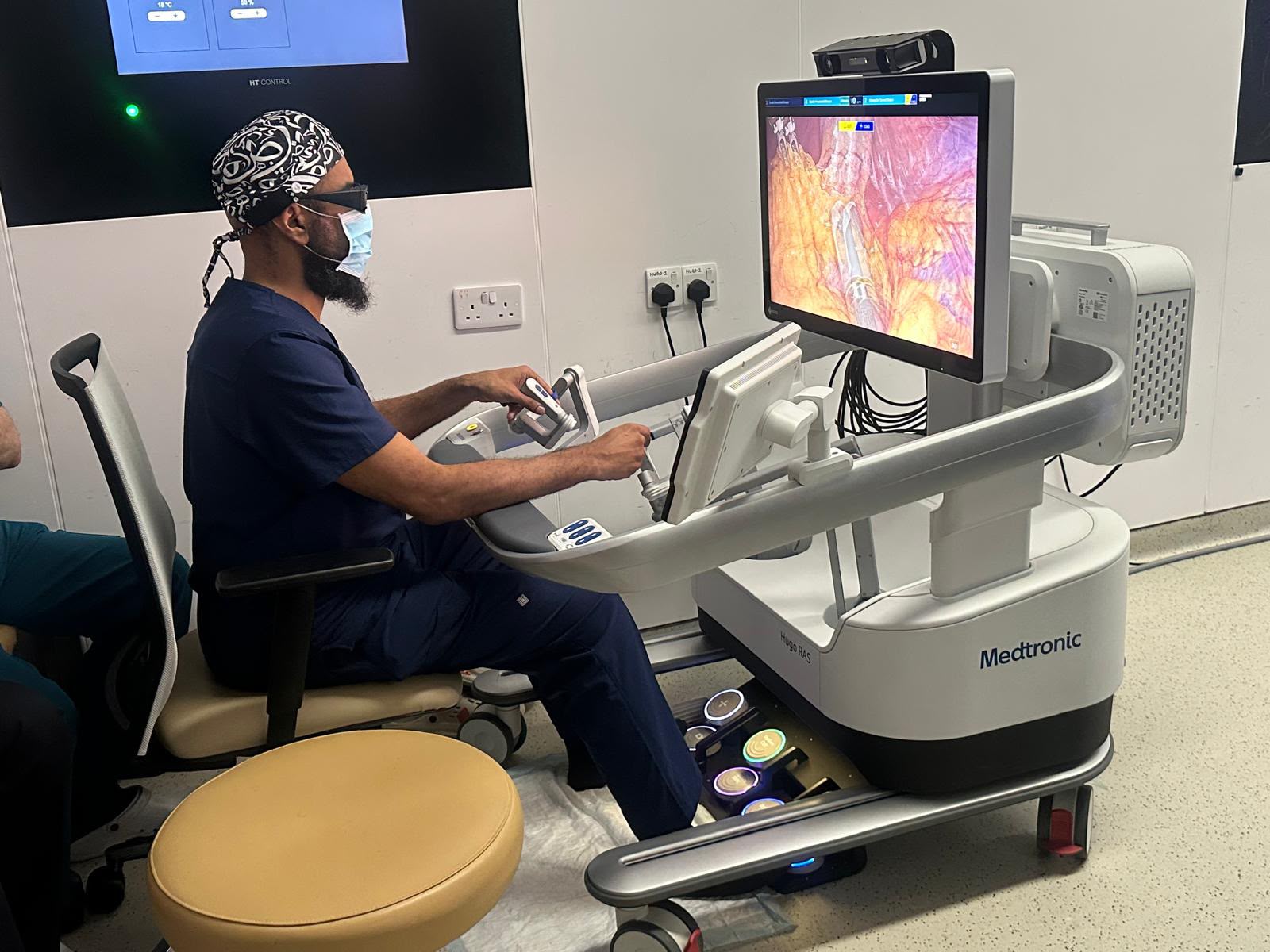
Undersecretary of Health Sheikh Dr. Salman Khalifa Al-Sabah confirmed the expansion of robotic and remote surgery in Kuwaiti hospitals, with international achievements in collaboration with Brazil, China, France, and Italy.
Translated by Qiyas from الوسط — Original source
The healthcare system in the State of Kuwait is witnessing increasing expansion in the adoption of modern and smart technologies in the medical sector, primarily robotic surgery and remote surgery. This development enhances the capacity of government and specialized hospitals to provide advanced therapeutic services and opens avenues for transferring medical expertise across different geographical locations within Kuwait and abroad.
Deputy Minister of Health Sheikh Dr. Salman Khalifa Al-Sabah emphasized that the development of surgical services relies on building sustainable national capacities that combine human resource efficiency, equipment quality, and practice safety. He stressed that the value of medical progress is measured by its contribution to the quality of care and patients' lives.
Speaking to the Kuwait News Agency (KUNA) on Monday, Sheikh Dr. Salman Al-Sabah stated that robotic surgery is currently implemented in several hospitals and specialized centers, including Sheikh Jaber Al-Ahmad Hospital, Al-Farwaniya Hospital, New Jahra Hospital, Chest Diseases Hospital, and Sheikh Sabah Al-Ahmad Hospital for Kidney and Urology. This reflects the diverse application of the technology according to therapeutic needs and the expertise of specialized medical teams.
He clarified that the robotic surgery journey at Sheikh Jaber Al-Ahmad Hospital began in 2019, witnessing expansion in specialties and expertise. By September 4, 2026, the number of performed surgeries reached 1,145, covering urology, bariatric surgery, upper gastrointestinal surgery, hernia, colon and rectal surgery, liver surgery, gynecology, and otolaryngology.
He added that the orthopedic surgery department at the hospital began performing robot-assisted surgeries in January 2024, with the number of cases exceeding 115. This reflects the extension of applications to orthopedic surgeries and the growing national expertise in this field.
At New Jahra Hospital, he noted that the robotic surgery program launched with the first surgery on April 27, 2025, reaching a total of 155 surgeries by September 6, 2026, in general surgery, urology, and specialized surgeries. These procedures included colon and kidney tumor removal, reconstructive surgeries, bariatric surgeries, and abdominal wall hernia repairs. He highlighted the completion of 100 surgeries in less than six months from the start of operations, reflecting the rapid acquisition of expertise and the integrated performance of surgical and nursing teams.
He pointed out that Chest Diseases Hospital also utilized robots in chest and heart surgeries, performing 30 chest surgeries and 25 heart surgeries within specialized robotic applications.
**Remote Surgeries**
The technological expansion was not limited to robot use within operating rooms but extended to remote surgery, enabling the utilization of specialized expertise by linking different geographical locations within Kuwait and abroad.
The Deputy Minister of Health stated that Sheikh Sabah Al-Ahmad Hospital for Kidney and Urology began performing remote robotic surgeries on December 20, 2024, successfully conducting 15 procedures, including 12 international surgeries and three local surgeries linked within Kuwait.
He explained that the international surgeries were distributed among eight from Shanghai, China; two from Strasbourg, France; one from Muscat, Oman; and one from Padua, Italy. Patients at the center in Kuwait received care from the medical team present beside them.
Among the documented cases, he mentioned a radical prostatectomy led by a Kuwaiti surgeon from Strasbourg for a patient at the Kuwait center, which was broadcast live during an international conference in July 2025, allowing for the display of national expertise and knowledge exchange regarding remote surgery applications.
Sheikh Salman Al-Sabah affirmed that these experiences highlight the capability of national cadres to utilize advanced communication technologies to provide specialized surgical services, emphasizing the importance of continuous direct patient care and the integration of roles among all medical team members.
**Cross-Border Surgical Cooperation**
In the field of international surgical cooperation, he mentioned a collaboration between Sheikh Jaber Al-Ahmad Hospital and the "Scula" center at "Cruz Vermelha" Hospital in Brazil. A medical team in Kuwait performed surgery on a patient in Brazil, an achievement documented by Guinness World Records on September 23, 2025, spanning a distance of 12,034.92 kilometers between the patient and the surgeon.
The cooperation also involved a medical team in Brazil performing a surgery on a patient in Kuwait, providing a model for mutual cross-border surgical cooperation.
At the local level, cooperation between the Gynecologic Oncology Unit at Sheikh Jaber Al-Ahmad Hospital and the Obstetrics and Gynecology Department at Al-Farwaniya Hospital resulted in three remote surgeries for patients with uterine cancer, announced by the Ministry of Health in October 2025. This reflects the potential to expand the utilization of specialized expertise among health institutions within the country.
Furthermore, in November 2025, cooperation occurred between the Surgery Department at Al-Farwaniya Hospital and Sheikh Sabah Al-Ahmad Hospital to treat a patient requiring gallbladder and left kidney removal. The gallbladder surgery was performed remotely from Al-Farwaniya Hospital while the patient was at the center, followed by kidney surgery performed by the urology team at the center, with a surgeon from Al-Farwaniya Hospital standing by the patient ready to intervene if necessary.
He clarified that this type of procedure relies on clear roles, preparedness to handle emergencies, and the integration of participating medical teams.
**Technology for Patient Service**
Regarding the impact of robotic surgery, Sheikh Salman Al-Sabah explained that these technologies offer potential to enhance vision, tool control, and the execution of precise tasks, potentially aiding in limited surgical interventions for suitable cases. He noted, however, that evaluating their impact on hospital stay duration and recovery requires monitoring outcomes based on the type of surgery, patient condition, and comparison with alternatives according to clear scientific indicators.
He stressed that the choice of technology should be based on patient interest and accompanied by result documentation and review, affirming that increasing the number of surgeries gains value when accompanied by sustainable quality and performance safety.
He stated that these achievements are the fruit of collective efforts deserving appreciation, emphasizing the importance of building upon them through continuous qualification, scientific evaluation, and enhanced cooperation among health institutions. He noted that every individual in medical, nursing, and technical teams contributes to the success of this system.
**Investment, Regulation, and Training**
Regarding strategic vision, investment, and regulation, the Deputy Minister of Health stated that the development of robotic surgery is linked to enhancing integration between health services and digital infrastructure, making medical expertise more accessible to those in need. He affirmed the importance of connection reliability, data protection, and system operational sustainability.
He added that investment evaluation includes equipment, training, maintenance, and supporting facilities, and that resource allocation should be linked to clinical need, usage efficiency, and outcomes, ensuring that technological expansion is coupled with sustainable operational capacity.
On the regulatory side, he stressed the importance of clear qualification requirements, professional responsibility, and informed consent, especially in cross-border surgery, affirming that continuous regulatory compliance is essential to safeguard patient rights and define the responsibilities of participating parties.
He also emphasized the importance of gradual training, simulation, skill assessment, and experience exchange, including surgeons, anesthesiologists, nursing staff, and technical teams. He explained that developing advanced simulation capabilities enables the preparation of cadres and training to handle emergency situations before facing them clinically.
Regarding malfunctions or connection interruptions, he clarified that any expansion in remote surgery should be based on a clear emergency plan, a qualified team beside the patient, and the ability to transition to appropriate alternatives when necessary, with readiness testing and training on response.
**Patient Trust as a Priority**
Sheikh Dr. Salman Al-Sabah affirmed that building patient trust begins with explaining the doctor's role and control over the robotic system, providing clear and understandable information about benefits, risks, and alternatives, and disclosing the location of the surgeon and the care team, alongside respecting privacy and listening to the patient's experience.
He stated that Kuwait's ambition is to consolidate a national medical capability that combines science, expertise, and responsibility, utilizing cooperation and technology to serve humanity, thereby reflecting on patient safety and quality of life and enhancing Kuwait's presence in the health sector.
The expansion in robotic and remote surgery is part of a broader trend to develop the healthcare system in the State of Kuwait, invest in national medical cadres, and qualify them according to the latest standards, while continuing to introduce modern technologies and develop digital and regulatory infrastructure to support the provision of advanced health services and enhance the health sector's capacity to keep pace with global developments in treatment, surgery, and prevention.
