Nepal Floods: Warning of Meltwater Risks Amid Global Warming
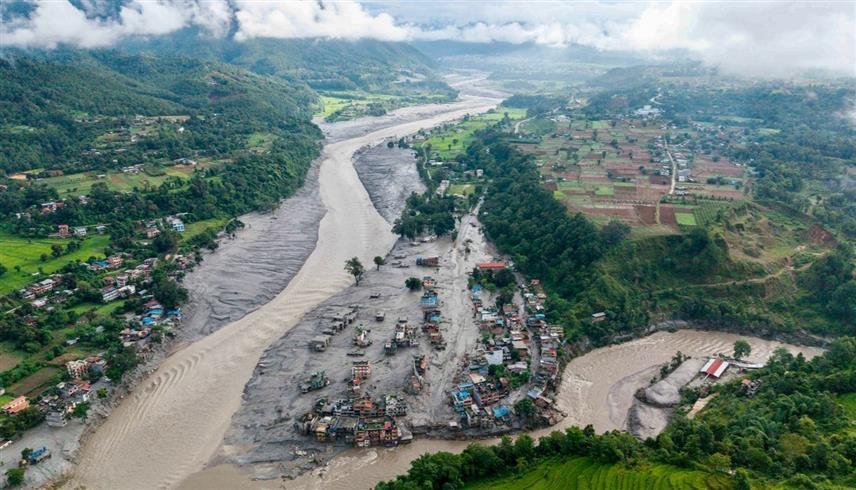
Geologists said that the floodwaters that killed hundreds in Nepal and China on Wednesday may have been triggered by a landslide from a glacier after it melted, viewing it as a harbinger of the dangers posed by melting ice in a warming world. The Washington Post reported: “High-resolution images taken by Planet Labs, a satellite monitoring company, show the landslide site visible high in the Himalayas, near the Nepal-China border. The image before the collapse shows a glacier about 4,000 feet above a narrow valley, feeding into the winding Lindi River.” It added: “Afterward, the glacier appears to have shrunk by about two million square feet, equivalent to the area of 25 professional soccer fields, and the valley appeared covered in ice and mud, swollen beyond its banks, and submerged in murky brown floodwaters along with surrounding vegetation.” Simon Cook, a glaciologist at the University of Dundee who was part of the team that analyzed the Planet Labs images, said: “You can imagine this large mass of ice sitting in a high place with a lot of potential energy. When it breaks off and crashes into the valley floor, all that ice turns into smaller pieces and a massive amount of water.” The report noted that the tremors caused by the disaster were so strong that scientists initially thought they were an earthquake, although the U.S. Geological Survey ultimately concluded that the 5.2-magnitude seismic event was caused by a glacier collapse and debris flow. Nepal’s Department of Hydrology and Meteorology attributed the floods to a “rock and ice collapse.” Nepal Police announced on Thursday that the floods sweeping through Nepal had killed at least 177 people, while more than 800 remained missing, according to the National Emergency Operation Center. Nepal’s Department of Tourism also reported the loss of more than 600 tourists, including 65 Americans. In China, state media reported that at least three people had died and 265 remained missing. Surveillance camera footage showed a massive wave of water, rocks, and ice sweeping through a crowded border crossing, swallowing people and a multi-story building. Cook said the torrent likely reached the crossing about ten minutes after the initial ice collapse, giving people little time to escape even if there had been an early warning system. He noted that while more research is needed to determine the exact cause of this incident, the collapse of mountain glaciers is an exacerbating symptom of global climate change. He said: “High temperatures have led to the melting of permafrost and accelerated melting, making ice at high altitudes dangerously unstable.” In the past five years alone, glacier collapses have buried a Swiss village, killed 11 mountaineers in Italy, and caused floods that destroyed two hydropower stations and swept away at least 200 people in India. He pointed out that with around 200,000 glaciers clinging to mountain slopes worldwide, most shrinking at an unprecedented rate, there is no easy way to predict which ones will trigger the next disaster. Cook said: “We don’t know the exact cause in some of these cases, and if we don’t know the cause, it’s hard for us to monitor, because we don’t know what to look for. It’s a really complex problem.” Satellite images from the previous day showed that nearby glaciers were covered with snow, which had disappeared by Wednesday morning. Cook said that rapid melting likely caused large amounts of water to slide through cracks in the glacier and accumulate beneath the ice, forming a slippery layer that allowed part of the glacier to slide off the mountainside. Although the collapsed portion of the glacier was massive, Cook believes there may have been an additional source of water, perhaps smaller pieces of decaying ice buried higher up in the valley, which contributed to the flood. Such disasters are expected to become more common as the planet warms, particularly in the Himalayas, where temperatures are rising at nearly twice the global average. Cook said: “Glaciers will shrink and melt. Permafrost will warm, weaken, and degrade over time, and landslides and debris flows will increase. If we combine all of this, we can say that climate change will negatively affect the stability of these high mountain regions.”
