Truce on the Brink of Collapse: Washington and Tehran in a 'Who Blinks First' Race
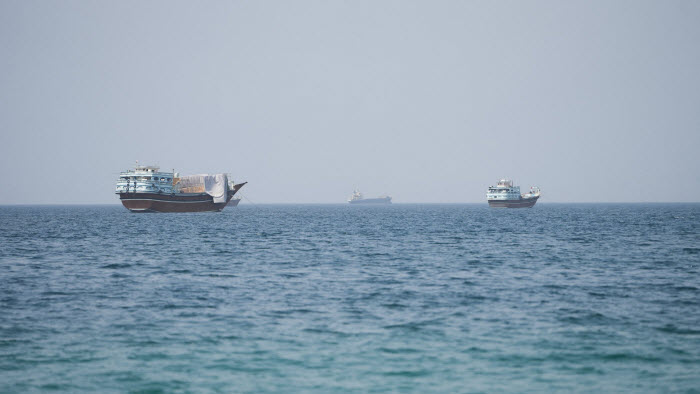
US Central Command (CENTCOM) announced the entry of the aircraft carrier USS George H.W. Bush into the Arabian Sea, marking the latest US naval movement in the region amid the ongoing maritime blockade of Iranian ports.
Translated by Qiyas from الوسط — Original source
US Central Command (CENTCOM) announced the entry of the aircraft carrier USS George H.W. Bush into the Arabian Sea, marking the latest US naval movement in the region amid the ongoing maritime blockade of Iranian ports.
With the expiration of the US-Iranian ceasefire memorandum deadline, Washington and Tehran appear less concerned with crafting a settlement than with testing each other’s capacity to endure pressure.
Several news reports indicate that the United States is betting on the blockade and sanctions to choke Iran’s exports and economy, while Tehran is counting on disrupting navigation in the Strait of Hormuz and keeping energy prices high to pressure US President Donald Trump ahead of the midterm congressional elections.
While a US official described the negotiations as “stale,” a senior Iranian official denied the existence of actual talks to extend the truce, demanding that Washington first return to its commitments under the June agreement.
Thus, the confrontation has shifted from seeking a resolution to the nuclear file to a battle of economic and political wills, with each side attempting to buy time on its own terms. Consequently, the stalemate does not appear to signal a lack of strategy, but rather constitutes the strategy itself, according to several experts. Trump is buying time until the elections, while Iran is buying time until the cost of the Strait of Hormuz becomes higher than the cost of making concessions to it. The question is no longer who holds greater power, but which political system is less capable of enduring pain until the “opponent blinks first.”
The US administration attributes part of the negotiation impasse to the existence of three decision-making centers within Iran: the Islamic Revolutionary Guard Corps (IRGC), the religious establishment, and the government leadership. According to a US official quoted by Politico, an agreement with one of these centers does not guarantee the approval of the others, causing Iranian negotiators to change their terms or fail to provide implementable commitments.
However, characterizing the situation as merely a “factional struggle” may be an exaggeration. Disagreements within the Iranian system are real, particularly between a government focused on saving the economy and security institutions that view the conflict as a struggle for survival. But this does not necessarily imply three contradictory policies.
It is more likely that there is competition for influence and authority, accompanied by consensus on red lines: avoiding the appearance of surrender, maintaining the Hormuz card, and refusing to make nuclear concessions without the lifting of sanctions and the release of frozen funds.
Reuters reported in April on the growing influence of the IRGC in managing the war and negotiations, but also noted the cohesion of the hardline core around confrontation terms. Therefore, the current divergence can be understood as a combination of genuine institutional differences and a division of roles: the government keeps the door to mediation open, the religious establishment lends ideological legitimacy to the stance, and the IRGC uses force to raise the cost of rejecting Iranian demands.
Repeated US talk of “Iranian divisions” may also be part of the negotiating tactic, allowing Washington to place the blame for the stalemate on Tehran, while Iranian leadership uses its multiple centers to argue that any agreement requires a higher price to be marketable domestically.
