Libya: Complete burnout of a power station in Al-Zawiya following its targeting
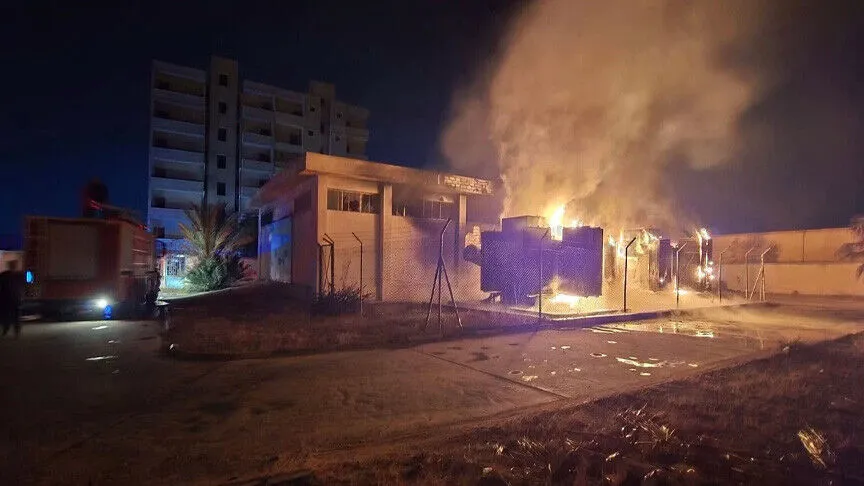
The General Electricity Company of Libya announced on Wednesday that a power station in the western city of Zawiya had been completely destroyed and taken out of service following an attack, as part of a series of strikes on critical infrastructure since last Saturday.
In a statement, the company said: "Substation 30/11, located south of Zawiya, was targeted, resulting in its complete destruction and removal from service. This has caused a loss of power supply to wide areas south of Zawiya city."
It added that technical teams affiliated with the company immediately moved to the site "to assess the extent of the damage, inventory it, and begin taking the necessary technical measures to address the consequences of the incident and work on restoring power to the affected areas."
The company warned of the "danger of continued attacks on power grid facilities and components, and the direct repercussions this may have on the stability of the national grid." It further noted that "the loss of additional substations, transmission lines, and energy components could lead to widespread disruptions in the system, potentially resulting in partial or total blackouts."
The company emphasized that the attacks and security disruptions witnessed in Zawiya during the recent period "have directly impacted the electricity sector." It explained that these incidents "have caused serious damage to several grid facilities and components, in addition to their direct impact on maintenance schedules for production units at the Zawiya power plant."
It continued: "Following today’s targeting of the Zawiya power plant (generation) facilities, the American company GE suspended all its operations at the plant and withdrew its technical teams from work sites until security conditions are confirmed."
The company stated that it "disclaims responsibility before the Libyan people for any consequences or damages that may befall the grid or affect the continuity of power supply, resulting from the continued targeting of its facilities and components or the inability to carry out maintenance and operational work in a secure environment."
It renewed its call on all relevant parties "to assume their responsibilities in protecting power generation and substations, energy transmission lines, and various components of the electrical grid, and to ensure the security of local and foreign technical teams working there."
Earlier on Wednesday, eyewitnesses told Anadolu Agency that an unidentified drone struck a power station in Zawiya at dawn, causing a fire and cutting off electricity to several neighborhoods.
Since last Saturday, critical facilities in Zawiya have been subjected to attacks of unknown origin by explosive-laden drones, with most strikes hitting the Zawiya Oil Complex, where large fires broke out.
On Tuesday evening, the National Oil Corporation (NOC) of Libya announced that the oil complex had been targeted for the fifth time by an explosive-laden drone that hit a fuel tank.
In a statement issued on the night of Monday/Tuesday, the NOC hinted at declaring a "force majeure" clause and completely halting operations at the Zawiya Oil Complex if the attacks continue.
"Force majeure" refers to a contractual clause (particularly in long-term gas and oil supply contracts) that allows the supplying party to exempt itself from contractual obligations (such as delivering shipments on time) without paying financial penalties, due to events entirely beyond its control, such as attacks.
As of 07:00 GMT, no party had claimed responsibility for the attacks.
On Tuesday evening, Libyan National Unity Government (NUG) Prime Minister Abdul Hamid Dbeibeh confirmed that those responsible for the attacks on oil facilities would be held accountable, vowing that "the matter will not go unanswered."
Two governments contest power in Libya. The first is the NUG, led by Dbeibeh, based in the capital Tripoli, which administers western Libya. The second, appointed by the House of Representatives in early 2022 and currently led by Osama Hammad, is based in Benghazi and administers eastern Libya and most of the southern regions.
For years, the United Nations Support Mission in Libya (UNSMIL) has been working to resolve chronic disputes among Libyan institutions that have prevented parliamentary and presidential elections in the oil- and gas-rich country.
Libyans hope that elections will end the political and armed conflicts and the continuous transitional periods that have persisted since the overthrow of Muammar Gaddafi’s regime (1969–2011).
