Saudi Crown Prince Emphasizes to Trump the Necessity of De-escalation as a Precursor to Diplomatic Solutions
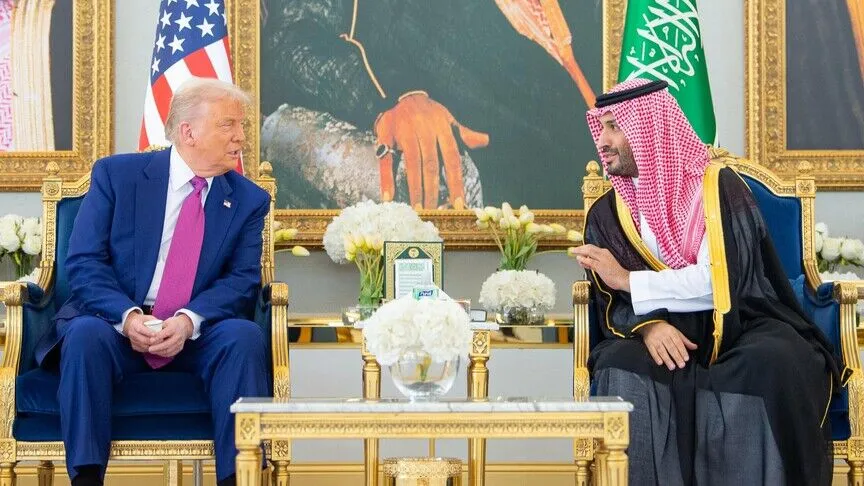
Saudi Crown Prince Mohammed bin Salman stressed the necessity of de-escalation in the region as a precursor to diplomatic solutions, at a time when the confrontation between the United States and Iran dominates the regio
Translated by Qiyas from الوسط — Original source
Saudi Crown Prince Mohammed bin Salman stressed the necessity of de-escalation in the region as a precursor to diplomatic solutions, at a time when the confrontation between the United States and Iran dominates the regional and international landscape. This came during a phone call he held with U.S. President Donald Trump, according to the official Saudi Press Agency (SPA), on Sunday.
The two sides discussed “developments in the region and their regional and international repercussions at various levels.”
The Saudi Crown Prince emphasized “the necessity of prioritizing dialogue to reduce tensions and making all possible efforts to achieve de-escalation.” He clarified that such de-escalation would “pave the way for diplomatic solutions that yield positive results to preserve the security and stability of the region, and prevent being drawn into a wider conflict whose repercussions would affect regional and international security and stability.”
On Sunday, Trump announced that he had agreed to cancel planned strikes against Iran, in exchange for reaching an agreement “quickly.” He stated via his platform, Truth Social: “Iran and other countries in the Middle East requested a deadline to complete an agreement that would lead to the immediate, full, and comprehensive reopening of the Strait of Hormuz, and the end of the Iranian nuclear threat.”
Washington and Tel Aviv accuse Tehran of possessing two programs, nuclear and missile, which threaten Israel and U.S.-friendly regional states, while Iran maintains that its nuclear program is peaceful, that it does not seek to produce nuclear weapons, and that it does not threaten other countries.
Israel, which occupies Palestine and territories in Lebanon and Syria, is the only country in the region possessing a nuclear arsenal, which is not officially declared and is not subject to oversight by the International Atomic Energy Agency (IAEA).
Trump added: “Based on this request, and for the sake of the future interest of the world, as well as for Iran’s continued success and prosperity, I agreed to cancel the attack, on the condition that an agreement is reached quickly.”
He warned that “the United States is on high alert and fully prepared to move against Iran.”
He noted that Israel shares his decision to suspend strikes, emphasizing that the decision remains conditional on the “ability to conclude a deal quickly.”
Earlier, on Friday, Trump announced that his country “would deliver very harsh strikes against Iran, until it says it can no longer endure.”
Between July 8 and 24, the United States launched attacks on Iran, and Tehran responded by attacking what it said were U.S. military facilities and equipment in Arab countries, particularly Jordan, Bahrain, and Kuwait.
Washington and Tehran had previously signed a memorandum of understanding on June 18 and began negotiations to conclude a final agreement, before disagreements erupted over guarantees for the freedom and security of navigation in the strategic Strait of Hormuz, which is vital for energy supplies and trade.
On February 28, the United States and Israel began an aggression against Iran, resulting in the deaths of more than 3,000 people, according to Tehran, which retaliated with attacks that killed Americans and Israelis.
