Hamas: Hope International Troops' Arrival Will Curb Israeli Violations
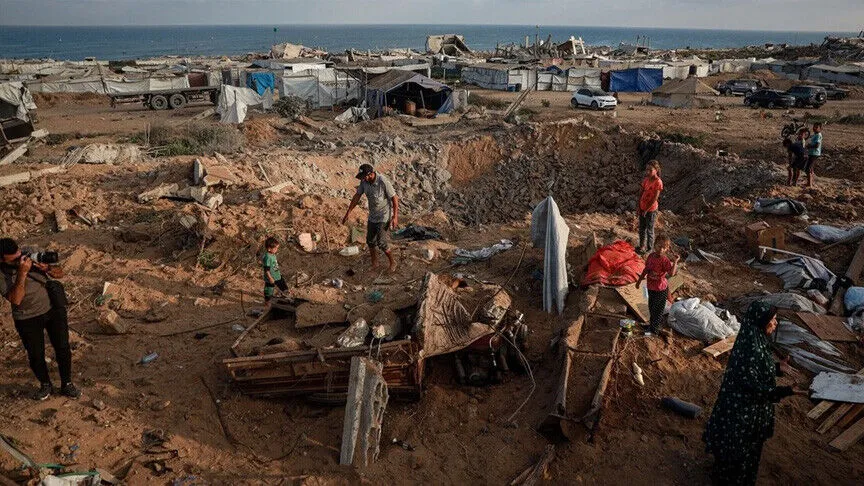
Hamas hopes the arrival of international forces will halt Israeli violations, while negotiations continue in Cairo.
Translated by Alqyas from Al-Wasat — Original source
Hamas expressed hope on Tuesday that the arrival of international forces would mark “the beginning of implementing their assigned tasks, which involve separating Palestinians from the occupation army and working to halt its violations” in the Gaza Strip. This came in a statement issued by Hamas spokesperson Hazem Qasem, following the announcement by the “Peace Council” regarding the arrival of the first tactical vehicles at the logistical support area known as “Endurance.”
“Endurance” is a logistical zone established in southern Israel near the Kerem Abu Salim crossing, not inside the Gaza Strip. It serves as a transit and support station for the International Stabilization Force (ISF), which will operate in Gaza, where vehicles, equipment, and personnel are received before being gradually transferred into Gaza, according to the Israeli channel I24 News.
Qasem said: “We hope that the Peace Council’s announcement regarding the start of the deployment of international forces in the Gaza Strip marks the beginning of implementing their assigned tasks, which involve separating our people in the Gaza Strip from the occupation army and working to halt its violations.”
The Hamas spokesperson called on the Peace Council to “begin the actual implementation of the ceasefire plan for Gaza, by introducing the National Administration for the Management of the Strip, providing genuine relief, and compelling the occupation to withdraw.” He also called for “the start of a reconstruction process, as it is an inherent right of all members of our people in all their locations in the Gaza Strip,” according to his statement.
Earlier on Tuesday, the Peace Council announced in a statement published on the American platform X (formerly Twitter): “Tactical vehicles have arrived at the logistical support area: Endurance.” The Peace Council attached images documenting the arrival of these vehicles to its post.
This announcement coincides with a visit by a Hamas delegation to the Egyptian capital, Cairo, to discuss approaches for implementing the ceasefire agreement in the Gaza Strip, amid continued Israeli violations of the truce. Earlier on Tuesday, Qasem told Anadolu Agency that a delegation from the movement was visiting Cairo to complete discussions and dialogues regarding the implementation of the ceasefire agreement. He clarified that Hamas and Palestinian factions had recently proposed “acceptable and logical approaches” to implement the agreement, noting that they had been “welcomed by the mediators.”
In this context, Al-Qahera Al-Youm (Cairo News) reported that a Hamas delegation had arrived in the Egyptian capital to resume negotiations on the roadmap for implementing the second phase of the ceasefire plan.
Meanwhile, Taher Al-Nunu, the political advisor to the head of Hamas’s political bureau, said in a statement that this round of negotiations “will include completing the discussion of the roadmap prepared by the Peace Council’s High Representative, Nikolay Mladenov, in cooperation with the mediator brothers, for the second phase of the agreement, the entry of the administrative committee and international protection forces, leading to the complete Israeli withdrawal from all territories of the Strip.”
On June 14, Hamas delivered the Palestinian factions’ response to Mladenov’s “roadmap,” emphasizing the necessity of a “complete” Israeli withdrawal from the Strip.
On May 21, Mladenov proposed a 15-point roadmap to implement the plan suggested by US President Donald Trump regarding the Gaza Strip. Mladenov’s roadmap outlines mechanisms for implementing files related to Gaza’s future, including reconstruction, disarmament, Israeli withdrawal, the operation of the International Stabilization Force, and the rebuilding of the police force. The roadmap stressed the necessity of “implementing measures promised at the start of the ceasefire, including humanitarian aid, fuel, crossings, and shelter, as well as measures outlined in the Sharm El-Sheikh understandings, before moving to the next phase.”
On September 29, 2025, it was announced
Trump’s plan to halt the Israeli war on Gaza consists of 20 points, including the release of Israeli hostages, the disarmament of Hamas, a partial Israeli withdrawal from the Gaza Strip, the formation of a technocratic government, and the deployment of an international stabilization force. The first phase of the plan entered into effect on October 10, 2025. While Hamas committed to fulfilling the requirements of the first phase, Israel reneged on its commitments and continued its attacks. Despite Tel Aviv’s reneging, Trump announced in mid-January the start of the second phase, which entails a broader Israeli military withdrawal and reconstruction efforts, in exchange for the beginning of the disarmament of armed factions—a step that Israel has also failed to implement, instead insisting on disarmament first. The ceasefire agreement was reached after two years of genocide initiated by Israel on October 8, 2023, with U.S. support, resulting in approximately 73,000 Palestinian deaths and more than 173,000 injuries, mostly among children and women, and causing destruction affecting 90 percent of civilian infrastructure.
