"Investment Guarantee": Arab Countries Own 2,900 Diverse Transport Ships
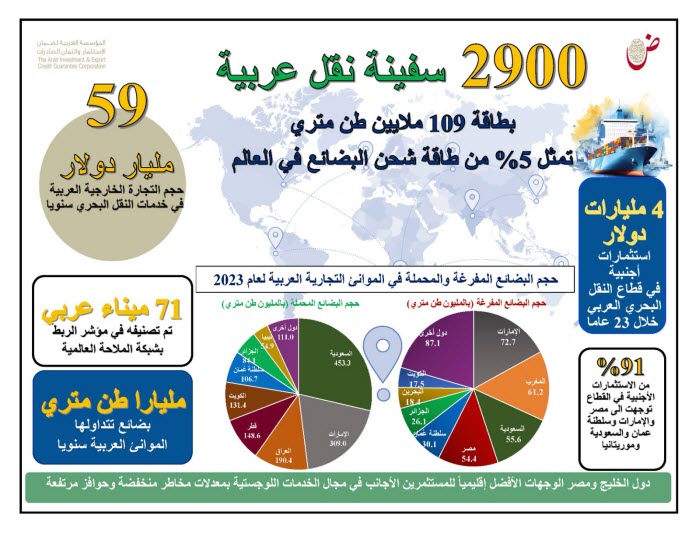
A report showed that Arab countries attracted 146 foreign projects in maritime transport.
Translated by Alqyas from Al-Wasat — Original source
The Arab Fund for Investment and Export Credit (Guarantee) revealed that the maritime transport sector in the Arab region attracted 146 foreign projects with an investment cost nearing $4 billion over the past 23 years, between January 2003 and December 2025.
In its fourth sectoral report for 2025 on maritime transport in Arab countries, issued from its headquarters in Kuwait, the Fund stated that five Arab countries—Egypt, the United Arab Emirates, the Sultanate of Oman, Saudi Arabia, and Mauritania—attracted 114 foreign projects during the same period, accounting for 78% of the total, with an investment cost nearing $3.8 billion, representing over 91% of the Arab total.
The report, which focuses on four main pillars—1. Fleet and Ports, 2. Trade in the Sector, 3. Foreign Projects in the Sector, and 4. Risk Assessments and Incentives—highlighted that Japan led as the most important investing country in the region’s maritime transport sector over the past 23 years, with a value exceeding $784 million and a share of 19% of the total, followed by Germany with a 16% share, and then the United States with a 15% share.
The report noted that the US-based Think Big Shipping and Logistics company led as the largest foreign investor in the region by investment cost, valued at $606 million and accounting for 15% of the total, followed by the German company Hapag-Lloyd with $581 million and a 14% share, and then the Belgian company CMA CGM with $550 million and a 13% share. These were followed by Taiwan’s Yang Ming, Japan’s Mitsui O.S.K. Lines, and Japan’s K Line, each ranking fourth with $371 million and a 9% share each.
Regarding intra-Arab investment in the sector, the report clarified that six Arab countries—the UAE, Saudi Arabia, Bahrain, Oman, Morocco, and Egypt—invested in 11 intra-Arab projects with a cost exceeding $218 million. Five Arab companies led the way, holding an 89% share of the total: Bahrain’s Kano Shipping, Saudi Arabia’s Triple F, and the UAE’s Abu Dhabi Ports, JAS, and Gulf Marine Services.
Based on the results of the logistics services sector risk assessment, the UAE, Qatar, Bahrain, Saudi Arabia, Oman, Egypt, and Kuwait ranked at the top of the Arab list for 2025, making them the most attractive destinations for investment in this field.
The report noted a 4% increase in the volume of the Arab commercial fleet, reaching 2,900 ships according to actual ship ownership in 2025. Additionally, the carrying capacity of these ships rose by 4.6% to reach approximately 109 million metric tons of deadweight tonnage in 2025, accounting for 5% of global shipping volume.
According to UNCTAD data, the report indicated that Arab ports handled more than 423 million metric tons of cargo in 2023 (with 58% in the UAE, Morocco, Saudi Arabia, and Egypt), compared to 1.6 billion metric tons of loaded cargo through Arab ports in the same year, representing a 14% share of the global total, with oil accounting for 58% of total loaded cargo.
It also pointed out a 19% increase in handling volume at 10 Arab ports in 2023 compared to 2019, reaching approximately 59 million twenty-foot equivalent units (TEUs), with more than half of handling activity concentrated in the UAE and Saudi Arabia.
The report revealed that the average Arab ranking in the Liner Shipping Connectivity Index improved during the fourth quarter of 2024, with the UAE, Morocco, Egypt, and Saudi Arabia leading the Arab region.
Seventy-one Arab ports were ranked in the Global Shipping Network Connectivity Index among more than 930 ports worldwide, with the ports of Jebel Ali, Tanger Med, Khalifa, Jeddah, Alexandria, Port Said, Dammam, Damietta, Salalah, and Casablanca leading the Arab region. Regarding foreign trade in maritime transport services for 11 Arab countries, the report noted a 12% increase, surpassing $53 billion in 2024 (accounting for 25% of total Arab trade in transport services), driven by a 14% rise in the value of maritime transport service exports from Arab countries to approximately $9 billion, and a 13% increase in imports to around $45 billion in 2024.
