Al-Shaigji... Discusses 'Nine Stories and a Story on the Gulf Novel'
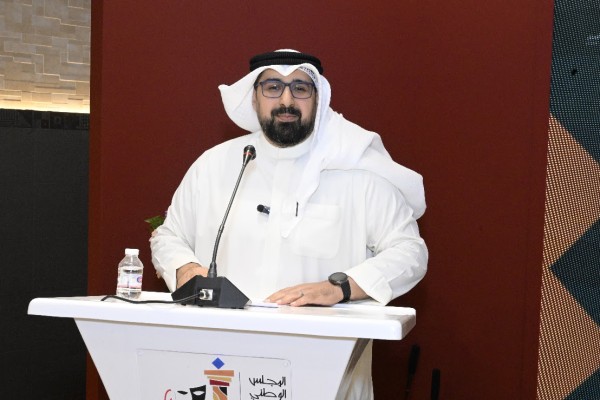
Kuwaiti author Hamoud Al-Shaigji reviews transformations in Gulf narrative and praises Zahrán Al-Qasimi's novels at the Book Fair
Translated by Alqyas from Al-Seyassah — Original source
The lecture was held at the Cultural Café and delivered in a narrative style.
On the sidelines of the 49th edition of the Kuwait International Book Fair, Kuwaiti writer and novelist Hamoud Al-Shaigi delivered a lecture titled “Nine Stories and a Story about the Gulf Novel.”
In the same vein, Al-Shaigi presented his lecture in a narrative style inspired by the spirit of “Scheherazade,” addressing the key intellectual, artistic, and social transformations that have shaped the contours of contemporary Gulf narrative literature.
At the outset of his talk, Al-Shaigi highlighted the danger of allowing culture and novelistic writing to fall prey to the obsession with fame and the logic of “trends” and social media, noting that reducing books to mere commodities subject to market laws threatens the essence of creativity.
He emphasized that the Gulf novel is no longer just an isolated creative act or a cultural luxury; rather, it has today become a “soft power,” an extraordinary diplomatic ambassador, and an economic resource.
Speaking about the trend among Gulf novelists toward historical writing, Al-Shaigi clarified that the return to the pre-oil era is not merely a romantic nostalgia for the past, but a necessity to demonstrate the historical depth of Gulf states and refute the notion of “emerging nations,” as well as to review history objectively and transparently, free from embellishment or falsification.
He showcased the richness of the Gulf novelistic environment, which has given narrative literature remarkable diversity, citing the five Gulf novels that won the International Prize for Arabic Fiction (the Arabic Booker). These works traverse the closed palace worlds in “Tarmi bi Sharrar” (Throwing Sparks) by Abdul Khal, the Meccan alleys in “Tawq al-Hamama” (The Ring of the Dove) by Raja Alem, questions of identity in “Saq al-Bamboo” (The Bamboo Stalk) by Saud Alsanousi, mysticism and wandering in “Mawt Saghir” (A Small Death) by Mohammed Hassan Alwan, and village and falaj worlds in “Taghribat al-Qafir” (The Exile’s Odyssey) by Zahrani Al-Qasimi.
