Khaled Saud Al-Zaid... intellectual beacons and creative paths
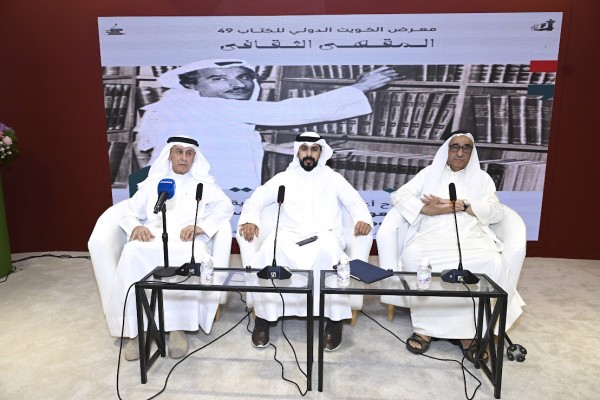
A seminar was held as part of the 49th Kuwait International Book Fair to evoke the biography of the writer Khaled Saud Al-Zaid and his achievements in documentation and literature
Translated by Alqyas from Al-Seyassah — Original source
During a seminar held as part of the 49th Kuwait International Book Fair
A thought-provoking seminar titled “Khaled Saud Al-Zaid: Intellectual Beacons and Creative Pathways” was held as part of the activities of the 49th edition of the Kuwait International Book Fair. The event recalled the biography of the late writer, poet, and historian Khaled Saud Al-Zaid, and his significant contributions to documenting the Kuwaiti literary movement and enriching the cultural landscape, through two sessions featuring a number of researchers, writers, and critics.
In his opening remarks, Dr. Mohammed Al-Jassar, Secretary-General of the National Council for Culture, Arts and Letters, emphasized the Council’s commitment to honoring figures of thought, literature, and the arts, and highlighting their achievements for future generations, in line with its mission to support culture, preserve heritage, and strengthen the presence of national memory.
He stated that the late Khaled Saud Al-Zaid represented a prominent Kuwaiti literary and intellectual figure who left indelible marks on the course of literature, culture, and history. He noted that Al-Zaid dedicated a significant portion of his life to documenting the literary movement in Kuwait, driven by his conviction that preserving cultural heritage is a national responsibility, and that documenting the history of literature is tantamount to documenting the nation’s memory and identity.
For her part, Dalal Al-Zaid, the late’s daughter, recalled the moral, human, and patriotic values her father instilled in his children. She affirmed that his legacy extended beyond his publications and his documentation of the literary movement, reaching into his educational and human impact on his family and circle.
In the first session, moderated by poet Abdullah Al-Filakaawi, “Personality of the Fair” Dr. Khalifa Al-Waqi’an presented a testimony titled “Testimonies on the Late Khaled Saud Al-Zaid.” He recalled Al-Zaid’s poetic beginnings at Al-Shuwaikh Secondary School in the mid-1950s, and the role of the cultural climate and teachers in nurturing his talent and refining his experience.
Al-Waqi’an pointed out that Al-Zaid stood out for his poetic talent, his eloquence, and his ability to take the stage, within an educational environment that included a distinguished group of Arab and Kuwaiti teachers who encouraged students to participate in poetry competitions and festivals and to write stories.
He recalled his friendship with the late Al-Zaid from that period, their participation in cultural and religious events, and Al-Zaid’s poetic quality and confidence in recitation, affirming that these beginnings contributed to shaping the contours of his literary experience.
For his part, writer Dr. Sulaiman Al-Shatti recalled four decades of literary and human relationship he shared with Al-Zaid, describing it as years of love, guidance, and support. He noted that his acquaintance with Al-Zaid began in the late 1950s, after he read a critical article by Al-Zaid in the newspaper “Al-Shaab” in 1958.
Al-Shatti explained that Al-Zaid was keen on providing him with cultural guidance, preparing for him a list of Arabic and foreign books on literature, criticism, philosophy, and history. They also shared daily sessions in Al-Zaid’s office at the Post Office, which featured literary and cultural discussions.
In a reading of the late’s documentary project, Dr. Abbas Al-Haddad presented a research paper titled “Khaled Saud Al-Zaid’s Project: From Synthesis to Documentation.” In it, he discussed Al-Zaid’s methodology for collecting, organizing, and interpreting the significance of texts and documents. He affirmed that his experience was not merely a process of retrieving heritage materials, but a cognitive project that contributed to shaping Kuwait’s cultural history and saving its literary memory from oblivion.
He noted that this interest culminated in his first published work, “Folk Proverbs,” which was released in 1961, after Abdullah Al-Hatim reviewed his personal collection of proverbs and requested that he write its introduction. For his part, Dr. Ali Ashour Jaafar presented a paper titled “Time and Its Manifestations in the Corpus of Khaled Saud Al-Zaid,” in which he examined the relationship between the historian, the poet, and the mystic in the late scholar’s experience, arguing that these were not scattered interests but rather paths converging in a single vision centered on time and the interplay of the past, present, and future.
He clarified that the encyclopedia “Kuwaiti Writers Over Two Centuries” represented a foundational work that transcended mere documentation, as it restored to cultural life the names of poets and writers marginalized by the passage of time, positioning them as partners in shaping national consciousness. He emphasized that Al-Zaid’s project was a form of resistance against oblivion before it was an act of historical writing.
The second session, chaired by Dr. Dalal Al-Baroud, was titled “A Reading of Khaled Saud Al-Zaid’s Poetic Experience” and focused on examining the artistic and intellectual dimensions of his poetry.
In his paper titled “Intertextuality in the Poetry of Khaled Saud Al-Zaid,” Dr. Fouad Na’na’ discussed the presence of religious texts, foremost among them the Holy Quran, as one of the most prominent sources that nourished his poetic experience, alongside Sufism, literature, history, mythology, and popular culture.
In the second track, Dr. Saad Masmouh presented a paper titled “Representations of Death and Martyrdom in the Poetry of Khaled Saud Al-Zaid,” in which he explored the concept of martyrdom as a resistant act that transcends the boundaries of the body, and which oppressive power cannot erase or diminish in value or undermine the meaning for which the individual sacrificed. Masmouh distinguished between two images of the martyr in Al-Zaid’s poetry: the first is the martyr of land and honor, who confronts oppression in defense of values and the nation; the second is the martyr of absolute truth, who transcends bodily centrality through annihilation in divine truth.
