Nasser Al-Mohammed: Francophonie is a Vital Space for Communication, Creativity, and Knowledge Exchange
Press coverage 5 newspapers covered this event: Al-Jarida · Al-Seyassah · Al-Qabas · Al-Nahar · Al-Wasat →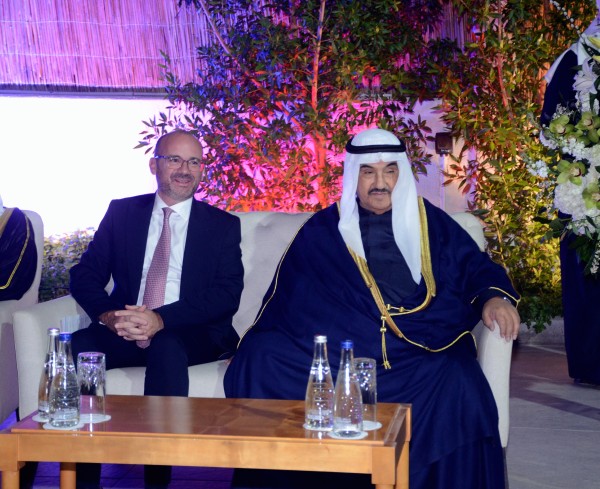
His Highness Sheikh Nasser Al-Mohammed appreciates the role of Francophonie in Kuwait
Translated by Alqyas from Al-Seyassah — Original source
His Highness emphasized at the conclusion of the month-long event that the French language does not compete with English but rather offers a model of linguistic and cultural integration.
Kuwait’s celebration of Francophonie over two decades reflects its growing importance.
Africa has become the beating heart of Francophonie and the main driver of its expansion.
The French language has contributed to shaping the concepts of the modern state and constitutions, as well as consolidating values.
Ambassador Gouvin: Kuwait is a sanctuary that embraces a "gem of a different kind," the French language.
His Highness Sheikh Nasser Al-Mohammed Al-Sabah, former Prime Minister and President of the Kuwait Council for the Promotion of Francophonie, affirmed that Kuwait’s celebration of World Francophonie Day over two decades reflects its growing importance in the region. He noted that although Kuwait is not yet an official member of the International Organization of Francophonie, it has a long and active history with the French language.
This statement was made in a speech delivered by His Highness in French yesterday evening during a reception hosted and attended by him at the residence of French Ambassador Olivier Gouvan, marking the conclusion of Francophonie Month 2026. The event was attended by ambassadors of member states of the organization, diplomatic corps members, a representative of the International Committee of the Red Cross, representatives from government entities, cultural institutions, and the private sector, as well as a select group of politicians, writers, artists, and media personalities.
His Highness pointed out that this year’s celebration coincides with the 38th anniversary of the launch of World Francophonie Day and the 56th anniversary of the organization’s founding, considering the continuity of the celebration over this period a success in itself.
He clarified that the celebration in Kuwait became annual since the beginning of the millennium, then expanded over the last two decades into a full month featuring spelling competitions, film screenings, sports tournaments, and discussion panels at the University of Kuwait. He noted that during the presidency of French leader Jacques Chirac, Kuwait witnessed the beginning of broadcasts by France 24 (International French Radio) via satellite.
Notable Successes
His Highness stated that the organization has achieved notable successes, most notably the continuous growth in the number of French speakers. He emphasized that Africa has become the "beating heart of Francophonie and the main driver of its expansion," viewing this as a shift that gradually moves the center of gravity of Francophonie from the banks of the Seine in Paris to the heart of the African continent.
He reviewed the 20th Summit of the organization, held this year in the Cambodian capital Phnom Penh under the theme "Reinvesting in Peace for Shared Prosperity and Sustainable Stability," a slogan reflecting Cambodia’s experience in overcoming wars to move toward reconstruction.
Organization’s Achievements
He added that the organization’s achievements extended to politics, education, and the economy. It adopted the "Bamako Declaration" in 2000, which for the first time linked membership in Francophonie with a commitment to democracy and human rights. The organization monitors elections and mediates conflicts, forming a voting bloc in the United Nations to defend the causes of developing countries. It also established the Agence Universitaire de la Francophonie (AUF), which includes more than a thousand universities and research institutes in over 110 countries, and the TV5Monde network, reaching hundreds of millions of households. Furthermore, it led UNESCO’s efforts to adopt the Convention on the Protection and Promotion of the Diversity of Cultural Expressions in 2005, alongside organizing the Francophone Games every four years, teacher training programs in Africa, and support for entrepreneurship and digital transformation.
His Highness emphasized that the French language has contributed to shaping the concepts of the modern state and constitutions, and to consolidating the values of freedom, citizenship, and human rights. He added that through it, modern philosophy underwent major transformations, from existentialism to postmodernism, and that in its space, the theater of the absurd and the "French New Wave" in cinema flourished. It also hosted the "Négritude" movement, which restored dignity to African identity.
French and English
He clarified that French, with the precision of its grammar, the rigor of its formulation, and its rational heritage influenced by Cartesian philosophy, has maintained its status in diplomacy and treaties, and remains present in the United Nations and the International Olympic Committee.
He continued that while English has become the language of finance, business, and technology, French retains a prominent position as a language of thought, critical analysis, philosophy, and literature. He noted that proficiency in it, alongside English, is a cultural and professional asset that opens wide horizons in regional and international institutions.
His Highness stressed that Francophonie is not a relic of the past, but a living space for communication, creativity, and knowledge exchange. He affirmed that, in the context of the global spread of Anglophonie, it does not seek to compete with or replace English, but rather to offer, alongside it, a model of linguistic and cultural integration. He stated that linguistic and cultural diversity is a source of richness for humanity, and that dialogue among civilizations is the foundation for building a more open, understanding, and peaceful world.
For his part, Ambassador Goufan affirmed that Francophonie in Kuwait has become a living reality reflecting the depth of historical and cultural ties between the two countries. He recalled the old pearl trade between Kuwaiti sailors and the Cartier house, saying that they never imagined that Kuwait, a haven of trade and tolerance, would one day become "a haven hosting a different kind of jewel: the French language."
He praised the efforts of His Highness Sheikh Nasser Al-Mohamed Al-Sabah in enhancing the presence of French in Kuwait, affirming that Francophonie is not merely an institutional framework, but a story of friendship and love that unites French with all its speakers.
He appreciated the commitment of Kuwaiti authorities to granting French a distinguished place in the educational system, and the efforts of the Ministry of Education and Anwar Al-Radwan, Director of the Technical Guidance Department for the French language, which contributed to expanding French instruction to include the tenth grade starting from the current academic year. He considered the scale of the French teaching program in Kuwait remarkable at the regional level.
400 Million
He clarified that Francophonie today unites more than 400 million people, a number that could reach 600 million by 2050. He added that it is a space for cooperation in education, culture, economy, innovation, and digital technology, offering young people new opportunities for study and work, and is based on values of solidarity, tolerance, justice, and inclusiveness.
He noted that Francophonie Month included events in sports, literature, cinema, poetry, and culinary arts, as well as visits by ambassadors and representatives of Tunisia, Canada, Belgium, Switzerland, and Armenia to public schools.
The ceremony featured a piano piece composed and performed by student Sharifa Al-Atiqi from Algeria School, and a performance by violinist Maria Artinyan.
For her part, Anwar Al-Radwan affirmed that the celebration is an occasion to honor French teachers, who serve as bridges conveying languages, cultures, and values among peoples, and contribute to preparing a generation open to the world.
She thanked His Highness Sheikh Nasser Al-Mohamed Al-Sabah for his attendance, the French Ambassador for his invitation, and the secondary school administrations for their warm reception of the Francophone delegation. She pointed out that language is not always translated literally, but understood within its cultural context, and that this is where the beauty and richness of learning foreign languages lie.
French in Kuwait
Towards
Decades of teaching, since its inclusion in government secondary schools in the 1960s.
1969: The Educational, Cultural, and Scientific Cooperation Agreement, and the establishment of the Voltaire Institute, the nucleus of the French Institute.
The French "Lycée": Established in the 1980s, it enrolls more than a thousand students of diverse nationalities.
More than a thousand Kuwaiti students learn French annually, thanks to the efforts of approximately 1,400 teachers.
The French Language Department at Kuwait University.
Francophonie by the Numbers
396 million French speakers, compared to 321 million in previous estimates, and 590 million projected by 2050.
French competes for fourth place globally with Arabic and Hindi, after English, Mandarin, and Spanish.
More than 170 million people learn French across the five continents.
65% of French speakers are in Africa, and every future speaker will be African.
Million speakers in the Democratic Republic of Congo, the largest Francophone country, surpassing France.
March 20, 1970: The Niamey Agreement and the establishment of the Agency for Cultural and Technical Cooperation, the nucleus of the organization, initiated by Habib Bourguiba, Léopold Sédar Senghor, Hamani Diori, and Prince Sihanouk, with the support of Charles de Gaulle and François Mitterrand.
