Kuwait calls on UN Security Council to take urgent action to confront famine and food insecurity caused by conflicts
Press coverage 2 newspapers covered this event: Al-Seyassah · Al-Qabas →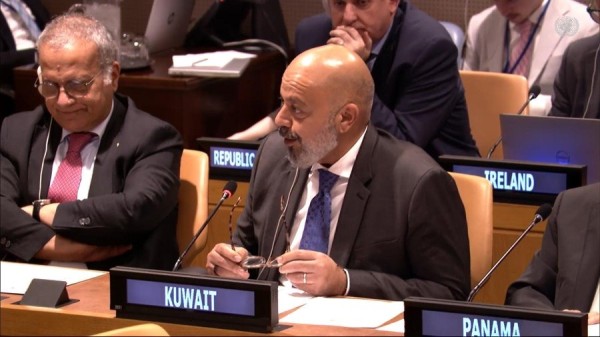
Ambassador Al-Bunai warns of worsening food insecurity due to conflicts
Translated by Alqyas from Al-Seyassah — Original source
The Permanent Representative of Kuwait to the United Nations, Ambassador Tariq Al-Banna, stressed the urgent need to take action to address food insecurity caused by armed conflicts and to ensure the unhindered delivery of humanitarian aid to civilians, warning that delays in responding to famine warnings will lead to further loss of life.
This statement was delivered by Ambassador Al-Banna on behalf of the four countries that drafted United Nations Security Council Resolution 2417 (2018): Kuwait, Côte d’Ivoire, the Netherlands, and Sweden, during a meeting held yesterday evening, Tuesday, under the “Arya” format, titled “Food Diplomacy and Conflict-Induced Food Insecurity: Enhancing Cooperation for Peace and Security.”
Ambassador Al-Banna stated that armed conflicts are among the primary drivers of food insecurity and famine, as ongoing fighting displaces farmers, disrupts their access to markets, and hinders the delivery of humanitarian aid to civilians, with long-term repercussions, particularly for women and girls.
In this context, he cited the Global Report on Food Crises 2026, which showed that the proportion of people assessed as facing crisis-level or worse acute food insecurity nearly doubled between 2016 and 2025, while the number of people experiencing catastrophic levels of hunger increased more than ninefold during the same period.
Al-Banna clarified that the Security Council unanimously adopted Resolution 2417 in 2018, which recognized the link between armed conflicts and food insecurity and famine, and strongly condemned the use of starvation of civilians as a method of warfare or the unlawful denial of humanitarian aid.
He emphasized the necessity for parties to armed conflicts to comply with international humanitarian law, allow the prompt and unhindered delivery of humanitarian aid, refrain from targeting civilians and facilities essential for food production and distribution, and ensure the protection of such infrastructure.
He noted that Resolution 2417 requests the UN Secretary-General to promptly inform the Security Council when risks of conflict-induced famine or widespread food insecurity are detected.
Al-Banna called on the Security Council to convene meetings without delay upon receiving such warnings, urged conflict parties to facilitate the delivery of humanitarian aid, protect food and water supplies, remove obstacles imposed on humanitarian agencies, and ensure that relief reaches those entitled to it.
During the same meeting, Ambassador Al-Banna delivered another statement in a national capacity, emphasizing that employing food diplomacy for conflict prevention requires ensuring the safety of supply chains and maritime corridors. He pointed out that the closure of the Strait of Hormuz clearly demonstrated how disruptions to navigation can pose a threat to food security within the Arab region and beyond.
He explained that disruptions in urea and other fertilizer shipments, rising shipping costs, and disruptions in natural gas supplies used in fertilizer production have increased agricultural production costs, negatively impacting crops and food prices, especially in import-dependent countries.
Al-Banna reiterated Kuwait’s strongest condemnation of Iran’s closure of the Strait of Hormuz and its obstruction of international navigation, as well as its attacks and threats against transport and commercial vessels in the strait. He stated that such destabilizing practices and activities constitute violations of international law and harm maritime security, international trade, energy security, and the global economy.
He called on Iran to fully implement United Nations Security Council Resolution 2817, and to immediately cease all actions and threats that obstruct legitimate transit or freedom of navigation in the Strait of Hormuz, or threaten maritime security in the Bab al-Mandab, emphasizing the importance of respecting navigational rights and freedoms in accordance with the United Nations Convention on the Law of the Sea.
Regarding the humanitarian situation in the Gaza Strip, Ambassador Al-Banna strongly condemned the restrictions imposed by the Israeli occupation on the entry of aid and essential supplies into the Strip, and the systematic exacerbation of hunger and increased suffering of civilians they cause. He demanded the immediate lifting of these restrictions and the facilitation of the rapid, safe, and widespread delivery of aid, strongly denouncing the situation in which civilians are forced to choose between starvation and surrender.
On the Sudanese issue, Al-Banna expressed deep concern over the escalating risk of famine in parts of North and South Darfur and North and South Kordofan, calling for an immediate halt to hostilities, the facilitation of cross-border and ceasefire-line aid delivery, and enabling farmers to safely engage in agricultural activities. He also called for urgent action to address acute hunger in Yemen, Somalia, Lebanon, and Syria.
Concluding his statement with a national perspective, Al-Banna emphasized that the credibility of the Security Council is measured by its responsiveness to the warnings and alerts it receives, stressing the necessity of its immediate action upon warnings of famine risks to open humanitarian corridors and save lives, as “families waiting for food today cannot wait for our consensus tomorrow.”
