Kuwait: Ambiguity of Israeli nuclear capabilities and Iran's program undermine regional stability and security
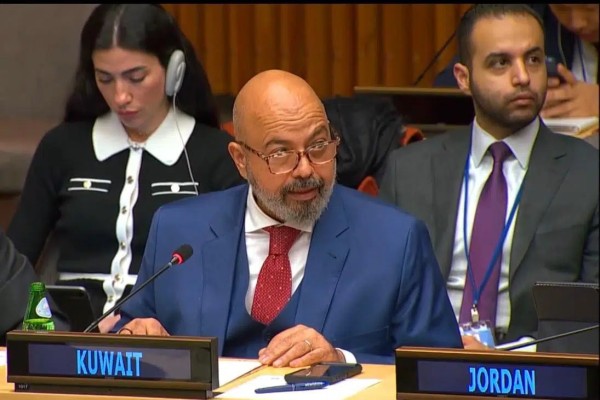
Ambassador Al-Binay condemns Iranian attacks and stresses the necessity of a nuclear-weapon-free zone
Translated by Alqyas from Al-Seyassah — Original source
Kuwait stated that the continued ambiguity surrounding Israel’s nuclear capabilities and growing concerns regarding Iran’s nuclear program increase the risks of miscalculation and escalation, undermining the confidence necessary to achieve security and stability in the Middle East.
This was expressed in Kuwait’s statement delivered by its Permanent Representative to the United Nations, Ambassador Tariq Al-Banna, on Monday evening, at the seventh session of the Conference on the Establishment of a Nuclear-Weapon-Free and Other Weapons of Mass Destruction-Free Zone in the Middle East, which is chaired by the Sultanate of Oman.
Ambassador Al-Banna said the region faces two main challenges, each fueling instability. The first is the ongoing ambiguity surrounding the nuclear capabilities of the Israeli occupation, which remains outside the framework of the Treaty on the Non-Proliferation of Nuclear Weapons (NPT) and the Comprehensive Safeguards Agreement.
He added that the second challenge lies in growing concerns about Iran’s nuclear activities and programs, as questions regarding their nature and level of transparency remain unresolved, amid insufficient cooperation with international verification mechanisms.
He warned that the security of the region cannot be built on capabilities beyond verification or assurances not backed by concrete measures, emphasizing the need for clear commitments, full transparency, effective international oversight, and consistent application of non-proliferation rules to all parties without selectivity or exceptions.
Ambassador Al-Banna renewed Kuwait’s call for the occupying entity to join the Treaty on the Non-Proliferation of Nuclear Weapons and to subject all its nuclear facilities and activities to the International Atomic Energy Agency’s (IAEA) Comprehensive Safeguards System.
He called for resolving outstanding issues to allow verification of the peaceful nature of Iran’s nuclear program, in accordance with international laws and IAEA frameworks.
He noted that the Middle East is experiencing highly dangerous security conditions, where armed conflicts intertwine with the risks of nuclear proliferation, while confidence in the ability of international mechanisms to ensure compliance with existing obligations is waning. This makes the establishment of a nuclear-weapon-free and other weapons of mass destruction-free zone in the region more urgent than ever.
In this context, Ambassador Al-Banna strongly condemned Iranian attacks on Kuwait, Gulf Arab countries, and Jordan, which targeted their populations and vital infrastructure, affirming that most countries in the world have denounced these attacks.
He clarified that these attacks and the tensions and confrontations currently witnessed in the region are a direct result of leaving files unresolved.
He pointed out that the expansion of confrontations, originally stemming from nuclear issues, to include direct Iranian attacks on Gulf Arab countries unrelated to any ongoing escalation, has contributed to destabilizing the global economy and using international waterways as a weapon.
He added that this has provided an excuse for militias and factions operating outside state frameworks in Iraq to carry out hostile actions against Kuwait and Gulf countries, driven by their own beliefs and objectives, thereby expanding and exacerbating the conflict.
Al-Banna stressed that establishing a nuclear-weapon-free and other weapons of mass destruction-free zone in the Middle East is an urgent necessity to enhance regional security and stability, emphasizing the importance of reaching clear, transparent, and legally binding international commitments that ensure the non-proliferation of these weapons in the region.
He expressed Kuwait’s hope that the current session of the conference will contribute to broadening consensus on the elements of a future treaty, building upon the technical discussions held by the Working Committee during its past three meetings regarding commitments, prohibitions, declarations, and verification.
Ambassador Al-Binai reiterated his affirmation that Kuwait will continue to work toward taking practical steps to establish the zone, considering it a necessity for the security of the Middle East and a fundamental pillar for safeguarding international peace and security.
