Chinese Ambassador: Kuwait is an Important Partner for Our Country in the Gulf
Press coverage 1 newspapers covered this event: Al-Qabas →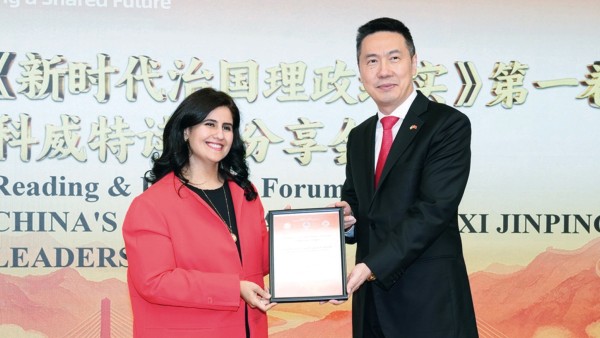
Reaffirmations on enhancing cooperation in technology and culture between Kuwait and China
Translated by Qiyas from السياسة — Original source
He affirmed that aligning the “Belt and Road” initiative with “Kuwait Vision 2035” has yielded tangible results.
Our economy is now the second largest globally... and we have succeeded in lifting 800 million people out of poverty.
President of the Artificial Intelligence Association: Kuwait-China relations enter a new phase in technology.
Al-Anoud Al-Sabah: Cultural cooperation and digitization of heritage strengthen historical ties spanning 55 years.
Yang Xing, Ambassador of the People’s Republic of China to Kuwait, affirmed that Kuwait represents an important partner for his country in the Gulf region, emphasizing China’s readiness to work with the Kuwaiti side to implement the agreements reached by the leaders of both countries, deepen the exchange of expertise in state management and governance, and enhance mutually beneficial cooperation across various fields to achieve shared development.
This statement was made during a reading session for the first volume of the book “China’s Governance under the Leadership of Xi Jinping,” organized by the Xinhua News Agency office in Kuwait in collaboration with the Chinese Cultural Center and the Chinese publisher “China Intercontinental Press,” attended by a number of personalities and stakeholders interested in cultural and developmental affairs.
Xing clarified that Kuwait-China relations have witnessed significant development in recent years, under the strategic guidance of Chinese President Xi Jinping and His Highness the Amir Sheikh Meshal Al-Ahmad Al-Jaber Al-Sabah. He noted that the deep alignment between the “Belt and Road” initiative and Kuwait Vision 2035 has yielded tangible results in various fields of practical cooperation.
He affirmed that China adheres to a policy of openness and mutually beneficial cooperation, and continues to provide new opportunities for the world through its economic development, stressing his country’s commitment to strengthening the partnership with Kuwait and expanding the horizons of bilateral cooperation.
Speaking about the book, Xing said that understanding contemporary China requires understanding the Communist Party of China, explaining that the first volume includes 26 Xinhua reports that showcase China’s experience in governance and administration and its journey toward modernization and development.
He pointed out that China has achieved historic economic and social transformations, rising to the second-largest economy in the world, and successfully lifted 800 million people out of poverty, while affirming the continued development of the governance system, strengthening discipline, and combating corruption to achieve long-term developmental goals.
For his part, Sheikh Mohammed Ahmed Al-Sabah, Chairman of the Board of Directors of the Artificial Intelligence Association, affirmed that Kuwait-China relations are based on a long history of friendship and mutual respect, and have evolved from traditional trade exchanges to broad cooperation in energy, investment, infrastructure, and culture.
He explained that the technological progress achieved by China, alongside Kuwait’s developmental ambitions under Vision 2035, opens wide horizons for establishing partnerships in smart cities, energy, healthcare, education, and scientific research.
He stressed that the future of Kuwait-China relations should not be measured solely by the volume of trade or the number of joint projects, but by the knowledge produced by both countries and the progress and opportunities they create for future generations.
He highlighted the importance of cultural cooperation in enhancing understanding between the two peoples, noting that Arab and Chinese civilizations share entrenched values in valuing science, education, and hard work, and that technology has become a new bridge for communication between civilizations.
For her part, Sheikh Dr. Al-Anoud Al-Sabah, representative of the Kuwaiti-Chinese Friendship Club Foundation, affirmed that cultural cooperation between Kuwait and China, particularly in preserving and digitizing heritage, constitutes a fundamental pillar for sustaining bridges of human communication and civilizational exchange, and for strengthening the historical ties between the two countries, which are celebrating the 55th anniversary of the establishment of their relations.
She explained that culture has served as a driving force behind China’s modern renaissance, noting that President Xi Jinping’s cultural vision is based on integrating a five-thousand-year-old civilizational heritage with contemporary innovation, while preserving national identity and remaining open to other civilizations.
