Lebanese President: Priority is Continuation and Renewal of UNIFIL Mandate
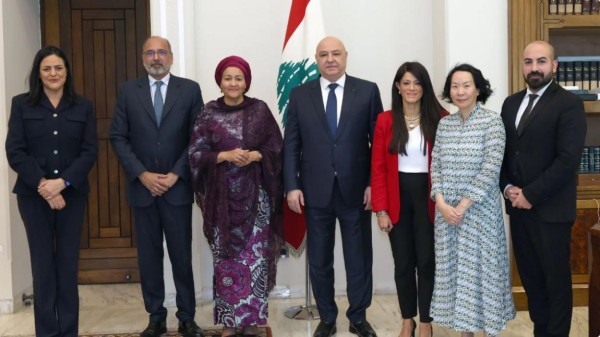
President Aoun affirmed the continuation of the UNIFIL mission and UN support for Lebanon in reconstruction and recovery.
Translated by Qiyas from السياسة — Original source
Lebanese President Joseph Aoun affirmed on Saturday that Lebanon’s priority remains the continuation of the United Nations Interim Force in Lebanon (UNIFIL) mission and the renewal of its mandate, while remaining open to discussing the development of its operational scope in light of field requirements and emerging circumstances.
In a statement, the Lebanese Presidency said that President Aoun emphasized, during his meeting with UN Deputy Secretary-General and Head of the UN Sustainable Development Group, Amina J. Mohammed, at the Presidential Palace, the importance of the role played by international forces in the south in terms of security, as well as their logistical and engineering capabilities and their relations with local communities.
He clarified that if the mission cannot continue in its current form by 2027, Lebanon insists on the necessity of UNIFIL continuing to carry out its tasks throughout the transitional period specified for its withdrawal, or working to establish an alternative mechanism under the UN umbrella “to ensure that no security or institutional vacuum occurs in the south.”
President Aoun stressed that International Resolution 1701 must remain the legal reference and foundation for any future international arrangements in the south, calling on the UN to support Lebanon in preserving this framework and ensuring the continuity of an effective international presence.
He noted that “Article 10 of the Tripartite Framework Agreement” constitutes a fundamental entry point for addressing the issue of the state’s monopoly on weapons, through a comprehensive approach that is not limited to the military aspect but also includes political, social, economic, humanitarian, and developmental dimensions.
He explained that addressing this issue sustainably requires providing conditions that enhance citizens’ trust in the state and its institutions, and ensure their security, services, and opportunities for a decent livelihood, pointing out that focusing solely on military solutions is insufficient to achieve the desired objectives.
President Aoun pointed to the possibility of reconstructing three areas partially damaged by attacks, noting that the financial cost of rehabilitating them “remains relatively limited, whereas the impact of this step could be significant in encouraging the return of residents and strengthening their trust in the state, by demonstrating its ability to respond to their needs and consolidating the presence of its institutions as the primary reference for citizens.”
He expressed his appreciation for UN support, affirming that his country looks forward to continuing close cooperation with the UN, not only to maintain stability and prevent any vacuum in the south, but also to support the return of displaced persons, reconstruction, economic recovery, strengthening state institutions, and building a more stable future for Lebanese citizens.
The Lebanese Presidency conveyed the UN Deputy Secretary-General’s affirmation that the UN remains by Lebanon’s side, emphasizing the importance of keeping the situation it is experiencing at the forefront of international attention and closely monitoring developments, particularly in light of the transitional phase related to the future of UNIFIL forces.
The UN official stressed that a vacuum in the south cannot be allowed due to its direct repercussions on the population and stability, affirming the UN’s interest in the return of residents to their areas, supporting recovery and reconstruction, strengthening Lebanese state institutions and their ability to exert authority and provide services to their citizens.
She emphasized the importance of adopting an integrated approach that addresses the root causes of crises and their humanitarian and social repercussions, citing international experiences that showed that restricting oneself to security and military approaches, without accompanying them with developmental, humanitarian, and institutional efforts, leads to the continuation of the population’s suffering.
The initiative, being implemented by the United Nations to support mental health and respond to the psychosocial needs arising from the crisis in Lebanon, emphasized the importance of strengthening international support in this area and encouraging more officials and international partners to visit Lebanon and assess firsthand the scale of the challenges faced by Lebanese citizens.
The Lebanese Presidency noted that the meeting also addressed international efforts to support Lebanon at the political, economic, and humanitarian levels, in light of the involvement of the World Bank, the International Monetary Fund, and other international partners in recovery and reform processes. It underscored the importance of “working in parallel on the political, security, economic, and humanitarian tracks and on reconstruction, and not linking progress in one track to the achievement of the others.”
