Suad Al-Sabah House Publishes 'To Write the World as a Woman'
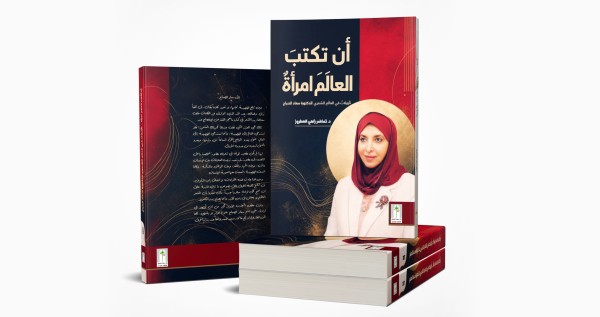
Publication of the book 'To Write the World as a Woman' by Dr. Tamader Zahi Al-Atrooz, which philosophically and critically examines Suad Al-Sabah's poetic experience.
Translated by Alqyas from Al-Seyassah — Original source
A new journey into the poetic world of Suad Al-Asbahani is undertaken by Professor of Modern Language and Linguistics, Dr. Tamadur Zahi Al-Atrouz, in her new book, “A Woman Writes the World: Interpretations of the Poetic World of Dr. Suad Al-Asbahani,” recently published by Suad Al-Asbahani House for Culture and Creativity.
In this book, Al-Atrouz presents an in-depth critical and philosophical study of the poet Suad Al-Asbahani’s poetic experience, spanning approximately 300 pages in large format, organized into four main chapters titled by the author as “Journeys,” followed by a dedicated critical chapter, an introduction, and a conclusion. The book’s central thesis argues that Suad Al-Asbahani’s experience is not merely an expression of traditional feminism or nationalism, but rather a “cognitive event and existential act” that reconfigures the world and language, reclaiming humanity’s right to name things.
The book begins with “The First Journey,” which examines psychological rhythm and its semantic dimensions in the poet’s work, demonstrating that her rhythm is not merely metrical but a conscious, individual imprint that breaks free from collective molds. It also explores the cultural and philosophical dialectic between the center and the periphery, tracing how the female subject in her texts transforms from an “object of description” into a “source of vision” and a creator of civilization and language.
“The Second Journey” shifts to a different philosophical horizon through an analysis of the logic of absence and sovereign systems, illuminated by the “Theory of Linguistic Zero.” In “The Third Journey,” the poem undergoes a historical trial through an interpretive reading of the collection *Fatafat Imra’a* (Trifles of a Woman), contemplating the dialectic of annihilation and immortality, and how poetry resists the disintegration of existence and the shocks of time by reclaiming the authority of writing and ink. This journey also includes a pragmatic analysis of the poem “Salam ‘Alaykun” (Greeting to You All, a Discourse of Resistance), employing speech act theory, dialogical implicature, and argumentative mechanisms.
“The Fourth Journey” concludes the book by discussing the concept of the homeland as an ethical conscience rather than merely a geo-political space, drawing inspiration from the poem “Three Urgent Telegrams to My Homeland,” where ethics, existential generosity, and human solidarity become the true geography of the nation. The book ends with a unique chapter on “Metacriticism,” in which it engages artificial intelligence in a dialogue with previous critical arguments, such as Dr. Abdullah Al-Muhanna’s reading, aiming to integrate the horizons of computational quantitative analysis with human critical intuition.
