Egyptian Foreign Minister: Gulf security inseparable from Middle East security... No military solutions for regional crises
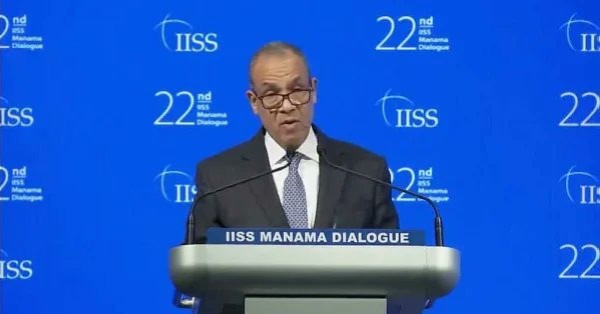
Dr. Badr Abdel Ati affirmed that Gulf security is inseparable from regional security, calling for integrating deterrence with diplomacy and resolving the Palestinian issue as a condition for sustainable security.
Translated by Qiyas from السياسة — Original source
- Threats to waterways endanger the entire world... and global trade must not remain hostage to escalation decisions.
- Deterrence without diplomacy postpones war but does not prevent it... and diplomacy without strength may fail to protect peace.
- There can be no sustainable security in the region without a just and comprehensive settlement of the Palestinian issue.
Egyptian Foreign Minister Dr. Badr Abdel Atty affirmed that the security of the Gulf Arab states constitutes an inseparable part of Egypt’s national security and Arab national security, stressing that Egypt will remain a responsible partner in safeguarding the security and stability of sister states, preserving their sovereignty, and supporting political and diplomatic solutions to the region’s crises.
Speaking during his participation in the first session of the Manama Dialogue 2026, held under the theme “Impacts of Transformative Regional Conflicts,” Abdel Atty stated that developments in the region have proven that Gulf security is inextricably linked to Middle Eastern security, and that any threat to the region’s security impacts global stability, particularly given the connection between sea lanes and energy and food security, as well as international supply chains and trade.
He expressed his appreciation to the Kingdom of Bahrain and the International Institute for Strategic Studies for organizing the Manama Dialogue, which has become one of the prominent regional and international platforms for discussing the future of security in the region. He noted that the challenge no longer lies solely in how to halt ongoing wars or contain their repercussions, but extends to how to protect the region from the outbreak of new wars and build a system that makes peace more sustainable.
He warned that wars and military escalation, along with what he described as unacceptable attacks on Gulf states, have revealed a highly dangerous strategic reality, clarifying that while a war may begin with a unilateral decision, no single party can unilaterally control its repercussions or bring it to an end.
He emphasized the necessity of shifting from crisis management to building a security system capable of preventing threats before they occur, stressing that achieving regional security requires not only new military arrangements but also the establishment of political and legal rules that prevent disputes from escalating into military confrontations.
Abdel Atty outlined five pillars of Egypt’s vision regarding the future of regional security. The first pillar is respect for the rule of law instead of the logic of force, through adherence to the sovereignty and territorial integrity of states, non-interference in their internal affairs, refraining from the use or threat of force, and settling disputes by peaceful means.
He stressed that targeting civilians and critical infrastructure cannot be justified under any pretext, nor can armed groups and militias operating outside state institutions be used as tools for influence and conflict. He criticized the selective application of international law, asserting that sovereignty is a right for all states and not a privilege reserved for stronger states.
He clarified that the second pillar rests on the principle that regional states should be the decision-makers in shaping their own security arrangements, rather than relying on external guarantees that may change with the shifting priorities of international powers, while continuing cooperation with international partners in line with the region’s vision and interests.
He highlighted the importance of enhancing Arab coordination and launching a broader regional dialogue based on good neighborliness, respect for sovereignty, and non-aggression, emphasizing that regional security should not evolve into an alliance directed against a specific party, but rather into a system of rules and commitments that apply to all.
Regarding the third pillar, the Egyptian Foreign Minister stressed the necessity of combining deterrence strength with diplomatic wisdom, explaining that military force alone does not achieve stability, and that the absence of communication channels increases the risks of miscalculation and escalation.
He stated that deterrence without diplomacy may postpone war but cannot prevent it, while diplomacy without the capacity for deterrence may fail to safeguard peace.
He called for the establishment of early warning mechanisms, crisis management frameworks, and measures to prevent military clashes, alongside confidence-building measures and serious dialogue on missiles, drones, and the risks of nuclear proliferation, leading to the establishment of a nuclear-weapon-free zone and a zone free of all weapons of mass destruction in the Middle East.
The fourth pillar concerns the protection of maritime navigation, energy, and critical infrastructure, emphasizing that the security of ports, oil and gas facilities, sea lanes, digital networks, and undersea cables has become an essential component of national security.
He called for enhanced regional maritime coordination, information sharing, and joint crisis response, led by regional states—particularly those bordering waterways—and in cooperation with international partners in accordance with international law.
He stressed that it is unacceptable for global trade to remain hostage to escalation decisions or the will of any single state.
In the fifth pillar, Abdel Aty affirmed that a just and comprehensive settlement of the Palestinian issue is a fundamental prerequisite for building a sustainable security architecture in the region, warning that addressing other regional crises without guaranteeing the Palestinian people’s right to self-determination will not secure safety for Israel or for the countries of the region.
He stated that ending the occupation, establishing an independent Palestinian state on the June 4, 1967 lines with East Jerusalem as its capital, and rejecting displacement, annexation, and settlement activities are not separate from regional security, but rather essential conditions for achieving it.
He underscored the necessity of coupling ceasefire stabilization and Gaza reconstruction efforts with a credible political process that preserves the territorial integrity of Palestinian lands, including Gaza, the West Bank, and East Jerusalem, ensures the legitimate rights of the Palestinian people, and halts settler attacks on Palestinian civilians in the West Bank.
He noted that security and development are two sides of the same coin, and that achieving sustainable stability requires strengthening water and food security, building strong national institutions, and fostering economies that provide opportunities and hope for future generations.
He called for moving from agreement on general principles of regional security to the implementation of practical mechanisms, based on the principles adopted within the framework of the Arab League in September 2025, by launching an organized dialogue and consultation framework led by regional states, grounded in respect for sovereignty, non-aggression, rejection of interference in internal affairs, and the renunciation of force in settling disputes.
The Egyptian Foreign Minister concluded his speech by reiterating that there are no military solutions to the region’s crises, only political, diplomatic, and peaceful ones. He pointed out that the region lacks neither resources nor capabilities, but rather requires the political will to make cooperation stronger than division and the rule of law stronger than coercion.
He said the time has come to build a security system whose success is not measured by the number of wars it can wage, but by the number of wars it successfully prevents from breaking out.
