Spain Declares Three Days of Mourning for Train Crash Victims
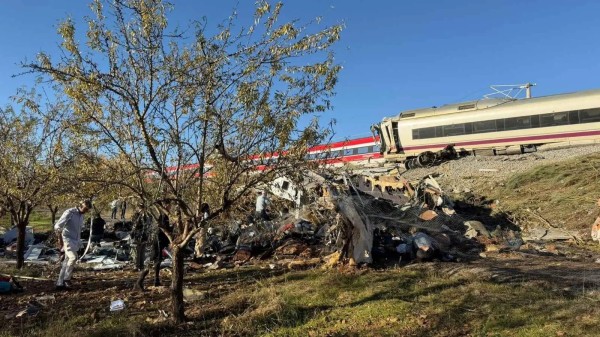
The Spanish government declared three days of mourning after a train collision in Toledo left 68 dead and 77 injured, with the Transport Minister revealing a technical fault.
Translated by Qiyas from السياسة — Original source
- Death toll rises to 68 killed and 77 injured, including 15 in critical condition
The Spanish government has declared three days of official mourning for the victims of a high-speed train collision in the province of Toledo, where the death toll has risen to 68 killed and 77 injured, including 15 in critical condition.
In a statement issued on Wednesday, the government announced that the mourning period would begin at midnight Wednesday and continue until midnight Saturday, with flags lowered on public buildings, Spanish diplomatic missions abroad, and warships, in solidarity with the families of the victims and the injured.
For his part, Spanish Prime Minister Pedro Sánchez, while inspecting the accident site, described the occurrence of two fatal rail accidents in the country within a single year as “unacceptable,” affirming that all necessary measures would be taken to restore citizens’ confidence in the rail system and enhance passenger safety.
Sánchez stressed that investigations would reveal the circumstances and causes of the accident, and that any proven negligence would face strict measures, expressing his condolences to the victims’ families and his solidarity with the injured.
Spanish state television quoted Emiliano García-Page, president of the Castile-La Mancha regional government, as saying that rescue teams would continue search and recovery operations for victims from the carriages that derailed and fell down an embankment at the crash site, warning that the death toll could rise as debris removal continues.
Regarding the details of the accident, Spanish Transport Minister Óscar Puente revealed that the Continuous Train Control system (ETCS), responsible for monitoring train speeds and locations, suffered a malfunction due to a communication failure among three computers along a 63-kilometer stretch of the rail network.
He explained that the control center of the Rail Infrastructure Management Authority (ADIF) allowed the resumption of movement for one of the trains, despite the other train having stopped before a station in Toledo and a red signal being present at its entrance, describing the decision to allow continued movement under those conditions as “unintelligible.”
The accident occurred shortly before 9:00 a.m. local time, when a Renfe train carrying 378 passengers collided with the rear of an Iryo train carrying 147 passengers, which was stopped near the entrance to Ugena station.
Both trains had departed from the capital, Madrid, bound for the city of Seville. The collision caused several carriages from the stopped train to leave the tracks, with some falling down an embankment and being almost completely destroyed.
Following the accident, authorities announced the suspension of high-speed train traffic on the line connecting Madrid and Andalusia until further notice, and the halt of ticket sales for trips on this route until December 13.
The incident is the second-deadliest high-speed rail disaster in Spain’s history, and the second of its kind in the country this year, following a train collision in Córdoba, Andalusia, on January 18, which resulted in 46 deaths and 123 injuries.
