Kuwait before the Security Council: Women are a key partner in facing crises and building sustainable peace
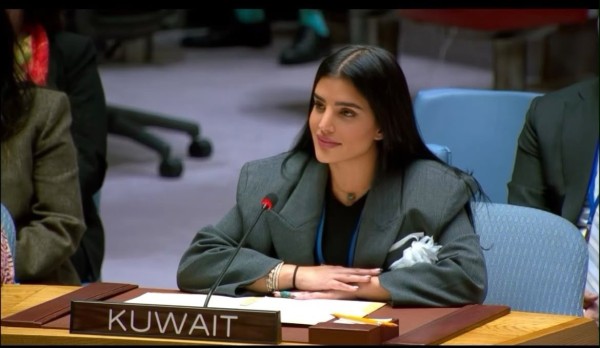
Kuwait affirms that women are a key partner in resilience and building sustainable peace during its address to the Security Council.
Translated by Qiyas from السياسة — Original source
The State of Kuwait affirmed that women are a fundamental partner in resilience against crises and conflicts, an active element in recovering from their repercussions, and an indispensable voice in building a future characterized by security, stability, and peace, calling for the enhancement of their full and effective participation in sustainable peacebuilding efforts.
This was stated in Kuwait’s address delivered by Vice Minister of Foreign Affairs and Permanent Representative to the United Nations, Wafaa Al-Mulla, on Tuesday night, during the open debate held by the UN Security Council on Women, Peace, and Security.
Al-Mulla praised the role of Kuwaiti women in confronting the challenges the country has faced since the brutal Iraqi invasion, highlighting their resilience and sacrifices, and their contribution to rebuilding the nation and strengthening its security and stability.
She noted that Kuwaiti women continue to play their role in serving their country and society, contributing to addressing the repercussions of repeated Iranian aggression against Kuwait since February 28, 2026, which targeted civilian objects, vital infrastructure, and critical installations, threatening the security and safety of citizens and residents.
She expressed appreciation for the efforts of Kuwaiti women across various work and responsibility positions, and their dedication alongside their fellow citizens to maintaining social cohesion and continuity of life, emphasizing that women are not immune to the effects of crises and conflicts, nor are they absent from the response to them.
At the national level, Al-Mulla outlined Kuwait’s efforts to enhance women’s participation in institutions related to security, justice, and decision-making, alongside work on preparing the country’s first National Action Plan on Women, Peace, and Security, through the relevant National Committee, in cooperation with the United Nations Economic and Social Commission for Western Asia (ESCWA) and relevant national entities.
She clarified that these efforts aim to integrate the pillars of the Women, Peace, and Security agenda into national policies and plans, and to expand women’s participation in conflict prevention, crisis response, and recovery, in alignment with Kuwait Vision 2035 and the Sustainable Development Goals.
She stressed the necessity of women’s participation beginning before conflicts erupt, through their contribution to preventive diplomacy and mediation efforts, and continuing through negotiations, implementation of peace agreements, and recovery and reconstruction phases.
She affirmed that protecting women is a fundamental responsibility requiring respect for international law, including international humanitarian law, protection of civilians and civilian infrastructure, ensuring safe and unhindered access for humanitarian aid, and holding perpetrators of violations accountable.
Al-Mulla warned that the repercussions of escalating conflicts do not end with the cessation of military operations, as women and girls face loss of family members, displacement, violence, and deprivation of education, healthcare, and livelihoods, while the responsibilities placed on their shoulders are increasing.
She pointed out that more than 25 years after the adoption of UN Security Council Resolution 1325, a gap remains between international commitments and the reality women face in conflict zones, citing a UN Secretary-General’s report showing that women accounted for only 5 percent of senior negotiators in 57 peace processes in 2025.
She affirmed that sustainable recovery requires empowering women and girls to return to education, access healthcare, regain their livelihoods, and participate in decisions regarding the reconstruction of their communities.
She also emphasized the importance of integrating women’s needs and priorities into recovery and reconstruction plans, providing employment opportunities and capacity building, thereby enhancing their economic independence and ability to contribute to the future of their families and societies.
Regarding technological developments, Al-Mulla emphasized the importance of leveraging digital tools to enhance women’s participation, facilitate knowledge exchange, and build capacities, while addressing threats they face in the digital space, including harassment and disinformation campaigns that may limit their involvement in public life and decision-making.
In conclusion her speech, she reaffirmed Kuwait’s commitment to continuing work with the United Nations, member states, and partners to translate the Women, Peace and Security agenda into tangible reality, stressing that sustainable peace is not built in isolation from women, but through their full and effective participation.
