Kuwait Calls on Iraq for Serious and Concrete Steps to Reveal the Fate of the Missing and Restore National Archives
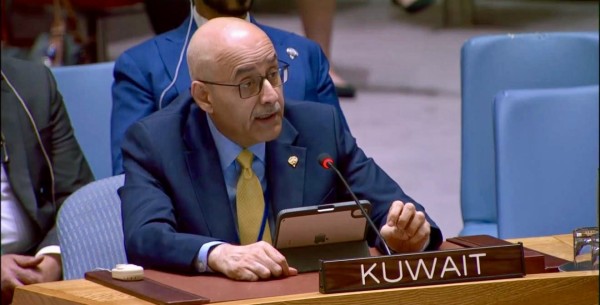
Ambassador Al-Adwani before the Security Council: No progress in revealing the fate of 315 missing persons; unfulfilled Iraqi commitments
Translated by Qiyas from السياسة — Original source
- Al-Adnani before the Security Council: No progress in revealing the fate of 315 missing persons.. Unfulfilled Iraqi commitments
- Possibility of remains of 150 to 180 Kuwaiti missing persons in "Al-Khamisiyah".. Call for a timeline to recover property and documents
The State of Kuwait has called on the Republic of Iraq to take serious and concrete steps to fulfill commitments regarding the disclosure of the fate of Kuwaiti prisoners and missing persons, as well as nationals of third countries, and to recover Kuwaiti property, including the National Archives. Kuwait emphasized that continued "delay in implementing these commitments necessitates actual measures and tangible results."
This statement was made in Kuwait’s address, delivered by Assistant Minister of Foreign Affairs for Prisoners and Missing Persons Affairs, Ambassador Rabie Al-Adnani, at a session held by the UN Security Council regarding the situation between Kuwait and Iraq.
Ambassador Al-Adnani stated that the first report of the UN Secretary-General, issued on October 1 of this year, confirmed that no progress was made during the period covered, and that 315 individuals remain missing, including 308 persons listed on the list submitted by the State of Kuwait.
He clarified that the challenge, more than 35 years later, is not limited to the scarcity of new information, but also includes the failure to fully follow up on known information and testimonies, as well as the delay in implementing procedures and commitments agreed upon years ago.
He pointed out that repeated Iraqi commitments were received to facilitate interviews with witnesses and former officials believed to possess important information about the fate of the missing persons, yet none of these commitments have been translated into actual measures.
He added that among these commitments was enabling the International Committee of the Red Cross (ICRC) to interview nine officers detained from the former Iraqi regime officials, interviews that have not yet been conducted.
He noted that one former official of the Iraqi regime, who held the position of what was called "Director of Kuwait Security" during the brutal Iraqi invasion, was supposed to be interviewed to obtain information he possessed regarding detainees, missing persons, and the National Archives. However, the execution of his death sentence in February 2026 prevented the interview, despite the Iraqi side’s approval.
Ambassador Al-Adnani warned that delaying interviews with known witnesses leads to the permanent loss of potential information sources, stressing the necessity of implementing agreed-upon interviews and removing administrative obstacles that prevent their completion.
Regarding the "Al-Khamisiyah" site, he said that available information and testimonies indicate the possibility that the remains of between 150 and 180 Kuwaiti missing persons are located in several potential burial sites.
He explained that one Iraqi witness provided documented testimonies containing information about potential burial sites, coordinates, and names of individuals inside and outside Iraq who may possess additional information. However, the follow-up on these testimonies has not been completed to date.
He added that a joint technical assessment of one potential site in the "Al-Khamisiyah" area was completed with the participation of the Iraqi side and the ICRC, but the Iraqi side requested further study despite its technical team participating in the site inspection since early September 2026.
He also stressed the need for safety requirements and permits to lead to clear implementation procedures, rather than continuing to suspend work without a specific date, thereby allowing technical teams to complete their tasks.
Regarding missing Kuwaiti property, including the National Archives, Ambassador Al-Adnani expressed Kuwait’s concern over the continued lack of any substantive progress in this file, emphasizing that important sovereign and historical documents remain missing.
The Iraqi government was called upon to establish a clear mechanism and a specific timeline for the actual search for these properties and documents by tracing their transfer routes during the invasion, identifying the entities and individuals responsible for their custody or transport, and verifying potential locations where they may be found.
In this context, he noted that the United States of America had returned archives of the former Iraqi regime to Iraq on two occasions, one of which was last year in digital format. He considered this to provide an opportunity to leverage advanced digital research and analysis tools, including artificial intelligence technologies, to verify whether these materials contain information that could help track Kuwaiti properties or identify the entities that handled them.
He emphasized that the primary responsibility for searching for Kuwaiti properties taken during the invasion, determining their locations, and returning them lies with the Iraqi government, in accordance with relevant United Nations Security Council resolutions.
In the context of supporting search efforts, Ambassador Al-Adwani clarified that Kuwait, in cooperation with the International Committee of the Red Cross (ICRC), had provided the necessary information, documents, satellite imagery, and technical assessments, including an annual contribution of one million dollars to assist the ICRC in this field.
He highlighted Kuwait’s readiness to provide any additional assistance required by the relevant Iraqi authorities, thereby contributing to accelerating the search process and fulfilling remaining obligations.
Regarding international follow-up, Ambassador Al-Adwani called for a shift from merely recording activities and commitments to measuring the level of implementation and results. He pointed out that Kuwait had previously submitted a proposal comprising 13 performance indicators aimed at monitoring existing commitments, identifying bottlenecks, and determining their causes.
He stressed the importance of future reports clarifying what was agreed upon, what has been actually implemented, what remains unimplemented, the reasons for delays, and the entities responsible for completing the required procedures.
He noted the significance of this matter as the scheduled review approaches in June 2028, which will rely on only four objective reports under the mandate of the High Representative, instead of five, according to the timeline stipulated in Security Council Resolution (2792) of 2025.
Kuwait expressed its appreciation for the pivotal role played by the Security Council over the past decades in following up on humanitarian files concerning the fate of the missing and the return of Kuwaiti properties, emphasizing the importance of continued collective attention by Council members to these files.
Kuwait also reaffirmed its full support for the mandate of the Secretary-General’s High Representative for implementing Resolution (2792), Ms. Yamashta, expressing hope that her efforts would help address existing obstacles and achieve tangible progress before the review deadline.
Ambassador Al-Adwani affirmed that Kuwait attaches great importance to its relations with brotherly Iraq and is keen to strengthen bilateral cooperation based on mutual respect, good neighborliness, respect for sovereignty, and non-interference in internal affairs.
He clarified that Kuwait’s primary objective is not to prolong these files or keep them open indefinitely, but rather to successfully close them as quickly as possible by revealing the fate of all missing persons and recovering Kuwaiti properties, including the national archives.
Concluding Kuwait’s statement, Al-Adwani emphasized that this file, above all, represents a humanitarian issue affecting the lives of Kuwaiti families who have waited for more than 35 years to learn the fate of their sons and fathers.
He stated that there are families who still cling to the hope of learning the truth, and that the least that can be offered to them is to ensure that opportunities to uncover the fate of their loved ones are not lost, and to work diligently to end their suffering. He emphasized that “it is their right to know, and it is our duty not to stop until they know.”
