'Environment': Rare Lesser Flamingo Spotted Alongside Greater Flamingo in Al-Jahra Reserve
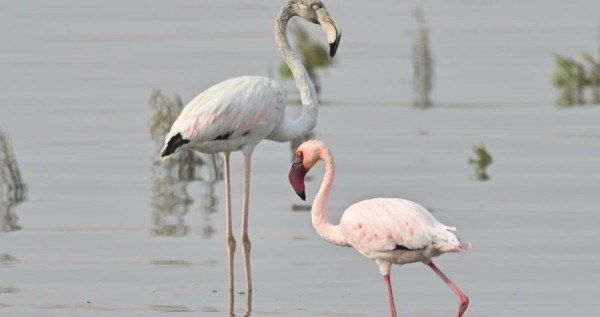
Samira Al-Khalifa documented the appearance of the Lesser Flamingo alongside the Greater Flamingo in Al-Jahra, highlighting its ecological importance and rarity.
Translated by Qiyas from السياسة — Original source
Samira Al-Khalifa, head of the photography team at the Kuwait Society for the Protection of Wildlife, documented the appearance of a Lesser Flamingo alongside a Greater Flamingo at the Al-Jahra Nature Reserve during the 2026 bird migration season, in a distinctive ecological scene highlighting the biodiversity hosted by the country’s nature reserves and their importance to migratory birds.
Al-Khalifa, who serves as a board member of the society, told the Kuwait News Agency (KUNA) on Monday that documenting the Lesser Flamingo represents an important addition to Kuwait’s bird monitoring records, given its rarity locally compared to the Greater Flamingo, as well as the scarcity of sightings of both species together.
She explained that the photographs clearly showed the morphological differences between the two species and the size disparity, noting that the Lesser Flamingo is characterized by its smaller body, pink coloration, and dark beak with a reddish-black tip, whereas the Greater Flamingo is distinguished by its taller stature and lighter beak with a black tip.
She added that Al-Jahra Nature Reserve is one of the key ecological sites for receiving migratory birds due to its water bodies, mudflats, and suitable habitats for feeding and resting, in addition to Kuwait’s location on bird migration routes.
She pointed out that the Lesser Flamingo is classified globally as Near Threatened on the International Union for Conservation of Nature (IUCN) Red List, due to environmental pressures facing its natural habitats, including the degradation of wetlands, changes in water levels and salinity, environmental pollution, and the decline in quality of some feeding and breeding sites.
Regarding the ecological role of flamingos in protecting wetlands, she said that while foraging, these birds help stir up surface layers of mud with their feet, which aids in resuspending organic matter and nutrients from the bottom and making them available to other organisms within the food web.
She emphasized that preserving these reserves has become essential to protect biodiversity and support the continuity of species that rely on them during their seasonal migrations, alongside the importance of international and regional efforts to conserve the wetland environments these birds depend on.
Al-Khalifa noted that flamingos feed on microscopic aquatic organisms, including small crustaceans, and use their specialized beaks to extract food from the water and sediments they stir up.
She stated that the process of churning up the bottom during feeding contributes to the redistribution of nutrients and the activation of ecological interactions within shallow water bodies, enhancing the importance of these birds in the natural balance of wetland habitats, although the nature of this impact varies from one environment to another.
She added that the presence of flamingos in muddy water bodies highlights the interconnection between living organisms and their natural environments, as their feeding activities influence the movement of sediments and nutrients, underscoring the importance of protecting these habitats from pollution, land reclamation, encroachments, and activities that could disrupt their ecological balance.
She noted that recording and photographically documenting sightings of rare species constitutes a significant contribution to environmental knowledge, helping to monitor the country’s biodiversity and highlight the importance of Kuwait’s nature reserves as vital stopovers for migratory birds, as well as their role in raising public awareness about the importance of protecting wildlife and their natural habitats.
