US Secretary of Homeland Security: We thank Kuwait for its contribution to the creation of the 'Desert Shield' and 'Desert Storm' memorial
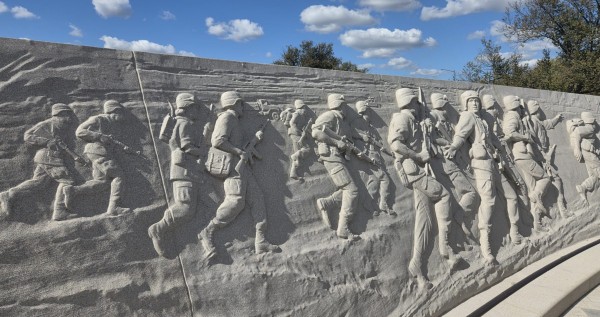
-The monument commemorates the sacrifices of US and coalition forces in liberating Kuwait and embodies our historic partnership - US Secretary of War: The coalition forces' victory in 1991 strengthened partnerships and laid solid ties with Gulf states US Secretary of Homeland Security Doug
Translated by Qiyas from السياسة — Original source
- The monument commemorates the sacrifices of U.S. and coalition forces in the liberation of Kuwait and embodies our historic partnership.
- U.S. Secretary of Defense: The 1991 coalition victory strengthened partnerships and forged enduring ties with Gulf states.
U.S. Secretary of Homeland Security Doug Burgum expressed the United States’ gratitude and appreciation to the State of Kuwait for its contribution to the establishment of the memorial to Operations Desert Shield and Desert Storm in the nation’s capital, Washington, D.C., emphasizing that the structure embodies the historic partnership between the two countries and honors the sacrifices made by U.S. and coalition forces during the 1991 Kuwait Liberation War.
Speaking at the unveiling ceremony on Sunday at the National Mall, Burgum stated that his country feels particularly indebted to Kuwait for its generous support in completing the project. He added, “Thank you very much to your country for the immense support in building this monument, which reminds us of how we worked together.”
The opening ceremony was attended by Kuwait’s Minister of Defense, Sheikh Abdullah Ali Al-Salim Al-Sabah, Kuwait’s Ambassador to Washington, Sheikha Al-Zain Al-Sabah, alongside U.S. officials, diplomats from several countries, veterans, and their families.
Burgum described the occasion as a day of patriotism, remembrance, gratitude, and celebration, noting that the completion of the memorial followed years of planning and work to honor the sacrifices of those who participated in Operations Desert Shield and Desert Storm.
He stressed that honoring veterans extends beyond their participation in military operations to encompass the cause they fought for: defending freedom, liberating the people of Kuwait, and supporting U.S. allies in the region.
He explained that the memorial’s design features two wreaths, one symbolizing those who lost their lives during Operation Desert Storm, and the other representing those who sacrificed their lives during the Desert Shield phase.
Burgum pointed out that the monument’s prominent location near the Abraham Lincoln Memorial gives it special significance, noting that the area attracts approximately 40 million visitors annually.
He announced that the U.S. Department of Homeland Security and the National Park Service would assume permanent responsibility for maintaining the memorial, ensuring that future generations are informed about the sacrifices of the military personnel it honors.
Burgum praised the artistic design of the monument, explaining that the creators selected stone whose color matches the sands of Kuwait. The design includes a symbol of two soaring birds: an eagle representing the United States and a falcon symbolizing the Middle Eastern tradition of falconry, both flying together toward a new dawn.
For his part, U.S. Secretary of Defense Pete Hegseth, whose remarks were delivered on his behalf by Under Secretary of Defense for Policy Elbridge Colby, stated that the memorial serves as a reminder of the importance of exercising wisdom and responsibility when making decisions regarding the use of military force.
Hegseth said the United States owes it to its fighters to commit to waging wars wisely and effectively, ensuring that sacrifices and costs are proportionate to the interests at stake, considering Operation Desert Storm a model of this approach.
He noted that Operations Desert Shield and Desert Storm demonstrated the exceptional impact of partnerships based on shared interests and contributed to solidifying strong relations between the American people and the peoples of Kuwait, Saudi Arabia, and other allied Gulf states.
He added that coalition forces succeeded in restoring Kuwait’s sovereignty and freedom, delivering a decisive defeat to Iraqi forces, and emphasized that the joint victory resulted from a meticulous strategy executed by forces characterized by competence, readiness, and courage.
He emphasized that the Kuwait liberation experience demonstrated the capacity of military force, when employed to achieve clear political objectives and in cooperation with capable and willing partners, to deliver decisive results.
He noted that this lesson remains relevant in addressing international challenges, pointing out that U.S. President Donald Trump’s approach is based on the principle of “peace through strength.”
Higheath affirmed that the memorial embodies gratitude to the participants in the two Kuwait liberation operations, particularly those who lost their lives or were injured during the operations, as well as to their families, expressing his hope that their sacrifices will remain present in the memory of future generations.
The opening ceremony included events honoring veterans and the families of soldiers who were killed during the two operations, alongside the performance of a Kuwaiti song about freedom, expressing Kuwait’s appreciation for the U.S. role in the liberation war.
The memorial is located at the intersection of 23rd Street and Constitution Avenue in Washington, D.C., near the Lincoln Memorial and the Vietnam Veterans Memorial, in a site that combines historical and political symbolism for the U.S. capital.
Constitution Avenue extends from the U.S. Capitol toward the Lincoln Memorial, passing several prominent federal institutions and buildings, including the National Archives Building, which houses the Declaration of Independence, the U.S. Constitution, and the Bill of Rights. Meanwhile, 23rd Street is linked to the U.S. Department of State headquarters, lending the memorial’s location symbolic dimensions connected to the history of the United States, its institutions, and its international relations.
