Kuwait Emphasizes the Need to Strengthen International Cooperation to Prevent Illicit Arms Trafficking
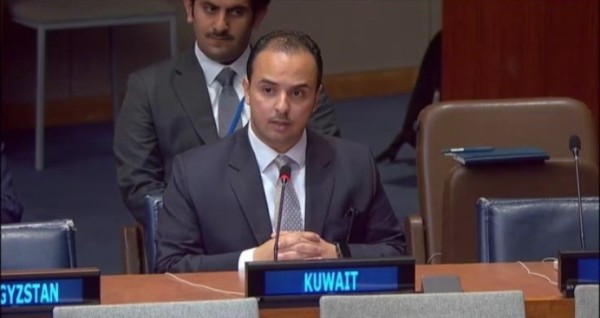
Kuwait stressed the importance of international cooperation in combating illicit trafficking in conventional arms during its address to the UN General Assembly.
Translated by Qiyas from السياسة — Original source
- Al-Anzi: Iranian attacks exemplify the danger of using missiles and drones to target civilians and vital facilities
The State of Kuwait, on the evening of Friday, emphasized the importance of enhancing international cooperation to combat the illicit trade in conventional arms and prevent their diversion, while adhering to the principles of the UN Charter and respecting the sovereign right of states to meet their legitimate defense needs.
This was stated in Kuwait’s address delivered by Diplomatic Attaché Jirah Al-Anzi before the First Committee on Disarmament and International Security of the UN General Assembly, during discussions on conventional arms.
Al-Anzi stressed the importance of balanced and non-selective implementation of the Arms Trade Treaty, ensuring that exporting and importing states fulfill their responsibilities without imposing unjustified restrictions on the legitimate rights of states.
He warned that illicit flows of arms and ammunition reaching terrorist organizations and armed groups outside state control prolong conflicts, undermine state institutions, and hinder peacebuilding and development efforts.
Kuwait reaffirmed its support for the full and effective implementation of the UN Programme of Action to Prevent, Combat, and Eradicate the Illicit Trade in Small Arms and Light Weapons in all its aspects.
He also emphasized the importance of strengthening national capacities in marking, tracing, securing stockpiles, exchanging information, and monitoring transfers to prevent arms from leaking into illicit markets or reaching unauthorized entities.
Al-Anzi noted Kuwait’s interest in the Global Ammunition Management Framework throughout the ammunition lifecycle, as a crucial step to address risks arising from poor ammunition management, diversion, and accidental explosions.
He expressed Kuwait’s pride in its election as Vice-Chair of the Preparatory Meeting and its recommendation for nomination to one of the Vice-Chair positions at the next session scheduled for 2027, enabling it to contribute to strengthening international cooperation and building national capacities.
On regional matters, Al-Anzi stated that serious developments in our region confirm that the risks of conventional arms proliferation are no longer confined to internal conflicts but now extend to threatening the security and stability of states.
He pointed out that Iranian attacks targeting Kuwait, GCC states, and Jordan—including those carried out by Iran-aligned militias in Iraq—exemplify the danger of using missiles and drones to target civilians, civilian infrastructure, and vital facilities.
In this regard, Kuwait reiterated its condemnation of these attacks, stressing the need for full compliance with UN Security Council Resolution 2817 (2026), halting direct and indirect attacks, and countering the supply of arms and military capabilities to armed groups that threaten state sovereignty and security.
Al-Anzi stressed the necessity of respecting international humanitarian law in all conflicts, including occupied Palestinian territories, and ensuring that conventional arms are not used to commit serious violations against civilians.
He concluded by reaffirming Kuwait’s continued support for international efforts to prevent arms from reaching illicit actors, reduce their use against civilians, and enhance states’ capacity to protect their security and sovereignty, thereby contributing to consolidating international peace and security.
