IMF: GCC Reforms Enhanced Countries' Ability to Handle Regional Spillovers
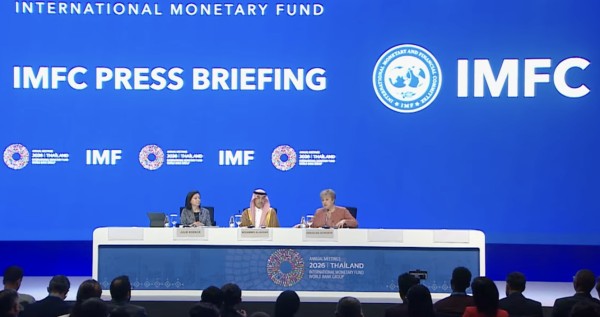
The International Monetary Fund confirmed that GCC reforms strengthened the region's ability to handle regional spillovers, while lowering growth forecasts for the area.
Translated by Qiyas from السياسة — Original source
Al-Jadaan: Disruptions to waterways and trade threaten energy and food security, increasing economic pressures
The International Monetary Fund (IMF) confirmed on Saturday that the reforms and precautionary measures adopted by Gulf Cooperation Council (GCC) countries have strengthened their capacity to cope with the repercussions recently witnessed in the region in the wake of the US-Iranian war.
This came during a joint press briefing on the proceedings of the International Monetary and Financial Committee (IMFC), held by IMF Managing Director Kristalina Georgieva and Committee Chair Saudi Finance Minister Mohammed Al-Jadaan, as part of the annual meetings of the IMF and the World Bank Group hosted in Bangkok.
Georgieva praised the GCC countries, noting that their reforms enabled them to mitigate the impact of the shock and benefit from the revenues they generated. On the other hand, Georgieva stated that the IMF has lowered its growth forecast for the Middle East and North Africa (MENA) region by 2 percentage points, while noting that Iraq has requested a program and that the Fund is ready to support it with financing and policy assistance.
She added that discussions with Lebanon have made significant progress toward reaching a program, with some work remaining to be completed, and that Egypt’s program is moving forward, with completion expected by the end of the year, while describing the IMF’s program with Jordan as successful.
For his part, Al-Jadaan said that the MENA region is divided into two groups; one entered the shocks after structural reforms and building precautionary buffers, including most GCC countries, while the other group entered the phase exhausted and lacking the necessary capacities and buffers.
He noted that investments in countries like Saudi Arabia have mitigated the severity of the energy crisis shock on the global economy.
He pointed out that wars and conflicts impose a heavy human cost and significant economic repercussions, adding that disruptions to waterways and trade routes threaten energy and food security.
He highlighted that geopolitical tensions and supply chain disruptions increase uncertainty and price pressures, while rising public debt and bond yields exacerbate financial vulnerabilities.
He called for the formulation of medium-term plans to rebuild precautionary buffers, while protecting the most vulnerable groups and growth-enhancing investments, emphasizing the importance of central bank independence, structural reforms, and private-sector-led investment.
Al-Jadaan stressed the need for international cooperation to address imbalances and trade tensions, and to accelerate and coordinate debt restructuring, including through the G20 Common Framework.
He said that committee members emphasized the importance of ensuring safe and flexible energy flows, upholding freedom of navigation, supporting countries facing debt-related vulnerabilities, and enhancing the Fund’s capacity to support low-income countries.
Bangkok is hosting the annual meetings of the IMF and the World Bank Group from October 12 to 18, with the participation of thousands of financial officials and economists, to discuss global challenges and ways to enhance monetary and investment cooperation.
