IMF Warns of Global Economic Implications of Attacks on Saudi Arabia
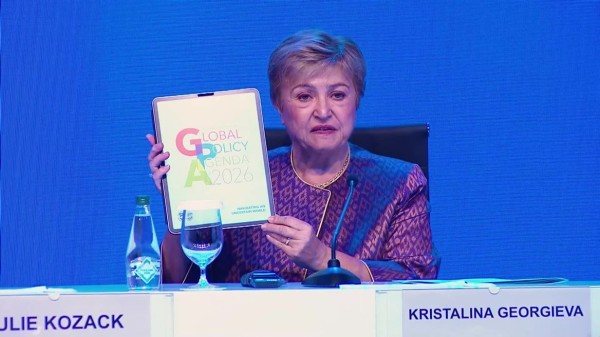
Gerosieva warns of the repercussions of attacks on Saudi Arabia and emphasizes the importance of the Saudi economy
Translated by Qiyas from السياسة — Original source
- Guterres Praises Gulf Reforms and Emphasizes the Importance of the Saudi Economy to the Region and the World
International Monetary Fund Managing Director Kristalina Georgieva warned on Wednesday that recent attacks on Saudi Arabia could have negative economic repercussions extending across the globe, amid disruptions in energy markets caused by the war in the Middle East.
Speaking at a press conference in Bangkok, Thailand, on the sidelines of the IMF and World Bank Annual Meetings, Georgieva stated, “The Saudi economy is of great significance to the region and the world, and recent developments may negatively affect everyone.”
In this context, she praised the economic and financial reforms implemented by Gulf Cooperation Council (GCC) countries to strengthen their capacity to withstand external shocks, through diversifying economic growth sources and building financial reserves and buffers to help absorb the impacts of crises.
Georgieva’s remarks came during the presentation of the 2026 Global Policy Agenda, in which she warned that the global economy’s resilience to repeated shocks and uncertainty is nearing its limits, as energy reserves and financial buffers are being depleted and high inflation persists in many countries, despite some economies benefiting from expanded artificial intelligence (AI) investments.
She explained that global economic growth is now influenced by two opposing forces: the first being a negative supply shock in energy due to the war in the Middle East, and the second being a positive demand shock driven by the expansion of AI investments.
She added that economies more integrated into AI supply chains are performing better than others, with many of them located in Asia, alongside energy-exporting countries unaffected by the wars. Meanwhile, low-income, fragile, and conflict-affected countries are bearing the brunt of the economic impacts, particularly energy-importing nations or those not benefiting from the technological boom.
She warned that the expansion of AI could widen the economic gap between rich and developing countries, amid declining international development assistance and rising borrowing, food, and energy costs. She noted that debt service burdens in developing countries rose on average from 6% to 14% of their revenues over the past decade.
She emphasized that advanced economies are this time falling short in addressing fiscal imbalances, urging governments to implement urgent reforms before these imbalances widen, by boosting revenues, rationalizing spending, and improving public financial management.
She added that current economic conditions may require many countries to adopt cautious, tightening monetary policies to contain inflation, alongside improving the business environment, enhancing competition, investing in digital infrastructure and energy, and developing labor market policies.
Regarding major economies, Georgieva called on China to rebalance its economic model by boosting domestic consumption and reducing reliance on exports, urged the United States to increase savings and address its fiscal imbalances, and encouraged European economies to expand investments to enhance competitiveness.
She warned that US economic growth alone would not be sufficient to reduce the public debt, which has surpassed $40 trillion, emphasizing the need for additional fiscal measures to address the deficit and ensure long-term debt sustainability.
In a related development, member states of the International Monetary Fund (IMF) called for strengthening the resources of the IMF’s Growth and Poverty Reduction Trust, which provides concessional financing to low-income countries to help contain disasters and alleviate debt burdens.
The IMF emphasized its responsibility to assist member states in addressing conflicting economic trends, stressing that international cooperation and joint action represent the most effective means of confronting growing economic and financial risks.
Bangkok is hosting the annual meetings of the IMF and the World Bank from October 12 to 18, with a broad Kuwaiti and international participation comprising thousands of financial officials and economists to discuss global economic and financial challenges and ways to enhance monetary and investment cooperation.
