Kuwait Calls for UN Security Council Reform to Ensure Fairer and More Effective Representation
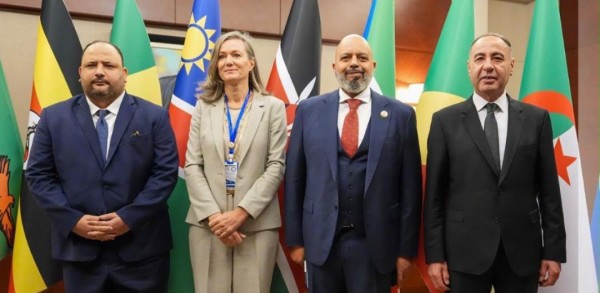
Kuwait's envoy demands addressing historical injustice against Africa in the Security Council
Translated by Qiyas from السياسة — Original source
- Al-Banai stressed the need to address the historical injustice suffered by Africa and ensure its fair representation in the Council.
The State of Kuwait emphasized the importance of moving forward with reforms of the United Nations Security Council, in order to enhance fair representation of member states, address historical imbalances in its composition, and make it more representative, effective, and capable of fulfilling its responsibilities in maintaining international peace and security.
In a statement, Kuwait’s Permanent Mission to the United Nations noted that this position was articulated by Kuwait’s Permanent Representative to the UN, Ambassador Tariq Al-Banai, in his capacity as one of the Co-Chairs of the Intergovernmental Negotiations on Security Council reform, during the 14th Ministerial Meeting of the African Union’s Committee of Ten on Security Council Reform, held in the Libyan capital, Tripoli.
The meeting was held yesterday, Monday, hosted jointly by the Republic of Sierra Leone, as Coordinator of the Committee of Ten, and the State of Libya, as the host country, with the participation of the Co-Chair of the Intergovernmental Negotiations, Netherlands’ Permanent Representative to the UN, Ambassador Liesje Schrijver van Harin.
Al-Banai stressed the necessity of addressing the historical injustice inflicted upon the African continent due to its lack of representation in the permanent membership category of the Security Council and its insufficient representation in the non-permanent membership category, highlighting the importance that the Council’s composition reflect contemporary geopolitical realities and the aspirations of member states.
He welcomed the African model presented by Sierra Leone during the 80th session of the UN General Assembly, based on the Ezulwini Consensus and the Sirte Declaration, which calls for granting Africa at least two permanent seats with all the powers of permanent membership, along with a total of five non-permanent seats.
He clarified that the African position opposes the use of the veto in principle, but demands that new permanent members be granted the same rights and privileges as current permanent members if the veto power is retained, pointing to the role of the African Union in selecting the continent’s representatives for election by the General Assembly.
Al-Banai added that the concept of fixed regional seats has emerged as a potential compromise formula between states demanding the expansion of permanent membership and those favoring limiting expansion to non-permanent seats.
He noted that this formula involves adding between six and seven seats distributed on a regional basis, whereby the General Assembly would elect countries to hold these seats for terms longer than the current two-year period, with the possibility of renewal, including re-election for two additional terms, thereby enhancing institutional continuity while maintaining accountability through periodic elections.
He continued, stating that the proposed seats would enjoy the same powers granted to current permanent members, including the veto power, with the total number of Council members ranging between 21 and 22, and including a mechanism for periodic review to assess the new arrangements.
He emphasized that these elements are primarily open for discussion, and that any compromise options must take the African position seriously and consider the continent’s demands for representation in both permanent and non-permanent membership categories.
He pointed out that the Pact for the Future has bolstered the political momentum for Security Council reform by acknowledging the priority of addressing the historical injustice suffered by Africa and encouraging member states to propose and refine reform models with the aim of reaching common ground.
Al-Bunai acknowledged the persistent fundamental divisions among member states regarding the expansion of the categories of permanent and non-permanent membership, noting that negotiations have not yet reached a stage of consensus on a unified reform model. He emphasized the importance of demonstrating flexibility and exploring areas of convergence among the various proposals, thereby contributing to the achievement of a reform that enjoys broad support and enhances the legitimacy and effectiveness of the Security Council. At the conclusion of the meeting, the Co-Chairs provided ministers with a briefing on the latest developments in the intergovernmental negotiations on Security Council reform, including the proposal submitted by the Co-Chairs. Views were exchanged on ways to advance the reform process, with emphasis placed on the legitimate African aspirations for fair representation on the Council. The meeting was chaired by Sierra Leone’s Minister of Foreign Affairs and International Cooperation, Mohamed Rahman Sowari, and Libya’s Chargé d’Affaires for the Ministry of Foreign Affairs and International Cooperation, Taher Salm al-Baghour.
