Kuwait: Full Solidarity with Saudi Arabia in Facing Houthi Militia Aggressions
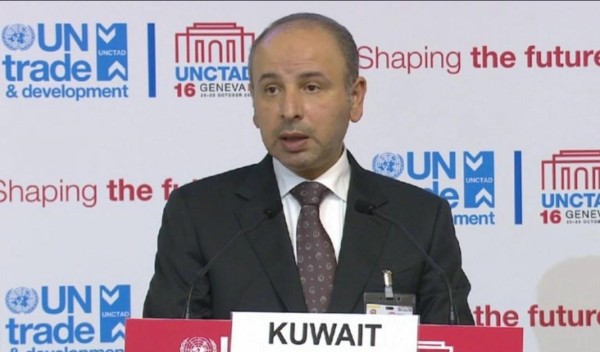
Kuwait's UN Representative Nasser Al-Hin affirmed his country's full solidarity with Saudi Arabia in facing Houthi aggressions, expressing concern over the humanitarian and economic repercussions of Iranian attacks, and reiterating Kuwait's support for the UN Refugee Agency.
Translated by Qiyas from السياسة — Original source
- Condemned Iranian attacks on countries in the region and their continued threat to the security of sea lanes and freedom of international navigation.
- Emphasized the need to intensify international efforts to de-escalate tensions, protect civilians, and address crises through dialogue and diplomatic efforts.
The Permanent Representative of the State of Kuwait to the United Nations in Geneva, Ambassador Nasser Al-Hin, reaffirmed Kuwait’s full solidarity with the Kingdom of Saudi Arabia in the face of attacks it is suffering from Houthi militias, which constitute a blatant violation of international law. He also condemned the brutal Iranian attacks on countries in the region and their continued threat to the security of sea lanes and freedom of international navigation.
News Services
News Readings
This came in a statement delivered by Ambassador Al-Hin today, Tuesday, before the Executive Committee of the Office of the United Nations High Commissioner for Refugees (UNHCR) Programme, held in Geneva from October 12 to 16.
In his statement, Al-Hin stressed that Iranian attacks and assaults targeting the security, stability, and sovereignty of states, and hitting civilian targets, vital facilities, and infrastructure, resulting in casualties and serious material and economic damage, constitute a blatant violation of international law and the UN Charter.
He expressed Kuwait’s deep concern over the security, economic, and humanitarian repercussions of these attacks, which could spill over beyond the region’s borders. He called for intensified international and regional efforts to de-escalate tensions, protect civilians, and adhere to dialogue and diplomatic efforts as means to address crises and achieve security, stability, and peace.
He added that these repercussions are not limited to direct losses; they threaten energy security, disrupt supply chains, affect international trade flows, and exacerbate fragile humanitarian conditions, thereby worsening the suffering of peoples and undermining humanitarian and development response efforts.
He emphasized that crises cannot be resolved through escalation or the use of force, but rather through dialogue, diplomatic efforts, and work toward sustainable solutions that ensure security, stability, and peace for peoples, while respecting state sovereignty and territorial integrity and guaranteeing the security of sea lanes and freedom of navigation. In this context, Ambassador Al-Hin expressed Kuwait’s firm rejection of attempts to forcibly displace the Palestinian people in the Gaza Strip and the continuation of settlement activities in the West Bank, stressing the necessity of adhering to international law and international humanitarian law, ensuring the protection of civilians, and guaranteeing the unimpeded delivery of humanitarian aid.
Ambassador Al-Hin expressed Kuwait’s concern over the politicization of humanitarian work and its use as a tool in conflicts, reaffirming Kuwait’s firm rejection of targeting humanitarian workers or obstructing the delivery of aid to those in need, particularly amid deteriorating humanitarian conditions in the Gaza Strip, the West Bank, Sudan, and Yemen. In this regard, he reiterated Kuwait’s steadfast support for the UN High Commissioner for Refugees (UNHCR) and its appreciation for the vital role the agency plays in protecting refugees and forcibly displaced persons worldwide amidst increasingly complex and widespread humanitarian challenges.
He clarified that supporting refugees and displaced persons remains a constant priority for Kuwait, which has consistently continued providing assistance to those in need. He noted that Kuwait’s total humanitarian contributions to the UNHCR over the past ten years exceeded $460 million, reflecting its commitment to supporting the agency’s efforts and responding to urgent humanitarian needs.
He welcomed the UNHCR’s efforts to transition from emergency humanitarian response to promoting self-reliance and finding sustainable solutions for refugees, emphasizing the importance of enabling them to access work, education, and essential services, and enhancing their capacity to contribute to host communities.
He reaffirmed Kuwait’s support for digital transformation and ensuring connectivity for refugees, considering it a key factor in facilitating their access to education, information, services, and employment opportunities, as well as strengthening self-reliance and integration into host communities.
Ambassador Al-Hinai stressed that the 75th anniversary of the adoption of the 1951 Refugee Convention presents an occasion to renew collective commitment to the principles of refugee protection and to safeguard the human right to seek safety and protection.
He stated that the best response to refugee crises begins with preventing conflicts and addressing their root causes by supporting political and preventive diplomatic pathways and resolving disputes through dialogue.
He added that peace is the true means to end displacement, and that sustainable solutions must create conditions for voluntary, safe, and dignified returns to countries of origin, with full respect for international law and the principle of non-refoulement.
He also reaffirmed Kuwait’s continued support for international efforts to protect refugees and displaced persons, support host countries and communities, and promote sustainable solutions, thereby placing humanity, human dignity, and the protection of individuals at the forefront of international action priorities.
