Kuwait: Addressing Insecurity in the Middle East Requires Confronting Occupation and Aggression Policies
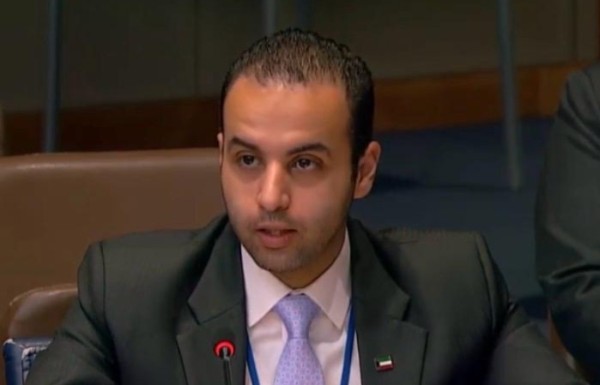
Kuwait emphasizes the necessity of confronting occupation and aggression policies to establish security.
Translated by Qiyas from السياسة — Original source
- Kuwait renewed its condemnation of Iranian attacks and called on Tehran to halt them, respect the sovereignty of neighboring states, and comply with United Nations Security Council Resolution 2817.
- Al-Saaidi: Kuwait is not a party to the conflict and has not permitted the use of its territory, airspace, or waters to attack Iran.
Kuwait affirmed that addressing insecurity in the Middle East requires confronting policies of occupation, aggression, and impunity, noting that “the continued attacks by the occupying entity on the Palestinian people and regional states undermine peace prospects and fuel cycles of violence.”
This was stated in Kuwait’s address, delivered by Third Secretary of its Permanent Mission to the United Nations, Abdulaziz Al-Saaidi, on Monday evening, before the First Committee of the UN General Assembly on Disarmament and International Security during the general debate.
Al-Saaidi reiterated Kuwait’s condemnation of Iranian attacks targeting its territory and the states of the Gulf Cooperation Council (GCC) and Jordan since February last year, including attacks carried out by Iranian-aligned factions and militias in Iraq. He emphasized that “Kuwait is not a party to the ongoing conflict and has not allowed the use of its land, airspace, or waters to launch attacks on Iran.”
He called on Iran to fully comply with UN Security Council Resolution 2817 (2026), cease its direct or proxy attacks and threats, and respect the sovereignty of neighboring countries and the principles of good neighborliness.
On the nuclear issue, Al-Saaidi reiterated Kuwait’s call for the occupying Israeli entity to join the Treaty on the Non-Proliferation of Nuclear Weapons (NPT) and subject all its nuclear facilities and activities to comprehensive safeguards by the International Atomic Energy Agency (IAEA), warning that “continued exemption of the entity undermines the credibility of the non-proliferation regime.”
He affirmed Kuwait’s support for establishing a nuclear-weapon-free and other weapons of mass destruction-free zone in the Middle East, and for reaching a legally binding treaty involving all relevant parties, ensuring equal security for all.
He expressed Kuwait’s regret that the 2026 Review Conference of the Treaty on the Non-Proliferation of Nuclear Weapons failed to adopt a consensus final document, stressing the need to fulfill commitments on nuclear disarmament, non-proliferation, and the peaceful uses of nuclear energy.
He highlighted Kuwait’s pride in being elected Chair of the IAEA Board of Governors (2026–2027) by consensus, reaffirming its commitment to enhancing the Agency’s independence and credibility, supporting technical cooperation, and verifying compliance with nuclear obligations.
Regarding conventional arms, Al-Saaidi stressed the importance of safe and sustainable ammunition management and preventing illicit trafficking, noting Kuwait’s election as Vice-Chair of the Preparatory Meeting for the Global Framework on Conventional Ammunition Management.
Al-Saaidi concluded by emphasizing the importance of translating international commitments into serious national actions and effective international cooperation, thereby strengthening trust in the disarmament and international security architecture.
