Indonesia Tests Using Mosque Loudspeakers for Early Earthquake Warning
- Joint research project with Japan to run until 2030, aiming to warn residents and save lives
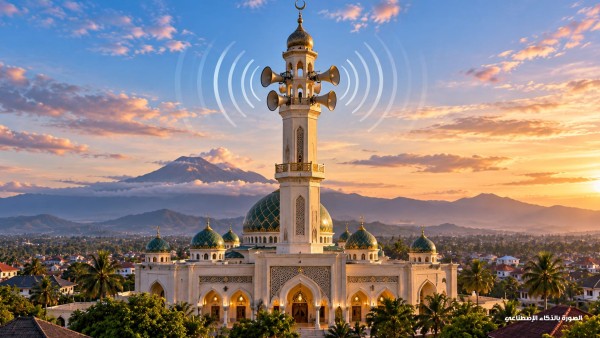
In an innovative move that could turn mosque loudspeakers used for the call to prayer into life-saving devices, Indonesia, in cooperation with Japan, is testing an earthquake early warning system that uses mosque loudspeakers to alert residents before violent ground shaking arrives, particularly in remote areas difficult to cover with traditional warning methods.
The British newspaper The Guardian reported that the pilot project, which will run until 2030, aims to leverage the widespread presence of mosques in Indonesia by connecting their loudspeakers to a network of earthquake sensors, enabling residents to be alerted and given time to take protective action.
News Services
The project is led by Japanese researcher Hiroshi Inoue from the Disaster Prevention Research Institute at Kyoto University, in collaboration with the Indonesian government and a team of local researchers. The goal is to develop a warning system suited to the country’s geographic nature, which comprises thousands of islands and hard-to-reach populated areas.
Inoue told the newspaper that the widespread distribution of mosques across population centers, along with the availability of loudspeakers that undergo regular maintenance, makes them a practical option for developing a broad warning network without the need to build entirely new infrastructure.
He noted that maintaining warning equipment is one of the major challenges facing disaster prevention systems, whereas mosque loudspeakers benefit from having individuals who regularly operate and maintain them, enhancing their reliability during earthquakes.
The idea for the project stems from research conducted by the Japanese researcher nearly two decades ago on devastating earthquakes in Indonesia’s Sumatra island. His interest in developing early warning systems was further strengthened after the 2009 earthquake that struck the western part of the island, killing at least 1,000 people.
Inoue believes that providing warnings before the arrival of violent shaking could have saved some victims of that earthquake, prompting him to seek a means of delivering alerts to as many residents as possible.
According to the Japanese news agency Jiji Press, a joint research team, partially supported by the Japan International Cooperation Agency (JICA), began working on the project in 2025 in three provinces in western Java, including the Greater Jakarta area, as part of a five-year pilot plan.
The project also includes the development of low-cost earthquake monitoring devices, alongside studying systems that can automatically halt certain industrial operations and train movements upon detecting seismic activity. These efforts aim to reduce human and material losses, though these systems are not yet intended for full operational deployment.
Researchers have already succeeded in connecting several mosques to the earthquake sensor network, taking advantage of the hundreds of thousands of mosques in Indonesia, home to the world’s largest Muslim population.
Despite the potential offered by the project, the limited time available for response remains a major challenge. Andi Ika Sakya, a researcher at Indonesia’s National Research and Innovation Agency (BRIN) and head of the Indonesian research team, noted that residents of a village located about 50 kilometers from the earthquake’s epicenter may have only 5 to 10 seconds to respond before the shaking arrives.
Sakya emphasized that the system is still in the prototype stage and has not yet begun issuing public warnings, adding that the ultimate goal is to enable residents to take protective actions as quickly as possible.
Researchers are considering expanding the early-warning network to include loudspeakers in schools, alongside radio and television broadcasts, to ensure that warnings reach the largest possible segment of the population, especially in the event that communication and mobile phone networks fail due to earthquakes.
The team is also conducting studies to develop safety guidelines tailored to the characteristics of buildings in Indonesia, where some homes lack adequate resistance to seismic shocks, making it crucial to determine the appropriate response during an earthquake to reduce injuries and fatalities.
Indonesia has had a tsunami early-warning system since 2008, but earthquake warnings face greater challenges due to the high speed of seismic wave propagation, compared to tsunami waves, which may take minutes or hours to reach coastlines.
Indonesia and Japan are located within the Pacific “Ring of Fire,” a region characterized by frequent seismic and volcanic activity resulting from the convergence of tectonic plates, making the development of early-warning systems a priority for mitigating the impacts of natural disasters.
