Kuwait: We Will Not Be a Party to Any Regional or International Conflict, Nor Have We Allowed Our Territory to Be Used to Attack Any State
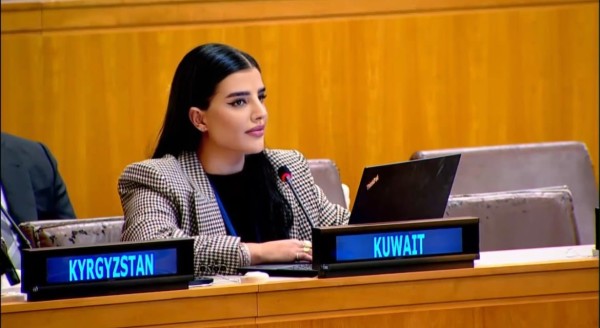
Kuwait affirmed its non-involvement in any regional conflict and accused Iran of bearing responsibility for attacks on infrastructure since February.
Translated by Qiyas from السياسة — Original source
Iran bears international responsibility for its attacks on the country since February 28 and for all resulting damages.
We reject the invocation of the right to self-defense to justify targeting civilian facilities and critical infrastructure.
On Wednesday night, the State of Kuwait emphasized that it will not be a party to any regional or international conflict, and that it has not allowed the use of its territory to launch attacks against any state, in line with its firm commitment to the principles of the UN Charter, good neighborliness, non-interference in the internal affairs of states, and respect for their sovereignty and territorial integrity.
News Services
This statement was made in Kuwait’s address delivered by Second Secretary of its Permanent Mission to the United Nations, Wafaa Al-Mulla, before the Third Committee of the UN General Assembly, which deals with social, humanitarian, and cultural affairs, during the discussion of Agenda Item 70, entitled “Promotion and protection of human rights.”
Al-Mulla affirmed that the promotion and protection of human rights cannot be achieved in isolation from respect for states’ sovereignty and territorial integrity and adherence to the principles of the UN Charter and the rules of international law, foremost among which are the preservation of the right to life, security, and safety, and the protection of civilians.
In this context, Al-Mulla addressed in Kuwait’s statement a series of Iranian attacks on the country since February 28 last year, which targeted civilian objects, critical facilities, and essential infrastructure, posing a direct threat to the lives, security, and safety of citizens and residents, and constituting a blatant violation of the country’s sovereignty, territorial integrity, and airspace.
She pointed out that targeting civilians and civilian objects constitutes not only a violation of states’ sovereignty and international law, but also directly infringes upon the most basic and fundamental human rights, foremost among which are the rights to life, security, safety, health, housing, and access to essential services.
Al-Mulla referred to Security Council Resolution 2817 (2026), expressing Kuwait’s firm rejection of Iran’s attempts to justify these attacks by invoking provisions of the UN Charter, particularly Article 51, outside their proper legal framework.
In this regard, she affirmed that the right to self-defense cannot be invoked to justify targeting civilian facilities and critical infrastructure, clarifying that the protection of human rights requires translating international principles and commitments into actual protection for civilians and holding perpetrators accountable for violations of their fundamental rights, rather than leaving them as mere theoretical obligations.
She reiterated that international responsibility for the unjustified attacks against the State of Kuwait and their consequences lies with Iran, including responsibility for all material and moral damages caused since February 28 last year.
Al-Mulla concluded Kuwait’s address by reaffirming the country’s firm commitment to promoting and protecting human rights, stating that the credibility of the human rights system is measured by its ability to protect individuals when their lives, dignity, and security are at risk, and to ensure that perpetrators of violations are not left unpunished.
