Head of 'Nizahah' Discusses with Saudi Counterpart Strengthening Cooperation in Combating Corruption
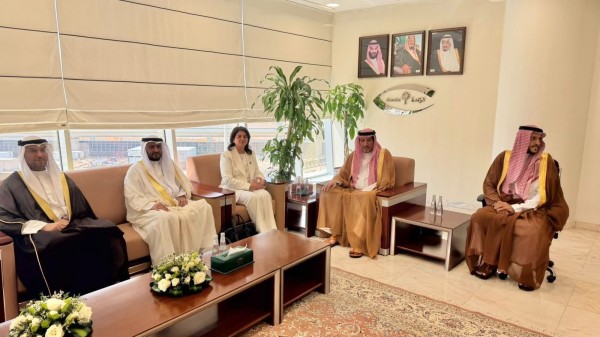
Dr. Rana Al-Faris, Head of Kuwait's General Authority for Combating Corruption, discussed with Saudi Anti-Corruption Commission Chairman Mazen Al-Qumous ways to enhance cooperation and exchange expertise in combating corruption and recovering funds.
Translated by Qiyas from السياسة — Original source
- Al-Faris: We look forward to benefiting from the Saudi experience in detection, investigation, accountability, and asset recovery.
- Al-Daihani: The discussions aim to develop supervisory tools and enhance the institution’s and technical capacities.
Dr. Rana Al-Faris, President of the Public Authority for Combating Corruption (Nazaha), held discussions on Wednesday with Mazen Al-Kahmous, President of the Saudi Anti-Corruption Authority (Nazaha), to explore cooperation between the two entities.
In a statement, Al-Faris noted that these discussions come within the framework of the memorandum of understanding signed between the two authorities in 2022, reflecting a move to activate it more fully and translate institutional cooperation into practical exchanges of expertise and experiences.
It was reported that the parties reviewed one of the most prominent regional experiences in combating corruption, benefiting from an advanced and firm model in supervision, investigation, inquiry, accountability, asset recovery, and the protection of public funds.
Al-Faris emphasized Nazaha’s commitment to strengthening cooperation with peer institutions and learning from advanced experiences in the fight against corruption.
She added that the Saudi experience has achieved remarkable results in combating corruption, including the recovery of funds and assets, alongside the accumulation of institutional and practical expertise in pursuing corruption cases, enhancing supervision, and protecting public funds.
Al-Faris stated, “We look forward to benefiting from experiences that have proven their ability to achieve practical results in combating corruption, and to moving from identifying flaws and suspicions to more effective tools for detection, investigation, accountability, protection of public funds, and asset recovery.”
She affirmed that “combating corruption does not stop at prevention and awareness; it requires an integrated system equipped with the necessary tools and capabilities for detection, investigation, inquiry, and accountability, alongside prevention and the promotion of integrity and transparency. This makes exchanging expertise with peer agencies that have advanced experiences an important part of developing institutional and technical capacities.”
Al-Faris confirmed that Nazaha looks forward to this visit marking the beginning of a broader path of practical cooperation with the Saudi Anti-Corruption Authority, building on the existing memorandum of understanding between the two sides and transforming it into more effective cooperation pathways, enabling mutual benefit from expertise and experiences.
For his part, Dr. Majid Al-Daihani, Vice Chairman of the Board of Directors of the Authority, confirmed that the discussions aim to build on successful experiences and practices and benefit from them practically, contributing to the development of supervisory work tools and enhancing the Authority’s institutional and technical capacities.
Al-Daihani said that “benefiting from advanced experiences does not mean transferring them as they are, but rather studying their tools, practices, and results, and utilizing those that align with the legislative and institutional environment in the State of Kuwait.”
He emphasized that exchanging knowledge and expertise with peer agencies constitutes one of the important pathways for developing the anti-corruption system and enhancing its capacity to protect public funds.
Al-Daihani added that the coming stage will see the Authority keen on expanding the circle of cooperation with peer agencies and reviewing the best regional and international experiences and practices, contributing to the development of the Authority’s tools and capabilities and enhancing its effectiveness in preventing and combating corruption.
Al-Faris led the Nazaha delegation during the official visit to Riyadh, accompanied by Dr. Majid Mohammed Al-Daihani, Vice Chairman of the Board of Directors of the Authority; Dr. Dhiyab Isam Al-Otaibi, Board Member; Fawaz Mahallel Al-Mutairi, Assistant Secretary-General for the Corruption Detection and Investigation Sector; and Abdulrahman Al-Wazan, representative of the International Cooperation Department.
The visit included an overview of the Saudi experience and the operational mechanisms employed by the National Anti-Corruption Authority (NACCA), as well as a presentation of the key institutional experiences and practices of both sides.
It also covered discussions on several files of mutual interest in the fields of oversight, investigation, and corruption prevention, mechanisms for handling financial and administrative corruption cases and asset recovery, and the development of institutional and technical tools and capacities supporting anti-corruption efforts.
The visit by Kuwait’s General Authority for Combating Corruption to Saudi Arabia’s National Anti-Corruption Authority (NACCA) aligns with its strategy to enhance cooperation with peer institutions and to learn from advanced regional and international experiences in combating corruption, drawing on models that have achieved tangible results in oversight, investigation, prosecution of corruption cases, asset recovery, and protection of public funds.
