Kuwait Calls for Resetting the 2030 Sustainable Development Implementation Mechanism and Protecting Human Capital
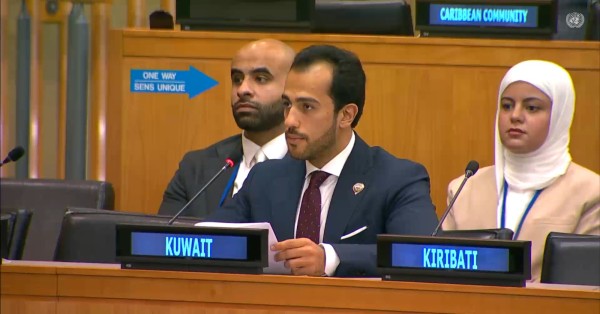
Kuwait called for resetting the mechanism for implementing the 2030 Sustainable Development Plan, condemned the closure of the Strait of Hormuz and Bab al-Mandab, and emphasized the priority of eradicating poverty and ending occupation.
Translated by Qiyas from السياسة — Original source
- Condemned Iran’s closure of the Strait of Hormuz and its threats to, and obstruction of, freedom of navigation in the Bab al-Mandab.
- Affirmed that eradicating poverty is a priority, and that ending occupation and ensuring the security of peoples are fundamental to achieving development.
Kuwait called on Monday for recalibrating the implementation mechanism of the 2030 Agenda for Sustainable Development toward clear priorities that safeguard human capital, expand fiscal space for developing countries, and link public and private investment to measurable objectives, while respecting national priorities.
This came in Kuwait’s statement delivered by Diplomatic Attaché Abdullah Bouskhar during the general debate of the Second Committee (Economic and Financial) of the United Nations General Assembly.
Bouskhar stated that the 2030 Agenda is no longer a test of intentions, but a benchmark for the international community’s ability to translate commitments into tangible impacts on people’s lives. He warned that the gap between countries’ pledges and on-the-ground achievements remains wide and is widening in areas such as food security, decent work, clean energy, sustainable cities, and building resilient institutions.
He added that reducing development to numerical indicators without addressing the root causes of inequality, the cost of financing, and the fragility of supply chains would empty the Agenda of its substance. He emphasized the need to direct implementation toward clear priorities that yield tangible improvements in people’s lives.
On the domestic front, Bouskhar affirmed Kuwait’s continued translation of its commitment to the 2030 Agenda through “Kuwait 2035” Vision, which takes economic diversification, human capital development, and sound public financial management as core pillars of national development.
He clarified that Kuwait has integrated the Sustainable Development Goals into its sectoral plans, enhanced investment in education, health, and social development, expanded programs for youth and women’s empowerment, and supported digital transformation and e-government services.
He noted that Kuwait is also working to improve resource efficiency, develop infrastructure, and encourage public-private partnerships in renewable energy, water management, and sustainable transport, thereby contributing to a more resilient and diversified economy.
On the external front, Bouskhar outlined Kuwait’s development contributions, which constitute an integral part of its foreign policy. He pointed out that the Kuwait Fund for Arab Economic Development, established in 1961, has financed more than 1,000 development projects in 107 countries across sectors such as roads, electricity, water, agriculture, education, and health.
He added that the Fund provides financing under concessional terms that take into account the needs of partner countries, while enhancing the impact of its projects through support for national capacity building, knowledge transfer, and leveraging local partnerships, thereby contributing to the sustainability of outcomes.
In this context, Bouskhar reaffirmed that the development path is inseparable from the requirements of security and stability, reiterating Kuwait’s strongest condemnation of Iranian attacks targeting its territory, in accordance with UN Security Council Resolution 2817 (2026).
He also condemned Iran’s closure of the Strait of Hormuz and its threats to freedom of navigation there, as well as the continued obstruction and disruption of navigation in the Bab al-Mandab Strait by its proxies in the region, given the repercussions for food and energy security, the rising cost of essential goods, and the hindrance to developing countries’ efforts to eradicate poverty and achieve the Sustainable Development Goals.
In this regard, he called for ensuring freedom and safety of navigation in accordance with international law and the 1982 United Nations Convention on the Law of the Sea, thereby protecting development gains and supporting the implementation of the 2030 Agenda.
On the Palestinian issue, Boukhar expressed his country’s strongest condemnation of the systematic destruction policies carried out by the Israeli occupation in the occupied Palestinian territories, which have affected infrastructure, the environment, and the food system, alongside the imposition of a siege, closure of humanitarian corridors, obstruction of aid delivery, and targeting of fields, warehouses, mills, and hospitals.
He considered the starvation of civilians a prohibited method of warfare under United Nations Security Council Resolution 2417 (2018), representing a violation of human dignity and a serious breach of international humanitarian law.
In conclusion, Boukhar reiterated the State of Kuwait’s position that eradicating poverty in all its forms remains the overarching priority for the work of the Second Committee, calling for equitable development, predictable sustainable financing, environmental protection, and the expansion of social protection systems.
He emphasized that the implementation of the 2030 Agenda cannot be completed without respecting the sovereignty of states, halting aggression, ending occupation, and ensuring the right of peoples to security and development.
