'Medical check-up' for Earth reveals serious warning... 7 areas exceed safety limits
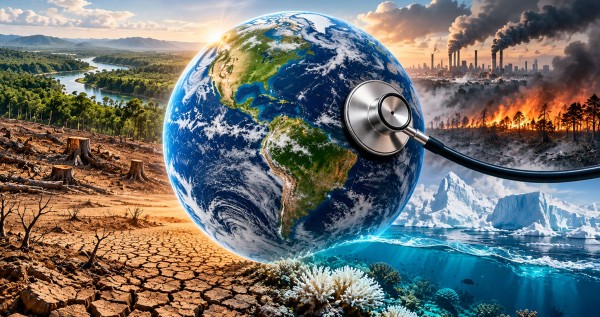
The Earth is facing a crisis that cannot be reduced to rising temperatures alone. Water, oceans, ecosystems, soil, and pollution collectively send escalating signals that human pressures are pushing the planet beyond safe boundaries.
This alarming picture is revealed in the "Planetary Health Check 2026" report, which concluded that seven key areas for Earth’s stability have exceeded their safe limits, with all reaching their highest recorded levels of transgression.
Published by the Planetary Boundaries Science Laboratory at the Potsdam Institute for Climate Impact Research, and involving more than 60 scientists, the report provides a coherent assessment of the planet’s condition, noting that the degradation of one natural system can increase pressure on others and weaken their capacity to withstand the impacts of human activity.
A Comprehensive Assessment
The evaluation is based on nine "planetary boundaries" that define a safe operating space for natural processes essential to maintaining Earth’s stability and resilience. Scientists use 13 variables to assess these boundaries, relying on the latest available data, some of which dates back to years prior to 2026.
The assessment resembles a comprehensive medical checkup that monitors multiple aspects of health rather than simply measuring temperature. While climate is part of the picture, it is not the only area showing signs of degradation.
Humanity has exceeded safe limits in seven areas: climate change, biosphere integrity, land-system change, freshwater change, biogeochemical flows (nitrogen and phosphorus cycles), introduction of novel entities into the environment, and ocean acidification.
Ocean acidification was the most recent of these areas to cross its safe limit in 2025, while the new report reveals continued degradation across all seven areas, reaching their highest recorded levels of transgression.
Interconnected Crises
These areas do not operate in isolation. Heat, drought, fires, and ecosystem degradation can reduce the ability of plants and soil to absorb carbon dioxide, and in some regions, turn them from carbon sinks into sources of emissions.
This undermines one of the natural protective mechanisms the world relies on to limit warming. The report also discusses the possibility that current models may overestimate the land’s capacity to continue absorbing carbon under increasing pressures.
Researchers warn that continued transgression of safe limits increases the risk of widespread and persistent changes, some of which may be difficult to reverse, thereby narrowing the margin for responding to environmental crises.
Warnings from Land and Oceans
Ocean heat content reached a new record high in 2025, coinciding with heatwaves, droughts, and fires in various regions.
Approximately 84.4 percent of global coral reef area experienced thermal stress levels causing bleaching between January 2023 and September 2025, marking the largest global coral bleaching event recorded to date.
This percentage does not mean that all affected corals died, but it highlights the extent of exposure to heat that threatens their integrity and recovery capacity.
The report also indicates that the impacts of extreme events may be exacerbated by ecosystem degradation, water stress, land-use change, and social conditions that make certain communities more vulnerable to harm.
Can the Course Be Changed?
Exceeding safe limits does not mean that the collapse of Earth’s systems is inevitable, but it does mean that risks are increasing as the planet moves further away from the zone of stability.
Researchers emphasize that the knowledge, capabilities, and solutions needed to change course already exist, and that addressing climate, nature, water, and pollution must be done in an integrated manner, rather than treating each crisis separately.
In contrast, the areas related to ozone depletion and aerosols have shown improvement over the past decade, although it is warned that global improvements may mask unsafe levels of aerosols in certain regions.
“Planet Health Check 2026” presents the world with a challenge that goes beyond merely reducing temperatures, namely, alleviating the escalating pressures across all seven areas to protect Earth’s capacity to sustain life and livelihoods.
