'Nama' and 'Al-Hussein for Cancer' Sign Agreement to Support Refugees
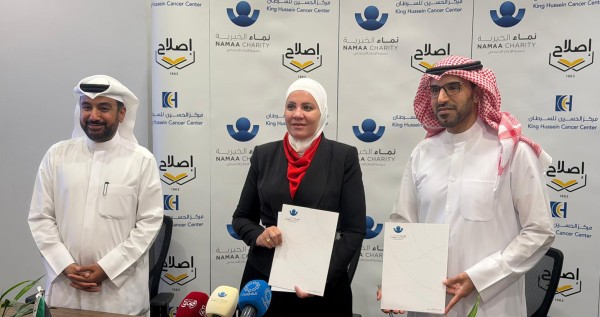
Signing of a $500,000 agreement to support the care of refugee children with cancer.
Translated by Qiyas from السياسة — Original source
Saad Al-Otaibi: The partnership embodies Kuwait’s humanitarian responsibility toward the most needy patients
Namaa Charity, under the auspices of the Social Reform Association, signed a cooperation agreement yesterday, Thursday, with the Hussein Cancer Foundation in Jordan, to support a comprehensive psychological and therapeutic care project for Palestinian and Syrian refugee children suffering from cancer. The project has a total value of $500,000, equally split between the two parties at $250,000 each.
Digital Press Membership
Breaking News
Opinion Articles
Saad Al-Otaibi, CEO of Namaa Charity, emphasized that the agreement reflects Kuwait’s humanitarian responsibility toward the most vulnerable patients. He noted that the initiative goes beyond providing medical treatment to include psychological and social support for the children and their families, in collaboration with a specialized institution possessing the necessary expertise and medical capabilities.
He clarified that the project benefits only financially disadvantaged patients who lack other sources to cover their treatment costs, based on medical and social studies that consider health conditions and economic status, ensuring that support reaches those truly entitled to it.
He further stated that the agreement includes clear mechanisms for follow-up and financial reporting to ensure transparency and optimal resource utilization, stressing the importance of expanding humanitarian partnerships that contribute to alleviating the suffering of children and their families.
For her part, Nesreen Qatamish, General Manager of the Hussein Cancer Foundation, affirmed that the partnership offers a window of hope for refugee children with cancer through integrated care combining medical treatment with psychological and social support.
She explained that beneficiary selection undergoes medical evaluation by a specialized team, followed by a social study, before cases are presented to relevant committees to develop treatment plans and determine priorities, taking into account the patient’s nationality, economic circumstances, income sources, and available treatment coverage.
On his part, Abdulaziz Al-Kandari, Deputy CEO of Namaa Charity, confirmed that the agreement aligns with the Association’s strategy to develop high-quality partnerships that transform charitable contributions into programs with tangible health and humanitarian impact.
He elaborated that the project encompasses an integrated system starting with case studies and needs assessment, proceeding to treatment priority determination, and culminating in expenditure monitoring and periodic financial reporting, thereby enhancing trust and transparency and ensuring aid reaches its rightful recipients.
