Italian Ambassador: New Update to 'Sky Guard' System to Counter Drone Threats
The ratification of the "Defense Cooperation Agreement" is complete, with only the President’s signature remaining.
We provided an alternative radar for Kuwait International Airport within weeks after the Leonardo company’s radar was damaged.
Negotiations are underway with the National Guard regarding an agreement for exchanging expertise in the protection of facilities.
Three Eurofighter jets are ready for delivery, as security conditions previously prevented their transfer.
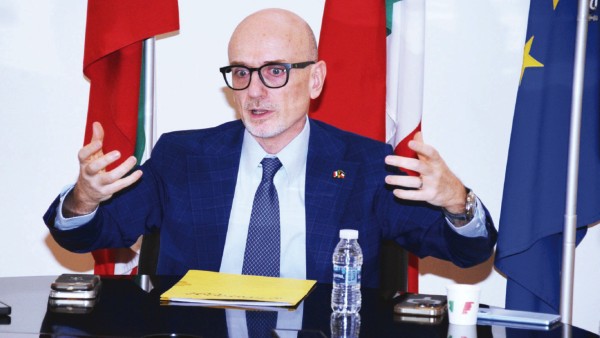
Italian Ambassador Lorenzo Morini affirmed the depth of Kuwaiti-Italian relations, highlighting their distinction in the fields of defense, security, economy, investment, and education. He noted his country’s commitment to continuing its support for Kuwait and contributing to enhancing the security and stability of the region and protecting freedom of navigation in the Strait of Hormuz in accordance with international law.
Morini stated during a press conference that defense and security cooperation between the two countries was strong prior to the recent crisis, explaining that approximately 400 Italian military personnel were stationed in Kuwait as part of the international coalition against the Daesh (ISIS) organization, primarily based at Ali Al-Salem Air Base and other locations.
He added that security developments forced Italian military personnel to remain in shelters for extended periods, while Kuwaiti authorities provided them with various forms of logistical and food support. He emphasized that his country’s message from the outset was: "We are here to stay, to help and support Kuwait."
He clarified that Italy was later compelled, for security reasons, to relocate most of its military personnel outside Kuwait, with no serious injuries recorded, except for minor ones. He noted that a group remained to provide support to the Kuwaiti Armed Forces within the framework of bilateral defense cooperation.
Defense Agreement
Morini revealed that Italy had completed the ratification procedures for the Defense Cooperation Agreement with Kuwait, with only the signature of the Italian President remaining as a final formal step, anticipating notification to Kuwait of the ratification soon.
He pointed to ongoing negotiations regarding a cooperation agreement with the Kuwaiti National Guard, which would include exchanging expertise in the protection of facilities, strategic infrastructure, and VIPs, combating the smuggling of antiquities and artworks, and leveraging the expertise of the Italian Carabinieri forces.
Regarding the Eurofighter aircraft deal, he clarified that the agreement dates back to 2016 and is separate from the new Defense Cooperation Agreement, revealing that three jets remain undelivered to Kuwait.
He said: "The three jets are ready for delivery, but security conditions over the past months prevented their transfer. We were waiting for the situation to stabilize, and the jets are ready for delivery."
Sky Guard Upgrade
Morini indicated the continuation of cooperation in defense systems, explaining that Italian companies had supplied the National Guard with ammunition for short-range weapons and other materials.
He disclosed work on a new upgrade for the "Sky Guard" air defense system, which Kuwait acquired from an Italian company more than 15 years ago, to enhance its capability to counter modern threats, particularly drones whose speed and capabilities have significantly evolved.
He explained that "Sky Guard" operates in an integrated manner with the "Patriot" system, with each system handling different types of targets within a central command center that determines the most appropriate means to counter each threat. He affirmed the satisfaction of both Kuwaiti authorities and the Italian side with the system’s performance.
He noted that the radar for Kuwait International Airport, provided by Leonardo company, was damaged during the crisis, and that Italy managed to provide an alternative radar within weeks, despite the fact that manufacturing its components usually takes months. He considered this an example of bilateral cooperation extending to civil equipment linked to security and stability.
He noted that training programs include long academic courses lasting a year or more, and specialized courses lasting from one to three months. These programs cover training for Eurofighter pilots, combating transnational criminal organizations and terrorism, and protecting archaeological sites and strategic facilities.
Morini emphasized Kuwait’s ability to play an important political role in the region, given its diplomatic approach, its relations with Gulf Cooperation Council (GCC) countries and regional partners, and its commitment to dialogue, respect for international law, and the role of the United Nations.
Visa Issuances Halved Due to Crisis
Regarding visa matters, Morini revealed that the number of visas issued by the embassy between January and September 2026 amounted to roughly half the number recorded during the same period in 2025. He attributed the decline to the crisis, which led to an almost complete halt in travel during March, April, May, and part of June.
He clarified that the decrease was concentrated in tourist visas, while business and family visit visas remained at their usual levels.
He added that study visas increased by approximately 10 percent, rising from about 50 visas last year to around 60 this year. The number of Kuwaiti students in Italian universities ranges between 150 and 200 annually, a figure that is on the rise.
No Changes to Visa System
Morini denied any unilateral changes to the Italian visa system or the introduction of a new electronic application process. He affirmed that Italy is part of the Schengen system, and any modifications to the system require collective agreement, describing rumors to the contrary online as “fake news.”
In Italy... Hijab Permitted, Face Covering Banned for Security Reasons
Regarding the wearing of the niqab in Italy, he explained that general law requires individuals to show their faces in public places and during document verification for security reasons. He stressed that this measure does not target women or religious beliefs, noting that wearing the hijab is permitted, while covering the face entirely is prohibited in certain public places, including museums.
